








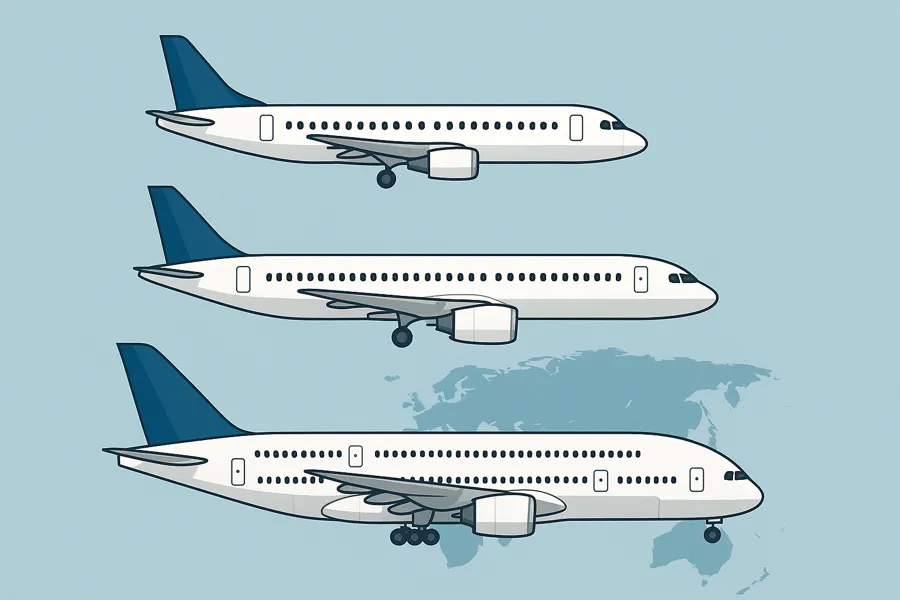
Low-cost carriers prefer new planes because they offer better fuel efficiency, lower maintenance costs, and help meet environmental and regulatory goals. Legacy airlines tend to fly older planes, which may be noisier, less comfortable, and more prone to delays. Frontier Airline’s fleet has an average age of 5.1 years, while United’s planes average 15.6 years. To see average fleet age and deliveries, look up the airline’s fleet page or consult fleet databases like Planespotters or Airfleets .
The Global Fleet
The US manufacturer Boeing and its European counterpart Airbus have a virtual duopoly of the global aircraft market, accounting for over 90% of the global commercial aircraft fleet. Boeing holds about 50-55% and Airbus around 40-45%, depending on the aircraft category and region.
The Breakdown
Boeing 777 and 787 and the Airbus A330 and A350, which serve long-haul international routes and are favored because of their fuel efficiency and passenger comfort. As of 2025, there are approximately 3,600 widebody Boeing aircraft and 2,900 widebody Airbus aircraft currently in active commercial service worldwide**.**
The large market for narrowbody aircraft, which are used for short- and medium-haul flights, is dominated by the Boeing 737 and A320 families, which are used extensively by low-cost and legacy carriers alike. Together they represent over 20,000 aircraft currently in service. Other manufacturers like Embraer, Bombardier, and COMAC make up a small fraction of the fleet, but primarily in regional and niche markets.
| Aircraft Model | Manufacturer | Estimated Global Fleet Size | Primary Use |
|---|---|---|---|
| Boeing 737 | Boeing | ~10,600+ aircraft | Short to medium haul |
| Airbus A320 | Airbus | ~10,000+ aircraft | Short to medium haul |
| Boeing 777 | Boeing | ~1,700+ aircraft | Long haul |
| Boeing 787 | Boeing | ~1,600+ aircraft | Long haul |
| Airbus A330 | Airbus | ~1,400+ aircraft | Long haul |
| Airbus A350 | Airbus | ~600+ aircraft | Long haul |
Why They Dominate
- Both manufacturers have extensive customer bases across every continent.
- Airlines prefer standardized fleets for maintenance and training efficiency.
- Newer models like the Boeing 737 MAX and the Airbus A320neo offer significant fuel savings and lower emissions.
There are approximately 2,600 Boeing 737 MAX and 3,000 Airbus A320neo aircraft in currently in active service worldwide. These numbers reflect the rapid adoption of next-generation narrowbody jets by airlines seeking fuel efficiency and lower emissions, as travelers increasingly take their carbon footprint into account.
Newer Fleets Versus Older Fleets
A plane is generally considered “new” if it’s under 10 years old, and “old” once it reaches 15–20 years of service. As of 2025, the average age of planes in the global commercial fleet is approximately 14.8 years. This marks a notable increase from pre-pandemic levels, when the average was closer to 13 years. The reasons are that aircraft deliveries have fallen significantly due to manufacturing delays and parts shortages. As a result airlines are holding onto legacy aircraft longer, many of which have older engine types with higher fuel consumption. Only 1,266 aircraft were delivered globally in 2024, a drop of more than 8% compared to previous years.
Why This Matters
Newer aircraft fleets feature significant advantages over older fleets, including greater fuel efficiency, reduced emissions, more advanced technology in the cabin and cockpit, and higher reliability, leading to lower operating costs and better passenger experience. While older aircraft can be safe with proper maintenance, they generally have higher fuel consumption, greater maintenance costs due to aging parts and difficulty finding spares, and may offer a less comfortable and less technologically advanced passenger experience.
Travelers should care about an airline’s fleet age because it directly affects safety, comfort, reliability, and environmental impact. Newer aircraft tend to offer a better passenger experience and are more fuel-efficient, while older planes may be noisier, less comfortable, and more prone to delays.
Comparisons
Here’s a deeper look at why fleet age matters:
Passenger Experience
- Newer aircraft often feature modern cabin designs, larger windows, better air pressure and humidity control, and advanced inflight entertainment systems.
- Older planes may lack USB ports, Wi-Fi, or comfortable seating, especially on long-haul flights.
Maintenance and Reliability
- Older aircraft require more frequent and intensive maintenance, which can lead to delays or cancellations.
- Airlines with aging fleets may face higher operational costs, which can trickle down to passengers through pricing or reduced service quality.
Environmental Impact
- Newer models like the Airbus A350 or Boeing 787 are designed for fuel efficiency and lower carbon emissions.
- Flying on older jets contributes more to environmental degradation due to higher fuel consumption.
Safety Perception
- While all commercial aircraft must meet strict safety standards regardless of age, public perception often associates newer planes with safer travel.
- Airlines that invest in fleet renewal use advanced materials (composites, high-strength alloys) and signal a commitment to modern safety technologies and passenger well-being.
Operational Efficiency
- Airlines with modern fleets tend to have better on-time performance, fewer mechanical issues, and more flexible route planning.
- This can make a big difference for travelers with tight connections or business schedules.
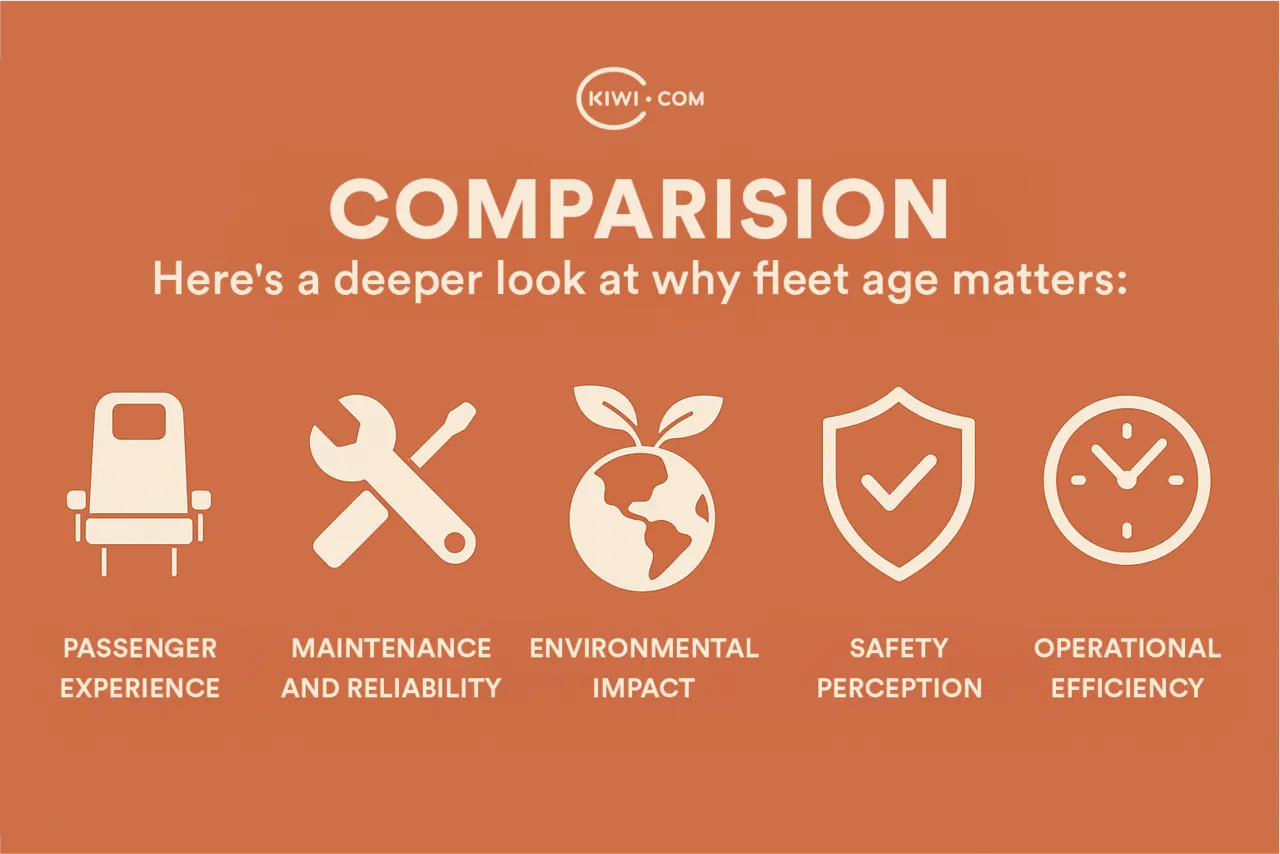
A closer look at why airline fleet age plays a major role in flight quality, safety, and efficiency © Kiwi.com
Key Attributes Comparison
| Attribute | Newer fleets | Older fleets |
|---|---|---|
| Fuel efficiency | Significantly better; modern engines and aerodynamics | Lower; higher fuel burn per seat |
| Operating cost | Lower per flight hour and per seat | Higher maintenance and fuel costs |
| Reliability & dispatch | Fewer unscheduled delays; built-in diagnostics | More frequent maintenance-related downtime |
| Avionics & automation | Modern glass cockpits, advanced FMS, ADS-B, fly-by-wire on many types | Analog gauges or legacy avionics; fewer automation features |
| Noise and emissions | Much quieter; lower NOx and CO2 per seat | Noisier; higher emissions per seat |
| Passenger comfort | Improved pressurization, humidity control, cabin layouts, IFE and connectivity | Older cabins, less insulation, limited connectivity |
| Maintenance complexity | More condition-based maintenance enabled by sensors; fewer line repairs | Simpler mechanical systems but more frequent heavy checks; parts scarcity risk |
| Resale / residual value | Higher demand for modern types; better lease options | Depreciated; harder to sell or lease |
| Certification & safety features | Latest safety systems (TCAS enhancements, EVS, better redundancy) | Compliant with older regs; may lack newer mitigations |
| Operational flexibility | Longer range with higher efficiency; optimized for point-to-point | Often shorter range; may require different network planning |
Why Airlines Choose Older Fleets
Airlines retain older airplanes primarily due to high replacement costs, supply chain delays, labor shortages and ongoing passenger demand, making continued use economically viable while maintaining safety through rigorous maintenance.
Economic and Financial Factors
Older aircraft are significantly cheaper to keep in operation than purchasing new jets, especially if the plane is fully paid off or leased at low cost. Airlines can avoidlarge capital expenditures, and older planes can remain profitable if maintenance costs are manageable relative to the revenue they generate. For legacy carriers with extensive fleets, this strategy offers flexibility in managing network demands or fill temporary gaps without major financial disruption.
Maintenance, Inspections, and Safety
Despite aging, airplanes are designed for long service lives and can remain safe with systematic maintenance. Components such as engines and airframes under routine inspections, overhauls, and part replacements, which can cost between
$500,000-$1 million annually per aircraft annually. This includes frequent inspections and replacement of parts nearing fatigue limits, which poses a challenge amid global spare parts shortages. For instance, Airbus predicts a 40 percent gap in the supply of A320 family parts by 2035. In addition, emerging digital technologies, robotics and inspection innovations help extend the lifespan of older aircraft while ensuring regulatory compliance and operational safety.
Supply Chain and Delivery Delays
Airlines are often forced to operate older jets because of delayed deliveries of newer fuel-efficient models from Airbus and Boeing. Global shortages in parts, skilled labor, and production capacity have extended waiting times for new enginesand aircraft, making it impractical to retire older stock as planned.
Operational Strategy
Older planes are sometimes retained for strategic fleet utilization. For instance, long-haul planes fly fewer cycles, causing slower wear, and therefore remain effective for certain routes longer than short-haul planes, which experience rapid cycles and pressurization fatigue. In addition, keeping older planes allows airlines to adapt quickly to market fluctuations, such as sudden increases in passenger demand without investing in new aircraft immediately.
Secondary Usage and Parts Market
Aircraft nearing retirement often have high-value components that can be reused or sold. However, engines, landing gear, and avionics usually fetch lower costs in the second-hand market, providing economic incentives for airlines to keep planes in operation longer.
Who Flies What?
Overview
Airlines vary widely in fleet age by business model, cashflow, and network needs. Low-cost carriers and well-funded flag carriers tend to prioritize newer, fuel- efficient models; legacy carriers and some regional or charter operators often retain older models for longer.
Airlines like Breeze Airways , Spirit , and Frontier use newer planes, with average fleet ages as low as 2.1 years, because they are newer, smaller, or budget-focused companies that can make large, modern fleet purchases. Older planes are used by many legacy carriers, such as Delta and United , as they have vast fleets that take longer to fully replace.
Airlines that Largely Choose Newer Aircraft Models
- Qatar Airways – heavy investment in A350 and latest widebodies for long haul.
- Singapore Airlines – A350, A380 (recently refurbished), and latest cabin refits.
- Emirates – large modern widebody fleet (newer 777 and A380 upgrades; adding newer types); average plane age: 11.1 years.
- Delta (select fleets) – replacing older frames with A220s, A321neos and new widebodies on long haul.
- Lufthansa Group (Lufthansa, Swiss, Austrian) – steady renewal with A320neo family and A350s.
- IAG airlines (British Airways, Iberia, Aer Lingus) – active orders for A320neo family, A350s.
- Ryanair — young, single-type fleet strategy focused on Boeing 737 MAX series.
- Wizz Air – aggressive renewal with A320neo/A321neo family.
- EasyJet – moving to A320neo family to replace older A320ceo aircraft.
Airlines Operating Older Aircraft Models (Significant Share)
- Some major US legacy carriers (such as older sub-fleets at American, United, Delta) have fleets that include older 737s, 767s and other legacy widebodies still in service.
- Many regional and commuter airlines operate older regional jets and turboprops because of lower acquisition cost.
- Certain state or national carriers with constrained capital operate older widebodies and narrowbodies until replacements become affordable.
- Charter and leisure carriers often keep older aircraft longer when utilization patterns or purchase budgets favor low capital expenditure.
Ages of US Airline Fleets (according to Planespotte r s.net )
| Airline | Median plane age in years |
|---|---|
| Sun Country Airlines | 18.5 |
| United Airlines | 15.6 |
| Allegiant | 15 |
| Delta | 14.5 |
| American Airlines | 14.3 |
| Hawaiian Airlines | 13.3 |
| JetBlue | 11.9 |
| Southwest Airlines | 11.4 |
| Alaska Airlines | 9.1 |
| Spirit | 6.3 |
| Frontier Airlines | 5.1 |
| Breeze Airways | 4.5 |
Average European Fleet Ages by Airline (according to Planespotter s.net )
| Airline | Average Fleet Age (Years) | Notes |
|---|---|---|
| Ryanair | 10.4 | Operates a fleet of Boeing 737s |
| easyJet UKeasyJet Europe | 11.4 10.7 | Primarily Airbus A319 family aircraftMix of Airbus A319s and A320s |
| Lufthansa | 14.8 | Mix of Airbus and Boeing aircraft |
| Air France | 12.5 | Includes newer A350s and older A320s |
| British Airways | 14.1 | Older Boeing 777s and Airbus A 319s in fleet |
| KLM Royal Dutch | 13.6 | Fleet renewal underway with 787s and A321s |
| Turkish Airlines | 9.5 | Rapid expansion with newer aircraft |
| SAS Scandinavian | 9.1 | Transitioning to Airbus A320neo family |
| TAP Air Portugal | 10.6 | Mix of new A330neos and older narrow-bodies |
| Wizz Air HungaryWizz Air Malta | 6.6 3.2 | One of the youngest fleets in Europe |
Urgent and Practical Guide: Airline Fleet FAQs
What are the advantages of flying on a new airplane (10 years & less)?
Newer airplanes are generally more comfortable, better equipped, less prone to mechanical issues and therefore less likely to be delayed. And because they are more fuel-efficient, they produce a significantly smaller carbon footprint than an older plane.
What are the disadvantages of flying on an old plane (15 years & older)?
Older planes may lack USB ports, Wi-Fi, or comfortable seating, especially on long-haul flights; require more frequent and intensive maintenance, which can lead to delays or cancellations; and they contribute to environmental degradation due to higher fuel consumption.
On what kind of airline would I be more likely to fly with a new plane?
You would be slightly more likely to fly on a newer plane with a budget airline such as Frontier (average plane age 5.1 years) or Wizz Hungary (6.6 years) than a legacy airline such as United (15.6 years). But there are exceptions: easyJet UK (11.4 years) has an older fleet than Alaska Airlines (9.1 years) and Turkish Airlines (9.5 years).
Are older planes dangerous?
No. A well-maintained older aircraft can be just as safe and comfortable as a newer one. What matters more than fleet age is how the airline invests in upgrades, retrofits, and maintenance.
How can I find out the age of an airline’s fleet?
To see average fleet age and deliveries, look up the airline’s fleet page or consult fleet databases like Planespotters or Airfleets.
How can I find out the age of an individual plane?
Find the plane’s registration number on your boarding pass, a flight tracking app or ask the airline. Then plug the registration number into Planespotters.net, Airfleets.net, FlightRadar24 or JetPhotos.com. These sites show manufacturer and model, delivery date, age, and operator history.