



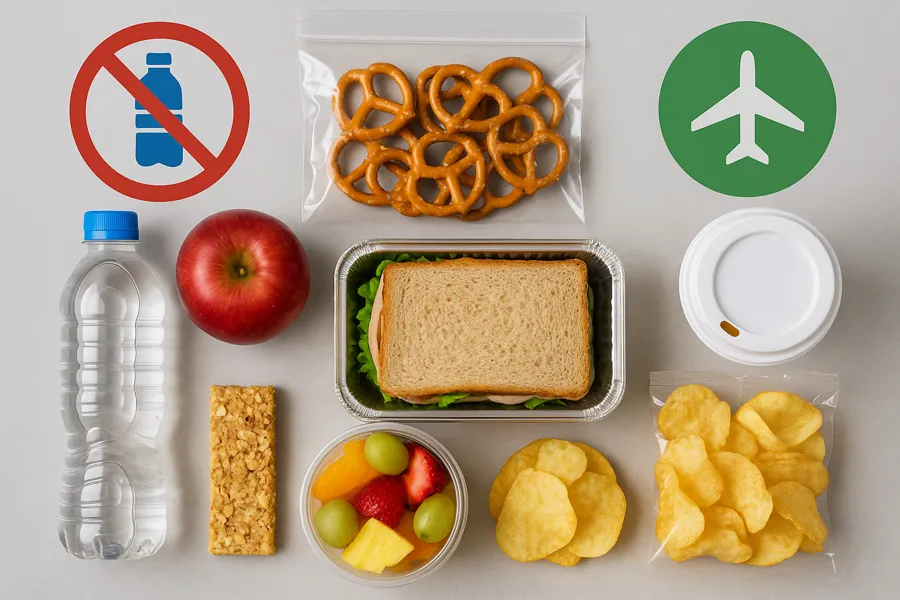
Airlines and airport security each have their own regulations regarding food. Airports typically enforce strict liquid limits, anything over 100ml, such as yogurts or soups, cannot pass through security. Solid food items like bread, chocolate, and nuts are generally permitted on board. However, airline policies vary, for example, Delta Airlines doesn’t allow ready meals, while Bangkok Airways prohibits foods, fruits, or flowers with strong odors. Before you fly, always review both the airport security and airline guidelines to ensure your food complies with their requirements.
Security Rules and Airline Rules - What’s the Difference?
It might seem odd that airport security and airlines have different rules about food, which can appear contradictory. However, they operate as two separate entities.
Airport security is more focused on what you’re bringing through for the safety of other passengers. Their priority is ensuring every flight arrives at its destination without incident, which is why many airports have a 100 ml limit on liquids, though it’s changing in some places. This means you cannot carry liquid-based foods, such as soups or sauces, through security if they exceed that limit. However, most airlines have no restrictions on these items once you’re past security, so purchasing them airside and taking them on board is usually permitted.
Airlines are more iffy about food for allergy and hygiene reasons. The last thing they want is to make an emergency landing because someone has an allergic reaction to an ingredient in food another passenger brought on board. The same goes for hygiene, when a bunch of people are crammed into a confined space and someone whips out something with a bad whiff to it, there will be complaints. For example, most airports in Europe aren’t used to seeing people carry smelly fruits like durian, so they don’t have specific rules about carrying them through security. However, certain carriers, such as Singapore Airlines , have an outright ban on it.
How It Works With Airlines
No airline is going to stop you from bringing a few snacks on board, in fact, it often works in their favor since it reduces the need for them to provide extra food during the flight. However, it’s important to make sure your snacks are packed properly, ideally in their original commercial packaging, to keep them fresh. Solid foods such as sandwiches, biscuits, fruit, or chocolate are generally fine to take with you and won’t cause any issues with the airline.
Some airlines will have restrictions in place, though, such as Delta Airlines , which doesn’t allow ready-to-eat meals in either carry-on or checked baggage for safety reasons. Another example is British Airways , which states that it doesn’t sell nuts on its flights and also asks passengers not to bring them on board in case someone boards with an allergy.
As already mentioned with durian, this isn’t the only ‘smelly’ food that airlines have banned. Bangkok Airways has implemented a strict no-tolerance policy on pungent-odor foods, fruits, and flowers, which applies to both carry-on and hold luggage. Although they don’t specifically say what items they’re talking about, I think we all know one or two… cough fish sauce.
What’s the Deal With Security?
If you don’t get your food through security, then it won’t make it on the plane anyway. Security is the first line of defence regarding food, and to be honest, the rules are quite similar. You can pack solid foods, like with airlines, but the key difference is that many airports only allow passengers to bring liquids of a maximum of 100 ml through. For some reason, people think this rule applies only to cosmetic liquids, but it also applies to foods. So if you pack a yogurt in your bag without putting it in the clear liquids bag, it will be flagged during screening.
Now, there are certain exceptions to this rule. The TSA in the USA clearly states that passengers can make it through with a ‘reasonable’ amount of baby food, with no restrictions. In other words, as long as you’re not sneaking massive quantities in your luggage, you’re not going to be stopped.
In certain parts of Europe, like specific airports in the UK, such as Birmingham , they’ve removed the 100 ml rule, so you’ll face even fewer restrictions. But you need to think about the destination you’re landing in and its rules. For example, an airport in the EU , such as Budapest Ferenc Liszt International Airport , may allow you through with meat. However, if you’re flying into the UK , it’s banned and would be confiscated, so always do your research.
Snacks You Can Pack
You’ve got the rundown on the rules and differences, now, here’s what’s safe to pack. For this section, we’ll stick to foods that will put you in the clear with both airlines and security, so you don’t face any issues.
- Bread
- Cereal
- Sweets like chocolate
- Crackers
- Solid cheese
- Biscuits
- Cream cheese (under 100ml)
- Coffee beans
- Dried fruits
- Nuts
- Cakes
- Spices
- Yogurt (under 100ml)
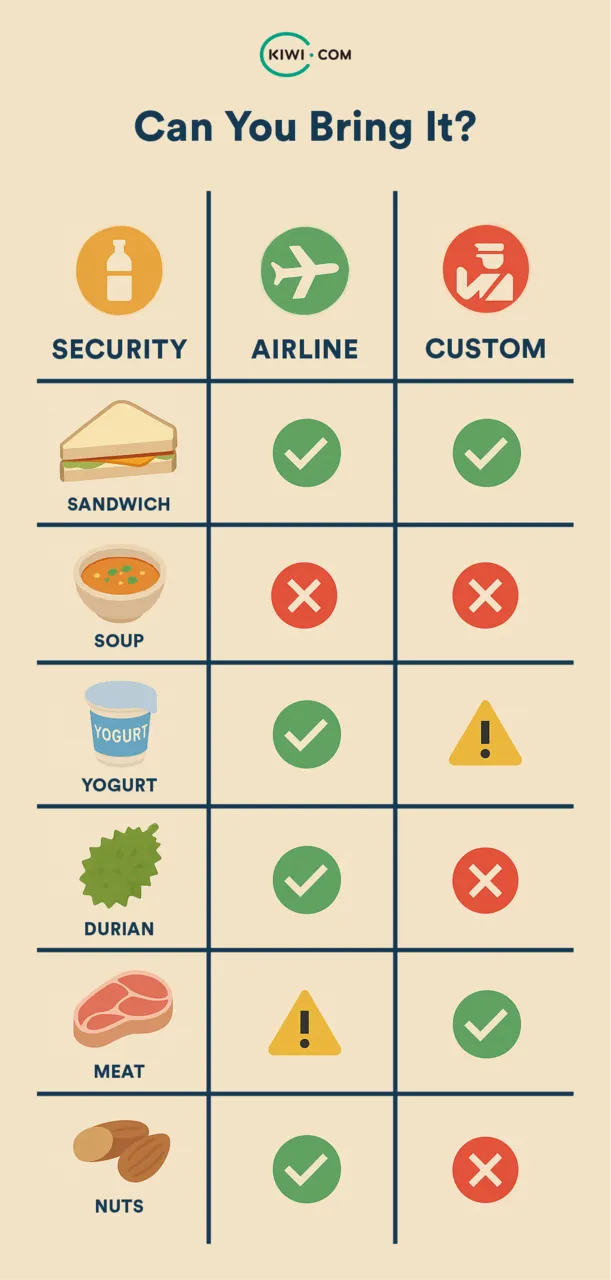
Quick guide showing which foods make it through airport security, airline policies, and customs inspections without trouble © Kiwi.com
Things to Know About Customs
You need to watch out for customs when traveling with food. Getting through the departure airport is one thing, but many countries have rules in place with outright bans on particular foods, which you’ll be subject to when you land. These can be related to things like meats and vegetables, and carry heavy penalties.
Here are a few examples of foods that can get you into trouble at customs.
- Raw, uncooked rice isn’t allowed into Australia .
- Cured meats, such as sausage, aren’t allowed into Canada.
- Meats such as lamb, beef, pork, or mutton aren’t allowed into the UK.
- Animal products aren’t allowed into Turkey .
| Country / Region | Allowed Foods | Banned Foods | Notes |
|---|---|---|---|
| USA (TSA) | Solid snacks, baby food (reasonable amounts) | Soups, sauces, yogurt over 100ml | 100ml rule applies to all liquids and semi-liquids |
| UK | Solid foods, baked goods | Liquids over 100ml (except at airports removing rule) | Rule removal underway at select airports |
| Australia | Sealed snacks, sweets | Raw rice, meat, fresh fruit | Very strict on agricultural imports |
| Canada | Bread, chips, solid cheese | Cured meats, sausages | Similar to U.S. liquid limits |
| EU (General) | Sandwiches, biscuits, dried fruit | Meat, dairy (if entering from non-EU country) | Regulations differ by member state |
How to Get Your Favorite Snacks on the Plane
Review Airport and Airline Websites in Advance
Eliminate all assumptions when traveling with food. Always check the airline’s and airport’s websites ahead of time for the most up-to-date information. They’ll have a dedicated section on there with the rules clearly laid out. Official government customs websites can also be helpful, too.
Use Ziplock Bags
Keep all your snacks in one place by storing them in a ziplock bag. This way, if you’re asked by someone in security to show them, you know exactly where they are. Plus, it serves as extra protection in case something leaks.
Skip the Smelly Foods to Be Safe
Leave the durian and kimchi at home. Even if an airline hasn’t clearly laid out that they’ve banned these sorts of foods, you may face problems if they end up stinking up the plane. Save yourself the hassle and just don’t pack them at all.
Follow the Food and Snack Rules for a Smooth Flight
As if flying didn’t already come with enough rules to keep up with, right? Luckily, this set is easy to handle once you know the dos and don’ts, and we’ve got them all laid out here for you. Follow along with what we’ve shared, and you’ll be fully prepped to enjoy a delicious feast onboard instead of subjecting yourself to plane food.
Urgent Travel FAQ: Airline and Security Food Rules
If certain foods are banned in carry-on luggage, will I still be able to bring them in my checked luggage?
It depends on the airline’s policy, as every carrier is different. For example, Singapore Airlines requests passengers not to put perishable items in their checked baggage, as the same rules apply for cabin baggage. Always follow airline guidelines to prevent complications.
Do the same food security rules apply to every airport worldwide?
No, every country has its own rules regarding food security. Even airports within the same country may have different rules. For example, Birmingham Airport doesn’t have a 100ml liquid rule, whereas London Stansted still does. Be sure to check the official airport website for up-to-date information.
Can I heat my food on a plane?
Most airlines don’t allow passengers to heat their own food on board due to safety and hygiene concerns. For example, Japan Airlines has banned heated lunchboxes because they’re considered dangerous items. However, some airlines, like Transavia, will heat baby food on request if requested in advance. To stay on the safe side, it’s best to avoid bringing food that needs to be heated.
Are there any airlines that don’t allow outside food on their flights at all?
Yes, some airlines have this policy. For example, AirAsia doesn’t allow any outside food or drinks on its flights, though many passengers report that this rule is rarely enforced. When flying with an airline that has such restrictions, stick to the rules and you’ll be fine.
Popular routes on Kiwi.com
- Cheap flights from London to Barcelona
- Cheap flights from London to New York
- Cheap flights from London to Asturias
- Cheap flights from London to Pattaya
- Cheap flights from London
- Cheap flights to Spain
- Cheap flights to Italy
- Cheap flights to Thailand
- Cheap flights to the United States
- Cheap flights to the United Kingdom
- Cheap flights from London Luton Airport
- Last minute flights
People Also Read


How to Travel Patagonia: A First-Timer's Guide to Chile & Argentina's Wild South