








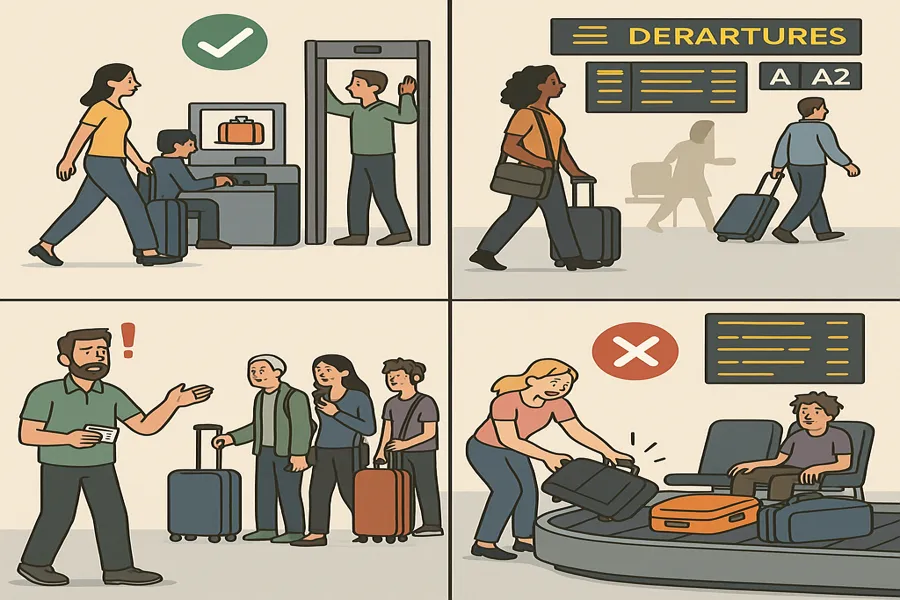
Flying from an inefficient airport can cause delays, long security lines and a poor passenger experience. At Newark and LaGuardia airports, only 55% and 57% of flights, respectively, leave on time. In Europe, Paris Charles de Gaulle (62%) and London Heathrow (63%) have the worst punctuality records. For an inefficient airport, allow at least 2-3 hours extra time for short connections and choose to leave or arrive outside of early-morning and late-afternoon peak times.
Factors That Make Airports Efficient
Ultimately, efficient airports strike a delicate balance between maximizing throughput, ensuring safety and security, and delivering a positive experience for both airlines and passengers.
Efficiency Factors
Well-Designed Physical Layout
An intuitive and uncongested layout (including runways, taxiways, gates, and terminals) minimizes travel distances for both passengers and aircraft, reducing bottlenecks and the risk of collisions.
Advanced Technology & Automation
Technology like AI, biometrics, self-service kiosks, and automated baggage systems streamlines processes, reduces human error, and provides valuable data insights for real-time decision-making. This leads to faster check-ins, security screening, and baggage claims, improving the passenger experience and optimizing resource allocation.
Efficient Operational Procedures
This includes synchronized processing at security and immigration checkpoints, rapid aircraft turnaround times at the gate (achieved through coordinated ground handling and equipment access), and effective air traffic management. Clear, real-time communication between all stakeholders (airlines, ground handlers, ATC, etc.) is vital for minimizing delays.
Effective Resource Management
Optimizing the allocation of critical resources such as gates, stands, and staff based on real-time data and predictive analytics ensures the airport can handle varying passenger volumes without compromising safety or efficiency.
Seamless Passenger Flow
Efficiency is highly dependent on how quickly passengers can move through the airport. Well-laid-out terminals, clear signage, and sufficient facilities (like security checkpoints, restrooms, and baggage carousels) reduce stress, prevent congestion, and enhance passenger satisfaction.
Adaptability and Flexibility
Efficient airports can quickly adapt to changing circumstances, such as sudden increases in traffic, evolving security requirements, or adverse weather conditions, ensuring continuity of operations.
Collaboration Among Stakeholders
Strong working relationships and data sharing between the airport owner/operator, airlines, ground handlers, and regulatory bodies help to ensure all parties are working towards the same operational goals.
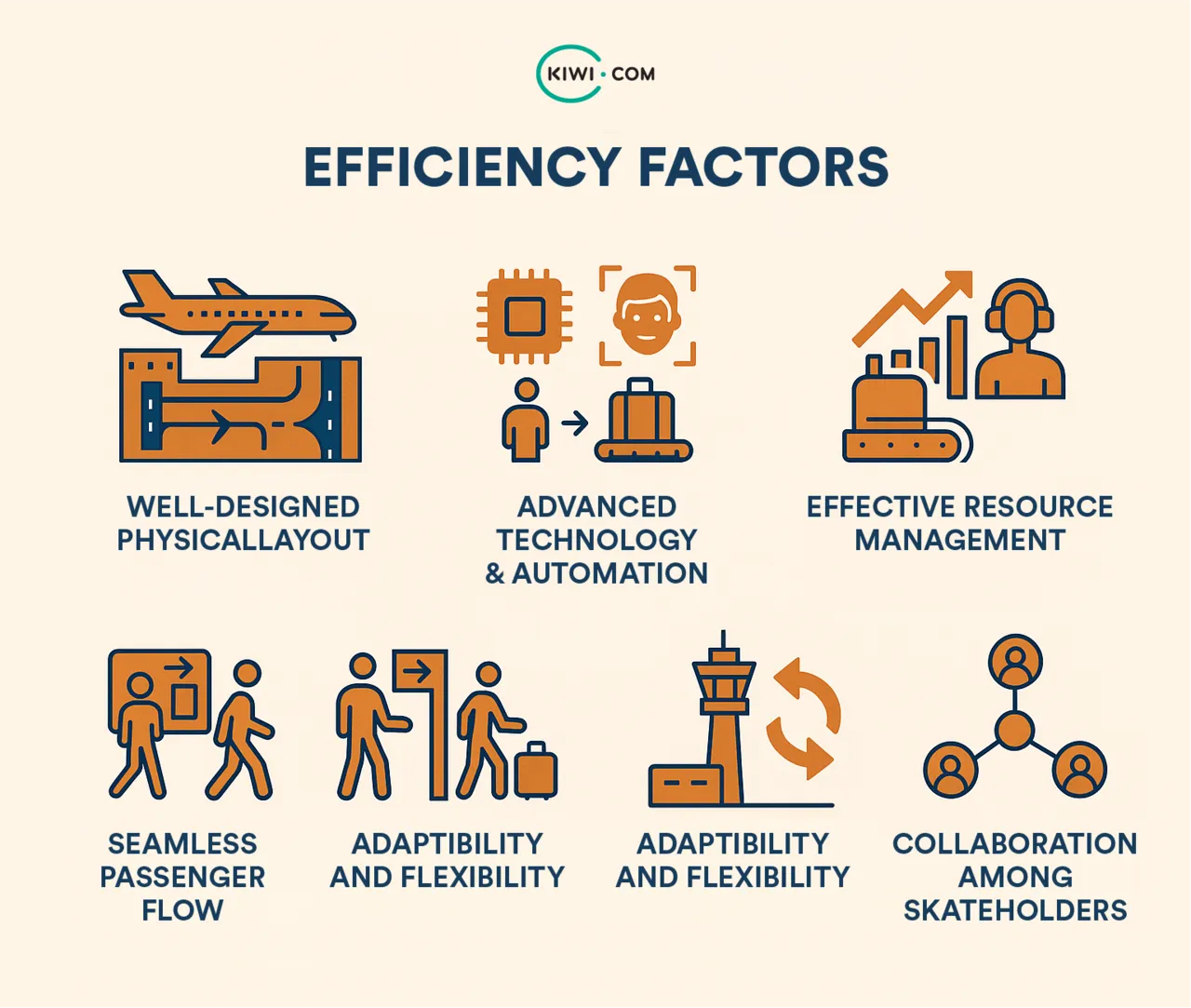
The main factors that drive airport efficiency, from advanced automation and smart layouts to teamwork and adaptability © Kiwi.com
Factors That Make Airports Inefficient
Airport inefficiency is primarily caused by infrastructure bottlenecks, operational shortcomings, external factors like weather, and a lack of seamless coordination among the many stakeholders involved.
Inadequate or Outdated Infrastructure
Airports with a limited number of runways, taxiways, gates, or terminal space struggle to handle high traffic volumes, especially during peak periods. Older airports often have layouts that were not designed for modern passenger volumes and security needs, leading to bottlenecks at security, check-in, and baggage claim areas.
Congestion and Overcapacity
When the volume of traffic (aircraft and passengers) exceeds the airport’s physical capacity, delays and disruptions are inevitable. This leads to aircraft holding on taxiways, circling in the air, and long lines in the terminals.
Operational and Logistical Issues
Inefficient processes, such as slow aircraft turnaround times (due to uncoordinated ground handling, fueling, or cleaning), insufficient spare parts inventory, or maintenance delays, can cause a domino effect of delays throughout the entire system.
External Factors (Weather and Events)
Unpredictable and extreme weather conditions (fog, snow, thunderstorms, high winds) are a major cause of delays, accounting for a significant percentage of air travel disruption. Other external events like air shows, civil unrest, or equipment outages can also halt operations.
Lack of Stakeholder Collaboration
The aviation system involves many independent entities (airlines, air traffic control, security, ground handlers, etc.). When these groups operate in silos and do not share real-time data or coordinate effectively, it hinders the ability to make informed decisions and manage disruptions promptly.
Crew and Staffing Shortages/Issues
Strict rules regarding crew working hours and mandatory rest periods mean that even minor initial delays can lead to flight cancellations if a replacement crew is unavailable. Staffing shortages in key areas like security or ground handling also cause significant bottlenecks.
Suboptimal Scheduling Practices
Airlines often schedule flights in “banks” during peak times to maximize revenue, which can exceed the airport’s practical capacity and lead to compacted demand and heavy congestion.
Security Processes
Security screening is a critical bottleneck. Long lines, passengers who are unfamiliar with packing rules, and the time required for thorough screening can all contribute to significant delays.
Some Efficient Airports
Seattle Tacoma (SEA)
Modern passenger amenities and high satisfaction scores
SEA has repeatedly ranked among the top U.S. airports in passenger surveys, reflecting good terminal layout, retail/food options, and customer service that speed passenger flows and reduce dwell-time stress.
Operational capacity and route mix
A large mix of domestic and international connections with well-developed gate and ground operations helps maintain steady throughput when demand is high.
Investment and continuous improvement
Active projects and targeted upgrades driven by Port of Seattle priorities help address bottlenecks and improve on-time metrics.
Salt Lake City (SLC)
New terminal design focused on flow and flexibility
SLC rebuilt its terminal in stages with a compact, right-sized layout that shortens walking distances, simplifies connections, and improves gate utilization.
Hub airline operations concentration
Delta’s strong presence creates predictable wave schedules and tight operational coordination between airline and airport resources, improving on-time departures and arrivals.
Passenger access and multimodal links
Easy rail and road access reduces surface-transport variability and speeds turnarounds for origin/destination traffic.
Ongoing phased upgrades and attention to amenities
Staged expansion and focus on passenger experience (shops, services, wayfinding) reduce dwell friction and improve throughput.
Denver (DEN)
Large, future-proof infrastructure and runway capacity
DEN’s expansive site and multiple long runways reduce runway congestion and allow simultaneous operations that support punctuality under high traffic.
Design that leverages daylighting and energy/asset management
Terminal design choices and modern building systems reduce operational interruptions and support predictable facility performance.
Long-term planning and scalable growth programs
DEN’s multi-decade plans for gates, concourses, and access roads target capacity shortfalls before they become delays, enabling smoother aircraft rotations and passenger flows.
Operational scale with systems for resilience
Investments in technology, sustainability, and asset management help the airport absorb peaks and recover faster from disruptions.
Copenhagen (CPH)
Copenhagen Airport combines deliberate terminal design, predictable traffic patterns and close coordination with airlines and ground handlers to minimize delays, speed passenger flows and keep turnaround times low. Those combined choices have produced high throughput, strong financial results and repeated external rankings naming Copenhagen among Europe’s most efficient airports.
Technology and data
The airport has prioritized automation and digital self-service (mobile check-in, self-bag drop, automated gates) and uses operational data to smooth peak loads and allocate resources in real time.
Layout and operations
Simple, compact terminals with clear passenger flows plus flexible staffing and processes for baggage, security and boarding reduce friction points that commonly cause slowdowns at larger, more complex hubs.
“Total Airport Management" (TAM)
The airport uses artificial intelligence (AI) and real-time data to monitor, predict, and prevent delays, improving overall operations.
Culture and collaboration
A local culture that values punctuality and predictable schedules, together with long-term cooperation between CPH, airlines and Danish authorities, supports tight slot management and fast aircraft turnarounds.
Some Inefficient Airports
Newark (EWR)
Airport’s inefficiency is due to a combination of factors including air traffic control staffing shortages, aging technology, runway limitations from construction, and general congestion. The combination of these issues has created a feedback loop where a single problem (like a runway closure) causes cascading delays that are difficult to recover from due to the existing constraints.
Air traffic control (ATC) issues
The airport has faced chronic understaffing for years, a problem worsened by retirements and issues with controller certifications. This means fewer controllers are available to manage the high volume of flights, leading to reduced operational capacity.
Aging technology
The ATC system, particularly the Newark TRACON (Terminal Radar Approach Control), has old technology that struggles to keep up with current air traffic demands.
Congestion and demand
As a major hub for airlines like United, Newark experiences a high volume of flights, making it particularly vulnerable to delays when its capacity is reduced.
Chicago O’Hare (ORD)
O’Hare is considered inefficient due to its complex layout with intersecting runways, which can cause dangerous and lengthy taxi times, especially when combined with construction and overcrowding. The airport is also criticized for being outdated, understaffed, and for having long security and connection times, which leads to poor passenger satisfaction.
Intersecting runways
O’Hare’s original layout with three pairs of angled, intersecting runways was designed for efficiency, but its design is now considered inefficient and can be dangerous, leading to delays.
Outdated infrastructure
The airport is described as old and having had to expand in a piecemeal fashion, which can lead to delays when taxiing to a gate, especially while construction is underway.
Overcrowding
The airport is frequently crowded, with long lines and crowded gate areas, leading to a poor overall passenger experience. Many travelers report very long waits for security lines and to find a gate, a problem that has been exacerbated by construction and increased passenger demand.
Operational issues
Ongoing construction projects to add more gates and improve infrastructure have added to the delays. When gates are not immediately available upon landing, planes can be forced to wait and taxi for extended periods.
London Heathrow (LHR)
London Heathrow is inefficient due to its aging infrastructure, lack of capacity, and geographic limitations, which result in constant construction, frequent delays, and the inability to easily handle traffic. Its layout is a patchwork of old and new buildings, not purpose-built for its current passenger volume, and it has only two runways and strict night-time flight restrictions, unlike newer, larger airports.
Aging and outdated facilities
Heathrow was built over many decades, not as a single, modern design. This results in a “hodgepodge” of terminals from different eras that are often cramped and require constant, disruptive construction and refurbishment.
Limited space and runways
The airport sits on a relatively small site with only two runways, while many competitors have three or four. This severely limits its capacity to handle the volume of flights, especially during peak times.
Strict noise and flight restrictions
Unlike other major airports, Heathrow has extremely strict noise curfews, with almost no flights allowed to take off or land at night. This adds to the pressure on the two runways during daylight hours.
_"_No spare capacity"
Heathrow has no spare capacity. Any minor issue, such as a weather event or a simple equipment malfunction, can cause a cascading series of delays throughout the entire system.
Disruptive connections
Passengers often have to use bus services to travel between terminals, and these routes are frequently changed due to construction work, causing unpredictable and long transfer times.
Complex security and immigration processes
Multiple terminal security rules and heavy passenger processing add to delays, especially for connections.
Operational consequences
Longer connection times, more frequent tarmac/holding delays and passenger service issues, which combine to worsen punctuality and customer satisfaction.
Practical tips for travelers to avoid problems at these airports
- Allow extra connection time (at least 2–3 hours for short international connections at these hubs).
- Book through-tickets on one PNR (Passenger Name Record) where possible, so airlines are responsible for missed connections.
- Prefer through-checked baggage or carry-on only when making tight connections.
- Choose arrival/departure times outside the busiest waves (avoid early- morning and late-afternoon peaks, when slots are concentrated).
- For London Heathrow specifically, consider alternative airports (Gatwick , Stansted ) if your itinerary tolerates slightly longer surface travel but fewer transfer risks.
Most and least punctual airports
United States (recent on-time % estimates)
| Rank | Most punctual (approx. on-time %) |
|---|---|
| 1 | Salt Lake City SLC — 88% . |
| 2 | Denver DEN — 86% . |
| 3 | Seattle SEA — 85% . |
| 4 | Portland PDX — 84% . |
| 5 | Minneapolis MSP — 83% . |
| 6 | San Francisco SFO — 82% . |
| 7 | Phoenix PHX — 81% . |
| 8 | Dallas/Fort Worth DFW — 80% . |
| 9 | Charlotte CLT — 79% . |
| 10 | Indianapolis IND — 78% . |
| Rank | Least punctual (approx. on-time %) |
|---|---|
| 1 | Newark EWR — 55% . |
| 2 | LaGuardia LGA — 57% . |
| 3 | New York JFK — 58% . |
| 4 | Chicago O’Hare ORD — 60% . |
| 5 | Los Angeles LAX — 61% . |
| 6 | Boston BOS — 62% . |
| 7 | Detroit DTW — 63% . |
| 8 | Philadelphia PHL — 64% . |
| 9 | Miami MIA — 65% . |
| 10 | Houston IAH — 66% . |
Sources: Cirium On-Time Performance and US airport rankings, Jan 2025; JD Power / industry airport satisfaction reporting.
Europe (recent on-time % estimates)
| Rank | Most punctual (approx. on-time %) |
|---|---|
| 1 | Zurich ZRH — 90% . |
| 2 | Copenhagen CPH — 88% . |
| 3 | Amsterdam AMS — 87% . |
| 4 | Helsinki HEL — 86% . |
| 5 | Munich MUC — 85% . |
| 6 | Stockholm ARN — 84% . |
| 7 | Vienna VIE — 83% . |
| 8 | Frankfurt FRA — 82% . |
| 9 | Madrid MAD — 81% . |
| 10 | Barcelona BCN — 80% . |
| Rank | Least punctual (approx. on-time %) |
|---|---|
| 1 | Paris CDG — 62% . |
| 2 | London Heathrow LHR — 63% . |
| 3 | Rome FCO — 65% . |
| 4 | Milan MXP — 66% . |
| 5 | Athens ATH — 67% . |
| 6 | Istanbul IST — 68% . |
| 7 | Lisbon LIS — 69% . |
| 8 | Brussels BRU — 70% . |
| 9 | Dublin DUB — 71% . |
| 10 | Oslo OSL — 72% . |
Sources: AirHelp / passenger-survey-based Europe airport rankings 2025; region on-time performance summaries.
Urgent FAQs: Navigating Flights Through Inefficient Airports
Are there “good” airports and “bad” airports to fly from?
There are very efficient airports and there are very inefficient airports where a number of factors lead to long security lines, overcrowding and departure delays. For example, only 55% of scheduled flights leave Newark Airport on time, while 88% of flights leave the Salt Lake City Airport on schedule.
What are some of the consequences of an inefficient airport?
Longer connection times, more frequent tarmac delays and passenger service issues, as well as lengthy taxi times, all leading to flight delays. Also overcrowding in the gate areas and long security lines, which create a poor overall passenger experience.
What are some of the worst airports in the US and Europe?
Newark, LaGuardia, JFK and O’Hare all have on-time records of 60% or less. In Europe, Paris Charles de Gaulle, London Heathrow, Rome Fiumicino and Milan Malpensa all have punctuality records of 66% and less.
What are some of the best airports in the US and Europe?
In the US, Salt Lake City, Seattle, Denver and Portland have on-time records of 84 to 88%. In Europe, Zurich, Copenhagen, Amsterdam and Helsinki airports boast punctuality performances of 86 to 90%.
What can I do to minimize stress if I am flying from an inefficient airport?
Allow extra connection time of at least 2–3 hours for short international connections. Book through-tickets on one Passenger Name Record (PNR). Prefer through-checked baggage; use carry-on only when making tight connections. And choose arrival/departure times outside the busiest waves, such as early-morning and late-afternoon peaks.