



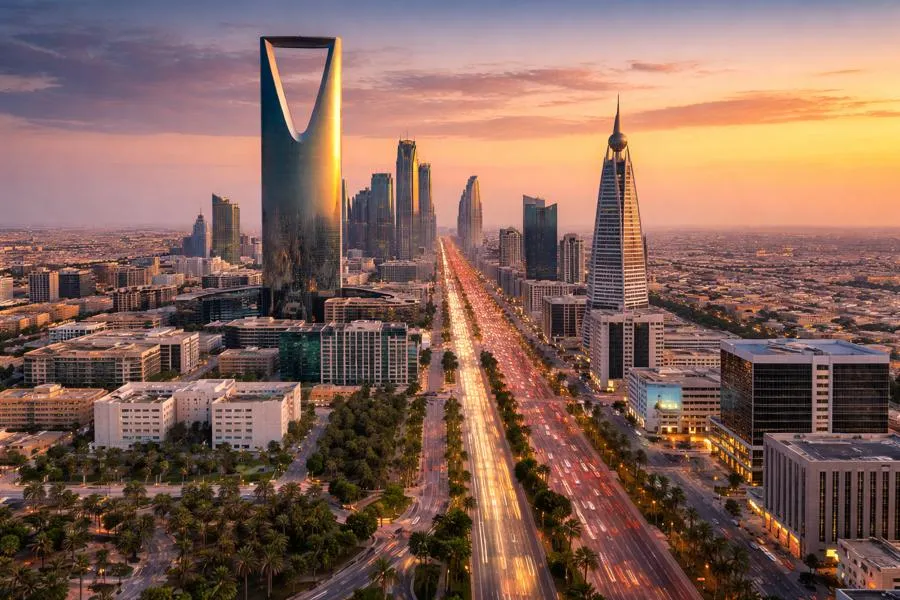
This is Riyadh without the luxury-hotel price tag — all substance, no gold-plated nonsense.
From Airport To Downtown Without Losing Your Mind
King Khalid International Airport looks intimidating, but getting into the city doesn’t have to be a logistical saga.
Official airport taxis and ride-hailing apps like Uber and Careem are reliable and widely used. Expect to pay around 60–100 SAR (£13–22) to central areas such as Olaya or Al Murabba, depending on traffic and time of day. The drive usually takes 30–45 minutes, but during peak evening hours it can stretch longer.
If you’re on a tighter budget, the Riyadh Metro is finally rolling out in phases. When fully operational, it will connect the airport with key parts of the city for a fraction of taxi prices — clean, air-conditioned, and blissfully traffic-free. Until then, taxis are the default, and unlike many cities, there’s no penalty for using them sensibly rather than constantly.
No haggling, no scams, no stress — just accept that Riyadh is a car city (for now) and plan accordingly.
Getting Around: Riyadh, But Make It Smart
Riyadh isn’t built for wandering aimlessly on foot — distances are huge, pavements can disappear without warning, and the summer heat is not here to play games.
Ride-hailing apps are king. Uber and Careem dominate the city, with short rides often costing 15–30 SAR (£3–6). If you’re moving around a lot in one day, this still works out cheaper and less exhausting than trying to walk between neighbourhoods.
The metro and bus network is the city’s big promise: once fully live, it will be a game-changer for budget travellers. Stations are sleek, signage is bilingual, and fares are expected to stay low. Keep an eye out — locals are excited for a reason.
Walking does work in pockets: around Diriyah, Diplomatic Quarter, parts of Olaya, and major malls. Just don’t expect European-style strolling. In Riyadh, movement is strategic.
Budget Bliss: Riyadh For Next To Nothing
Diriyah (At-Turaif District)
This is where Saudi Arabia began — literally. The mud-brick ruins of At-Turaif, a UNESCO World Heritage Site, sit just northwest of the city and tell the story of the first Saudi state.
Entry to many areas is free or very low-cost, especially outside of major events. Budget 1.5–2 hours to wander the restored alleys, climb viewpoints overlooking the Wadi Hanifah, and soak up the contrast between ancient architecture and the modern skyline beyond.
Come in the late afternoon when the light softens and the heat drops. It’s atmospheric, calm, and a reminder that Riyadh isn’t just glass towers and giga-projects.
National Museum Of Saudi Arabia
If you want context — real context — this is the place. Located in the King Abdulaziz Historical Centre, the National Museum is modern, well-curated, and refreshingly honest about the region’s history.
Entry costs just a few riyals (often free), and you’ll want 1.5–2 hours to explore everything from prehistoric Arabia to the formation of the modern kingdom. Interactive exhibits, bilingual explanations, and zero tourist chaos make this one of the city’s best value cultural stops.
Pair it with a walk through the surrounding park for a low-key afternoon that doesn’t involve a shopping mall.
Al Masmak Fortress
Right in the heart of old Riyadh, this clay and mudbrick fortress played a central role in the birth of modern Saudi Arabia.
Entry is free, and you only need 30–45 minutes to explore the courtyard, towers, and small museum inside. It’s compact, meaningful, and surrounded by traditional souqs where you can browse without buying a thing.
Go early evening when locals gather nearby and the call to prayer echoes through the streets — it’s quietly powerful.
Diplomatic Quarter (DQ)
Think Riyadh is all highways and high-rises? The Diplomatic Quarter proves otherwise.
This leafy, well-planned neighbourhood is filled with walking paths, public art, cafes, and landscaped parks — and it’s completely free to explore. Budget 1–2 hours for a stroll, people-watching, and a breather from the city’s intensity.
It’s popular with locals, diplomats, and families, and it feels worlds away from the traffic chaos elsewhere. Bring a takeaway coffee and pretend you’re in a very well-funded urban oasis.
Big Plates, Small Bills: Where Riyadh Eats Best
Local Restaurants & Rice Plates
Riyadh is generous with food — portions are large, prices are fair, and no one leaves hungry.
Traditional Saudi dishes like kabsa or mandi (spiced rice with chicken or lamb) are widely available for 15–25 SAR (£3–5). You’ll often be served enough food for two, especially in no-frills local spots where plastic trays beat fancy plating every time.
Eat where families eat. If it looks basic and busy, you’re in the right place.
Shawarma, Everywhere
Shawarma in Riyadh is a lifestyle. Thinly sliced meat, garlic sauce, pickles, wrapped in soft bread — simple, perfect, unstoppable.
Prices range from 5–8 SAR (£1–2), and quality is consistently high. Everyone has their favourite spot, and everyone insists theirs is the best. Grab one late at night when the city truly wakes up and join the queue — that’s how you know it’s good.
Bakeries And Breakfast Cafes
Riyadh’s cafe scene is booming, but you don’t need to spend 30 SAR on a latte to enjoy it.
Local bakeries sell fresh flatbreads, cheese pastries, and sweet buns for pocket change. Pair that with Arabic coffee or tea and you’ve got breakfast for under 10 SAR.
For something trendier but still reasonable, neighbourhood cafes often serve excellent breakfast plates for 20–30 SAR, with portions generous enough to keep you going all day.
Mall Food Courts (Trust Them)
Malls are Riyadh’s social hubs, and their food courts are surprisingly solid. Alongside global chains you’ll find local concepts serving proper meals at fair prices.
It’s air-conditioned, relaxed, and ideal if you need a break from the heat without breaking the bank. Sometimes practicality is the luxury.
Evenings Without The Expense Account
Coffee Culture, Saudi-Style
Alcohol isn’t part of the picture — but coffee absolutely is.
Riyadh’s cafes range from minimalist specialty spots to traditional places serving Arabic coffee with dates. A good coffee costs 10–15 SAR, and staying for hours is normal. No pressure, no rush, just conversation and people-watching.
Late nights are the norm. Arriving at 9 pm is considered early.
Boulevard Riyadh City (On A Budget)
Yes, it can be flashy. Yes, it can be expensive. But you don’t have to spend much to enjoy Boulevard Riyadh City.
Entry is often free on certain days, and wandering the illuminated streets, watching street performers, and soaking up the atmosphere costs nothing. Skip the high-end restaurants and just enjoy the spectacle — it’s like a theme park for urban development.
Under-The-Radar Riyadh
Wadi Hanifah
This restored valley cuts through the city and feels like a small miracle: walking paths, greenery, water, and wildlife — all free.
It’s best visited in cooler months or at sunset. Budget 1–2 hours for a relaxed wander and a reminder that Riyadh is still rooted in its landscape, not just its skyline.
Local Souqs (Without Shopping Pressure)
You don’t have to buy anything to enjoy Riyadh’s traditional markets. Wander, observe, chat if invited, and move on.
There’s no aggressive selling culture, and browsing is perfectly acceptable. It’s one of the easiest cities in the region to explore without feeling like a walking wallet.
Out Of The City: Easy Day Trips From Riyadh
Riyadh might feel all-encompassing, but some of its best experiences sit just beyond the ring roads. With a car or a driver for the day, you can trade skyscrapers for cliffs, villages, and desert silence — all without blowing your budget or needing an overnight stay.
Edge Of The World (Jebel Fihrayn)
This is the one everyone talks about — and for good reason. About 90 minutes northwest of Riyadh, the Edge of the World delivers dramatic cliffs that drop straight into an endless desert plain, creating views that genuinely stop conversations mid-sentence.
You don’t need a tour if you’re confident driving (ideally in a 4×4), but organised trips can be surprisingly affordable when split between a few people. Entry itself is free. Budget 2–3 hours on site for walking along the cliffs, photos, and sitting quietly pretending you’re in a nature documentary.
Go late afternoon for cooler temperatures and stay for sunset — the way the light melts across the desert is unreal. Bring water, snacks, and a healthy respect for gravity.
Ushaiqer Heritage Village
If you want history without the crowds, Ushaiqer is your day trip. About 2–2.5 hours northwest of Riyadh, this traditional Najdi village is a maze of mud-brick houses, narrow alleys, and mosques that feel completely untouched by time.
Entrance is free, and you can explore at your own pace for 1–2 hours. There are a few small museums and cafés, but the real joy is wandering, getting lost, and imagining life here centuries ago.
It’s calm, photogenic, and deeply human — a perfect counterbalance to Riyadh’s scale and ambition.
Thumamah Desert
You don’t have to drive hours into the Empty Quarter to experience the desert. Thumamah, just 30–45 minutes north of the city, offers rolling dunes, open space, and the kind of quiet you didn’t realise you were craving.
Locals come here for picnics, sunset drives, and late-night gatherings. You can visit for free, wander the dunes, or simply park up and watch the light change. Budget 1–2 hours, more if you bring food and settle in.
It’s especially lovely in winter evenings when the desert cools and the city noise fades behind you.
Al Muzahimiyah & Western Escarpment
Less famous than the Edge of the World but just as striking in places, the western escarpment near Al Muzahimiyah (about 1 hour west) offers rocky cliffs, viewpoints, and winding roads that feel miles away from urban Saudi Arabia.
This is a great option if you want dramatic scenery without committing to a full expedition. Pull over, explore carefully, take photos, and head back before dark. No tickets, no infrastructure — just raw landscape.
Perfect for a half-day escape when you want space, not spectacle.
Wadi Namar
If you want something even closer, Wadi Namar sits right on Riyadh’s edge and feels like a small oasis carved into the city. There’s a walking path, a dam, water features, and shaded areas where families gather in the evenings.
Entry is free, and you only need 45–90 minutes for a relaxed visit. It’s not wild desert, but it’s green, peaceful, and incredibly accessible — especially nice if you don’t want to spend half the day driving.
When To Go
Oct–Mar: Ideal weather, outdoor exploring, peak season Apr–May: Warming up, still manageable Jun–Sep: Extremely hot — plan indoor activities and evenings only
How Expensive Is Riyadh?
Food: shawarma 5–8 SAR, rice dishes 15–25 SAR Coffee: 10–15 SAR Transport: short Uber rides 15–30 SAR Attractions: many museums and sites free or under 10 SAR Accommodation: budget hotels from ~150–250 SAR/night
Finding Your Rhythm In Riyadh
Riyadh doesn’t scream for attention — it unfolds slowly. It rewards curiosity, respect, and a willingness to adapt to its rhythm. Skip the assumptions, follow the locals, and you’ll discover a city that’s far more accessible than its reputation suggests.
Come for the transformation, stay for the generosity, and leave knowing you didn’t need a luxury budget to experience Saudi Arabia’s capital properly.
Popular routes on Kiwi.com
- Cheap flights from London to Turkey
- Cheap flights from London to Barcelona
- Cheap flights from London to Japan
- Cheap flights from London to New York
- Cheap flights from New York to Paris
- Cheap flights to Spain
- Cheap flights to Italy
- Cheap flights to the United States
- Cheap flights to the United Kingdom
- Last minute flights
People Also Read

How to Travel Patagonia: A First-Timer's Guide to Chile & Argentina's Wild South
Where to stay in Palma de Mallorca: best areas for beaches, culture and nightlife