






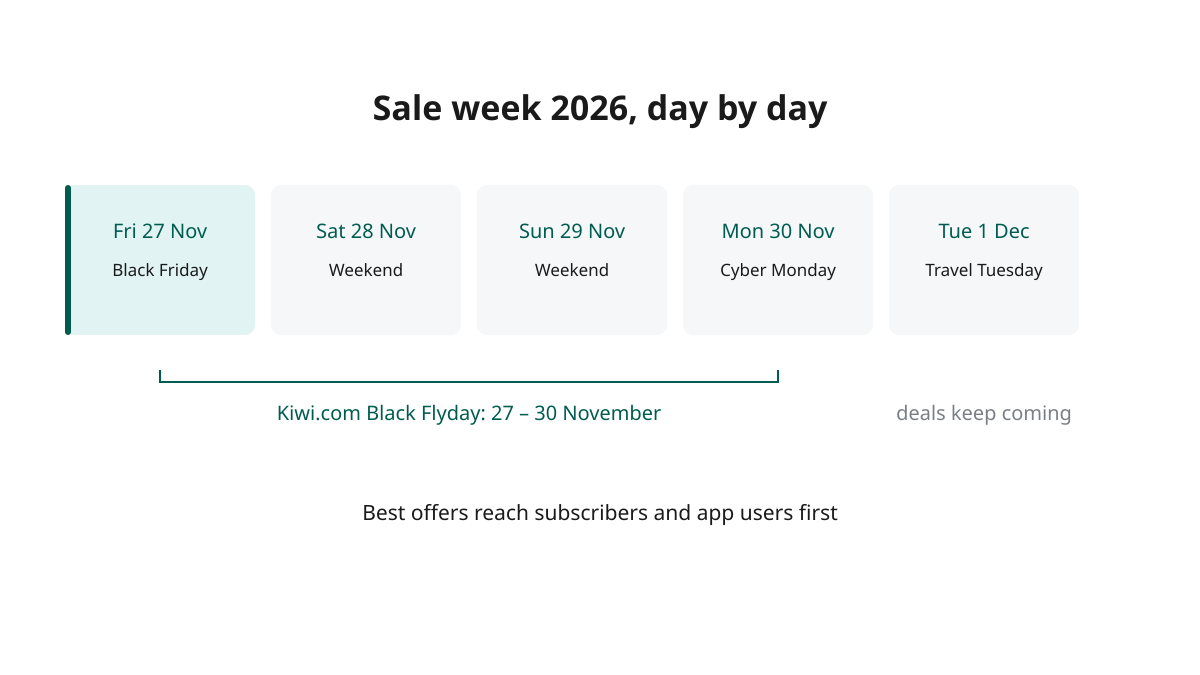
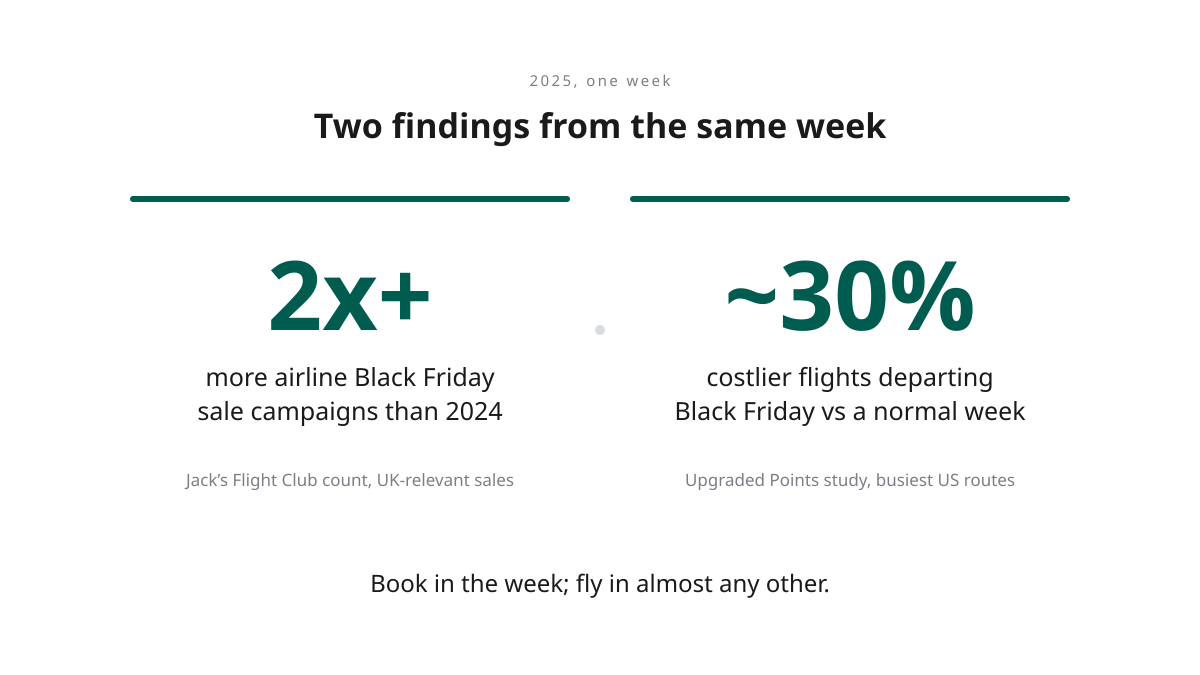
Black Friday 2026 falls on 27 November, and the sales now run as a week: through the weekend, past Cyber Monday on 30 November, and on to Travel Tuesday on 1 December. Airlines that usually spread their winter sales across months stack them into these five days. In 2025 one UK deal-hunting club counted what ran in that week and found more than double the airline sale campaigns it had spotted the year before.
In this article
A sale price on a fare and the price of flying that same day are two different things. The offers are for booking inside the window; the flights departing inside it are a different story.
What the week is worth to you gets decided before it starts, by the total fares you write down while nothing is discounted. That page of numbers is the one thing the banners can’t move, and it takes one afternoon to make.

Key takeaways
Treat it as a week, not a day. The 2026 window runs 27 November to 1 December; the sales open on the Friday and close on Travel Tuesday.
Book in the week, don't fly in it. Flights departing Black Friday 2025 itself cost about 30% more than in a normal early-November week, per a US study of busy routes.
Write down the normal fare first. Note the full price you'd pay on your dates before the sales open; every claim gets measured against that number.
What last year’s numbers say
Upgraded Points, a US travel site, studied more than 40,000 flights on the busiest American routes over the 2025 holidays. Flights departing on Black Friday itself cost about 30% more than in a normal early-November week. The finding covers American routes only, so read it as an estimate rather than a promise. Its direction matches what UK travellers see that weekend, busy airports and full planes, and the play it points to is simple: book in the week, fly in almost any other.
Find flights for this trip
The same club’s tally of the individual campaigns shows how much they vary. Some are genuinely discounted winter fares. Others are a normal fare with a Black Friday banner over it, and one low-cost carrier ran five separate campaigns in that single week, spread across the whole range between the two. The club’s own advice to members is to check fares a week or two before the sales open, because airlines, in its words, like to get creative with how they advertise their prices.
Which day to check, though, has no fixed answer. The old idea of one cheapest day to book came from flight-search records collected in 2018 and 2019, and it ages worse every winter. What the recent counts show instead is movement: Hopper, the booking app behind Travel Tuesday, saw more deals on the Tuesday after Thanksgiving in 2024 than on Black Friday and Cyber Monday combined, while one comparison of the 2025 window put Cyber Monday ahead overall. No day wins twice in a row, so the Tuesday matters as much as the Friday.
How to tell a real deal from a rebadged fare
That pre-sale check needs one thing from you: a number. Pick the routes you’d actually fly, whether that’s London to Prague , Manchester to Rome , or wherever your winter trip really points, and write down the total price on your real dates, taxes and fees included, while nothing is on sale. Kiwi.com shows that total up front, so the number you note is the number you’d pay.
When the sales start, compare like with like. A fare that has genuinely dropped sits below your written number on the same dates; a rebadged normal fare sits within a few pounds of it. The landing page for Kiwi.com’s own Black Flyday sale makes the same check in one line: compare the fare against nearby dates, and look at what you’d pay overall rather than the headline figure, because some deals only look cheap next to a raised reference price.
Two habits catch most of the tricks:
- Compare totals, never percentages. An advertised discount is almost always a base-fare percentage on select routes, with the taxes and fees still added on top. A 20% banner can mean £9 off a short hop.
- Keep your dates fixed. A sale fare that exists only on Tuesday departures in January isn’t a discount on your trip; it’s a different trip.
Every advertised number that week, ours included, is trying to set your reference point for you. The page of totals you wrote beforehand is the only number in the room that isn’t selling anything.
Where the UK sales will show up
Once you can judge a fare against your own number, the next question is where the UK sales actually appear. The pattern from recent UK years is consistent enough to plan around. The big British and Irish carriers run sale pages across the weekend, usually with a code or an automatic discount on bookings made in the window. The travel dates inside those sales cluster in winter and early spring, roughly December to March, because that is the season airlines struggle to fill; summer dates are rare, and Christmas is rarer still, with only a handful of past sales including the holidays. One package holiday operator is already advertising up to 20% off flights booked into early December, with travel valid through to 2028. That is the usual shape of these campaigns: a generous booking window, a restricted travel window.


Comparison sites run their own campaigns in parallel, and they are worth watching because they sit across every airline’s sale at once. Cheap flights searches over 500 airlines in one place, so one Friday afternoon of checking does the work of twenty separate sale pages.
 Inspiration
Do Flight Alerts and Price Trackers Really Work When Prices Change Fast?
Flight prices move quickly. Learn whether flight alerts and price trackers actually work, when they help, and when you need to act immediately.
Read the guide
Kiwi.com’s own sale is called Black Flyday , and it runs 27 to 30 November. The best offers go to newsletter subscribers and app users, so the practical move is to subscribe on the landing page or switch on app notifications before the Friday; last year’s popular fares sold out first, and the early hours matter. There’s no minimum spend and no code to hunt for this year, just the offers themselves.
Your pre-27-November plan
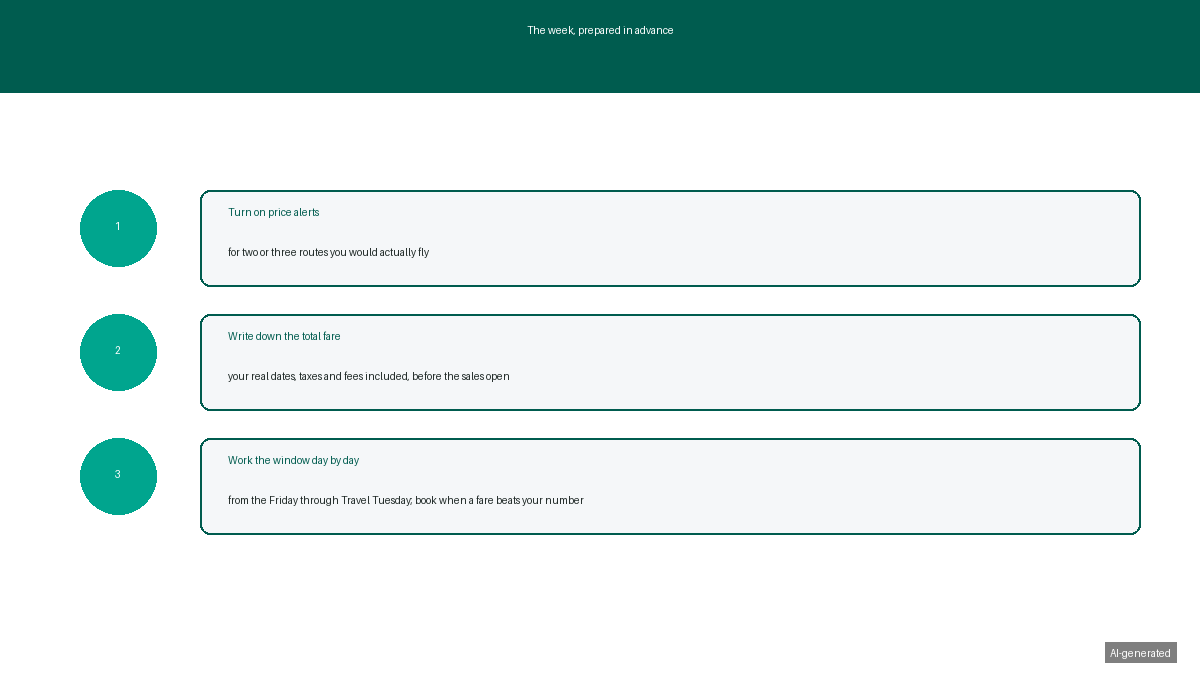
The preparation fits into the days before the sales open, while nothing is discounted and the prices you see are honest. Turn on price alerts for two or three routes you’d actually fly. They watch the fare and tell you every time it moves, up or down, which is exactly the record you want when a sale starts shouting. Alerts can’t predict a flash sale; they catch the drop the moment it’s published.
Then write your totals down: routes, real dates, taxes and fees included. With alerts running and your numbers on paper, you’ll see every change from the first day to the last.
From the 27th, work the window as a week. Check your routes on the Friday, again across the weekend, and once more on Travel Tuesday, because new fares land daily. When a tracked fare drops below your written number on your dates, book it that day: the sales end on the Tuesday, and a better price later is a possibility, not a promise.
When to book has its own rhythm, separate from when to search: most fares are at their lowest one to three months before travel, and they tend to climb as the plane fills. A Black Friday fare for a February trip fits that window exactly; a fare for next August is worth checking against when to book and when to wait , because the further out the trip, the more a “sale” can just be the normal early price wearing a banner. If you enjoy the hunt, the same patience also pays in mistake fares , the pricing errors that occasionally undercut every sale on the calendar.
Two things to keep straight while you work the week. The discounts are for booking in it, and the dear fares are for departing in it, so don’t book a flight that leaves that Friday expecting the sale to fix its price. And if nothing beats your written number by the Tuesday, let it go: January brings its own wave of post-Christmas fares, and there is nothing wrong with the fare you already noted.
Find flights for this trip
Frequently asked questions
Are Black Friday flights actually cheaper?
Sometimes. The 2025 campaigns included genuinely discounted winter fares. But the discounts are for booking in the window, not for flying in it: departures that weekend priced well above a normal November week.
Which UK airlines run Black Friday sales?
Most of the big British and Irish carriers ran Black Friday campaigns in 2025, along with the package holiday operators; one low-cost airline ran five separate promotions on its own. For 2026, expect the same names again, with sale pages live across the weekend and travel dates mostly inside winter.
Book on Black Friday or wait for Travel Tuesday?
There’s no reliable winner: the cheapest day moves from year to year. Check across the whole window, because new fares land daily through it. Book the moment a tracked fare beats the total you wrote down; waiting for a perfect day is how the window closes.
Do the sales cover Christmas travel?
Rarely. Most UK Black Friday sales are for travel between December and March, and they carve out the Christmas and New Year peak. A handful of past sales did include the holidays, so check the dates on each sale page. But if you need to fly at Christmas, booking earlier is usually the better bet than waiting for a sale.
What is Kiwi.com’s Black Flyday and who gets the deals?
Black Flyday is Kiwi.com’s Black Friday flight sale, running 27 to 30 November 2026. The best offers reach newsletter subscribers and app users first, so sign up on the Black Flyday page or in the app before the Friday; last year’s popular fares sold out first.