







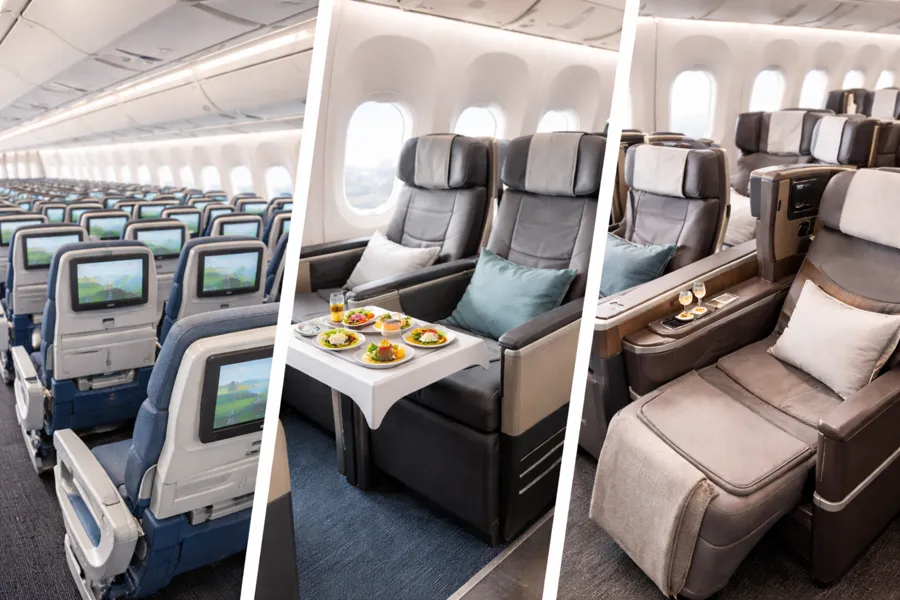
At Kiwi, we compare flight options across airlines to help you find the best deals. We don’t provide the classes themselves. That’s up to travelers to choose. If you’re curious about the different airplane classes and what they offer, stay tuned as we break them down.
Table of Contents
Quick Answer
Economy, premium economy, business, and first class are the four main different flight classes that airlines sell tickets for. Economy is the cheapest class, with minimal amenities, while premium economy is a big upgrade with more room and added perks. Business class sits just below first class, with higher-standard seats, refined dining, and extras like free lounge access. First class is the most expensive and premium cabin, often featuring private suites, personalized hospitality, and additional benefits like chauffeur drop-off at the plane.
What Is Economy Class?
Economy is the lowest class available on a flight. It’s the base tier offered by almost all airlines and is usually the cheapest option available.
Seat Pitch
The standard seat pitch (legroom) in economy class is typically between 76.2 cm and 81.28 cm.
Standard Amenities
Economy comes with basic amenities. Most seats have tray tables, limited recline, seat pockets (sometimes with magazines), and overhead storage for carry-on luggage.
Meal Expectations
Meal service in economy depends heavily on the airline. Full-service airlines like EVA Air provide basic hot pre-packaged meals in economy, especially on long-haul flights. Then there are the budget airlines offering cheap flights , such as Ryanair, where meals aren’t included in the ticket price (nothing unusual there).
Baggage Rules
Baggage rules also vary based on whether you’re flying with a full-service airline or a budget carrier. Full-service economy tickets may come with checked bags (usually 20–25 kg), one carry-on bag, and one personal item. Budget airlines tend to be stricter. If you’re flying with a low-cost carrier like Spirit Airlines, your ticket might only have one personal item, with carry-on bags and checked luggage costing extra.
Economy vs Coach: Are They the Same?
Carriers in the US sometimes call economy ‘coach flights.’ It’s just their way of selling the lowest-cost tickets. Many people think economy is only one class, but it’s not. It’s split into multiple subclasses, like basic economy, standard economy, and Premium Economy.
Premium Economy: The Mid-Tier Upgrade
Premium economy is the sweet spot between different airline classes like economy and business. Not all flights have it, but it’s a regular feature on many long-haul routes.
Legroom
One of the big draws of premium economy is the legroom. It’s an upgrade from standard economy, with between 88.9 cm and 101.6 cm and a comfier seat, allowing you to really stretch those legs and sprawl.
Better Meals
Meals in premium economy are usually a bit tastier (ish), like with Lufthansa’s elevated European dining experience on board.
Priority Boarding
Eager to get to your seat early? Premium economy packages can sometimes include priority boarding, letting you board before the swarms of economy passengers.
Enhanced Comfort
Premium economy gives you added layer of comfort compared to standard economy. For instance, on Emirates, you get spacious tables, reusable amenity kits, cozy sustainable blankets, cushioned leg rests, and leather seating.
Cabin Layout
Most premium economy cabins use either a 2-3-2 or 2-4-2 configuration, though every airline is slightly different.
Price Differences
Premium economy tickets are typically 50% to 100% more expensive than standard economy tickets, but they still cost less than if you were to splash out on business class.
Business Class Explained
Oh, business class. Wouldn’t it be great to fly like a VIP? Well, there is a rare breed out there that does, whether they’re loaded or just dangerously good at collecting airline miles.
Business class is an enhanced version of these, designed for long-haul comfort.
Business Class on International vs Domestic Flights
Business class on international and domestic flights can differ significantly.
Seat Types (Recliner vs. Lie-Flat)
The two main seat types in business class are recliner and lie-flat.
Recliner seats have a deep pitch and usually include a footrest, giving passengers the opportunity to stretch their legs and recline comfortably.
Lie-flat seats are the preferred option among frequent business-class travelers and are standard on most international routes. These seats can recline to 180 degrees so that you can lie completely flat like in a bed. JetBlue Airways, Delta, and United Airlines all have them.
Service Level
Priority check-in is standard, with dedicated queues for business class passengers on both domestic and international flights.
In-flight dining also differs by route. Domestic flights usually have a more limited meal service due to shorter flight times, although the quality remains high. On international flights, meals are more elaborate, as with Air France, which offers multi-course menus created by Michelin-starred chefs.
Pricing Difference
Business class is undeniably a splurge. Prices vary widely by route, airline, and booking timing. On average, international business-class tickets cost about two to four times more than premium economy. On domestic routes, the price gap is often smaller because the seat and service differences are less significant.
First Class: The Most Exclusive Cabin
Although many airlines focus more heavily on business class, first class plane tickets still exist. Etihad, Emirates, Qatar Airways, and Swiss International Air Lines all still have first class cabins, and they’re seriously swanky.
There are generally two versions: standard first class and international first class. Standard first class is a step down, usually with smaller seats and simpler meals. International first class, on the other hand, provides considerably more room for seating, better food, and a much more luxurious overall experience.
First Class vs Business Class: How Do They Compare?
First class vs. business class - you’re probably wondering which one comes out on top. Here’s a realistic comparison of the two.
Space and Privacy
Lie-flat seats in business class provide solid privacy, with plenty of personal space and little disruption from other passengers. However, first class goes beyond that. Some airlines have private suites, such as on Singapore Airlines’ A380 flights. Passengers get their own bed, an enclosed space, sliding doors, and window blinds.
Service
The service levels in business and first class can feel quite different.
Business class already provides strong service with gourmet meals and attentive cabin crew. First class, however, usually takes things up another level. With fewer passengers in the cabin, crew members can give more personalized attention to each person. Meals are served à la carte, although some business class cabins now offer similar dining options on certain flights.
Cost
Ticket prices are where the two differ the most. Business class fares on long-haul flights can be around $3,000 (€2583.54) to $5,000 (€4305.90), while first class tickets may easily exceed $10,000 (€8611.80).
Overall Value
In terms of value, business class is the better choice. You still get a high level of comfort, but at a much more reasonable price. First class focuses more on exclusivity. However, it comes at a premium.
How Flight Search Tools Help Compare Cabin Classes
We don’t mean to brag (okay, maybe a little…), but using travel search engines like Kiwi is among the easiest ways to compare different flight classes. In just a few clicks, you can review cabin class options across multiple routes, see how prices change on different dates, and explore cheaper alternatives so you get the most out of your money.
Don’t limit yourself to one cabin, discover cheap flights to anywhere and find a range of options for your upcoming trip.
Finding Last-Minute Deals Across All Flight Classes
No matter what cabin class you’re looking at, it’s possible to find last-minute flight deals.
Demand is the biggest factor. If many people want to fly to a destination in a particular cabin, prices will be higher. But if demand is low, airlines may slash their fares to try to fill seats.
Premium cabin prices can be tricky to track. But if you try routes where not many travel for work, prices can sometimes fall in the days or weeks before departure if the seats are struggling to sell.
If you want to score a cheap seat upgrade, having some flexibility helps.
Giving yourself a few days of wiggle room can increase the chances of finding a lower fare. Another strategy is booking a mixed-cabin itinerary with different flight classes. Imagine flying from Bangkok to Muscat and then on to Cairo. In some cases, the Bangkok–Muscat leg might be cheaper in economy, while the Muscat–Cairo segment could have a discounted business class seat available.
Ready to Compare Flight Classes and Find Better Deals?
After learning everything about flight classes, you’re ready to start searching for different options with Kiwi.com . Our platform gives you everything you need to compare cabins, filter by comfort level, and bag some great bargains across different airlines. Find the best deals now and plan your journey around your preferences!
Need to compare flight classes fast? Start with these practical FAQs
Why is business class more expensive than economy?
Business class is more expensive because it usually includes better service, more legroom, upgraded meals, and a more comfortable overall experience. Prices can also rise because of demand, so in some cases economy may still be the better value.
Is premium economy worth the upgrade on long flights?
If the fare is only slightly higher than economy, premium economy can be worth the upgrade on a long flight. It often gives you more comfortable seating and a better chance to rest, but it is still important to check what is included before booking.
Do all airlines offer the same types of flight classes?
No. Every airline has its own setup. Full-service airlines such as Singapore Airlines may offer economy, premium economy, business, and first class on selected aircraft, while low-cost carriers such as AirAsia structure their cabins differently and may offer alternatives like AirAsia Premium Flatbed instead.
How do I know which class I booked when buying a ticket?
Your booking class is usually shown in the confirmation email sent by the airline. If you do not see it there, you can enter your booking reference on the airline’s website to view the cabin class linked to your ticket.
Do seat sizes really change a lot between classes?
Yes, although the exact dimensions vary by airline. Economy seat widths are often around 43.18 cm to 45.72 cm, while premium economy seats may range from 45.72 cm to 50.8 cm. You can usually find the exact measurements on the airline’s website.
Are first class seats always lie-flat?
Not always. Lie-flat seats are common on international first class routes, but domestic first class in the United States often uses recliner-style seats instead. For example, United typically does not offer lie-flat seats on most domestic first-class flights.
What is the best flight class for long-haul flights?
Premium economy is often a strong choice for long-haul travel because it can offer better legroom, improved meals, and more comfort without the higher cost of business class. Still, the best option depends on the airline, route, and what is included in the fare.
Popular routes on Kiwi.com
- Cheap flights from London to Turkey
- Cheap flights from London to Barcelona
- Cheap flights from London to Japan
- Cheap flights from London to New York
- Cheap flights from New York to Paris
- Cheap flights to Spain
- Cheap flights to Italy
- Cheap flights to the United States
- Cheap flights to the United Kingdom
- Last minute flights
People Also Read


Best places to visit in October 2026: fall foliage, warm beaches, and city breaks