

Planning a trip and wondering: do babies need passports? They certainly do. Toddler or newborn, every child needs a passport to cross an international border.
In this article
The main exception is within the EU, where children can use a national ID card instead of a passport in certain circumstances. However, kids travelling on UK passports still need valid travel documents for all countries.
In this article, we’ll break down the key passport questions you may have about travelling with a baby or young child. You’ll find a table outlining the rules for eight nationalities and an explanation of the new border checks introduced in 2026. Plus, tips for booking your trip while you wait for your child’s passport to arrive.
Key takeaways
Every baby needs their own document From birth, a child needs a passport to cross any international border. Most countries stopped letting kids travel on a parent's passport.
EU and Schengen borders accept an ID card An EU national ID card can replace a passport for EU citizens inside the EU and Schengen area, but not for trips to the UK or beyond.
UK passports for children cost £66.50 online A child's passport costs £66.50 online or £80 by paper form, lasts 5 years, and usually arrives within 3 weeks.
EES started on 10 April 2026 Children under 12 are exempt from the fingerprint scan at the new EU Entry/Exit System, but may be asked for a photo.
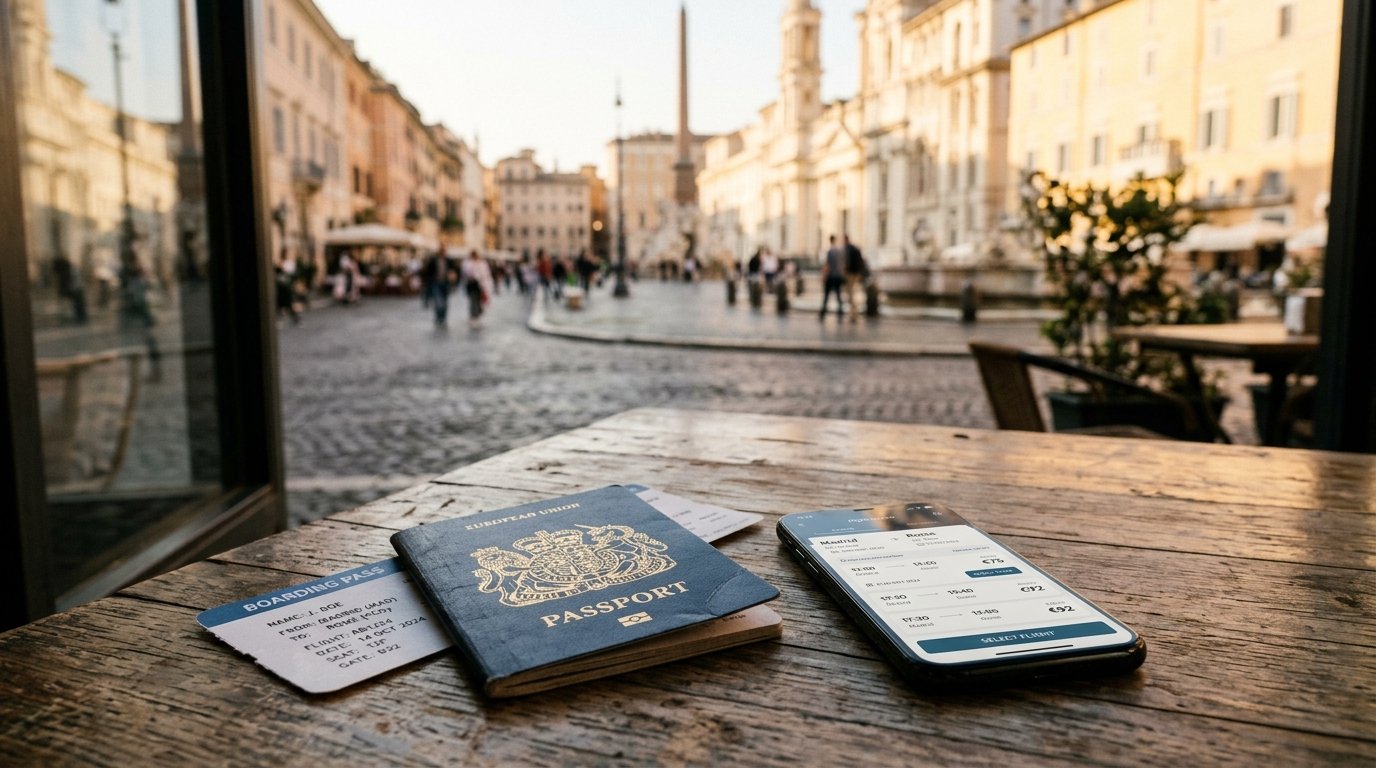
Book flights before the passport arrives You can add or correct your child's details after booking, up to 48 hours before departure, as long as the name matches their documents.
Quick Answer: Does Your Baby Need a Passport?
- If your child is an EU citizen and crossing an EU/Schengen border, they can present a passport or national ID. Even if border staff don’t check it, the airline will.
- All UK-born kids must present a passport when crossing all borders, Europe and beyond.
- Non-EU children need a valid passport to travel, as well as any required travel authorisation, visa, ETA or ETIAS.
Every Baby Needs Their Own Travel Document, From Birth
Do newborns need a passport? Yes, they do, from birth, to travel internationally, just like adults.
In the past, kids often travelled on their parents’ passports, but this practice has largely been phased out. Most countries no longer allow it, as the Dutch government has confirmed .
Other European countries have also followed suit. For example, Germany discontinued its child passport (Kinderreisepass) on 1 January 2024. Since then, children have needed an ordinary passport to leave the country, depending on their destination.
Have a baby six weeks before your vacation and already dreaming about flying to Madrid ? You can’t add them to your or your partner’s passport. You must get them their own travel documents beforehand.
Find flights for this trip

Why Babies Need Passports, Even Inside the Schengen Area
So, why do babies need passports? For several reasons. First, even though Schengen travel rules are more relaxed for EU citizens, that doesn’t mean you can travel without ID altogether. For instance, if France were to introduce temporary border checks, you might have to show something to get through.
Airlines also have strict documentation requirements. Usually, they want to see valid ID or passports for every passenger, including babies, regardless of age. Ryanair, for example, accepts passports or national ID cards but does not accept birth certificates or driving licences as travel documents. Read the Europe guide to travel documents for EU citizens for more information.
Aer Lingus has also tightened its requirements. From 25 February 2026, all children and infants need their own travel documents to board its international flights.
In many cases, a child’s parents must give consent for the passport application. When a child travels abroad with only one parent, additional consent documents may also be required, as there are rules in place to help prevent abduction.
Passport or ID Card? What Babies Need in 8 European Countries
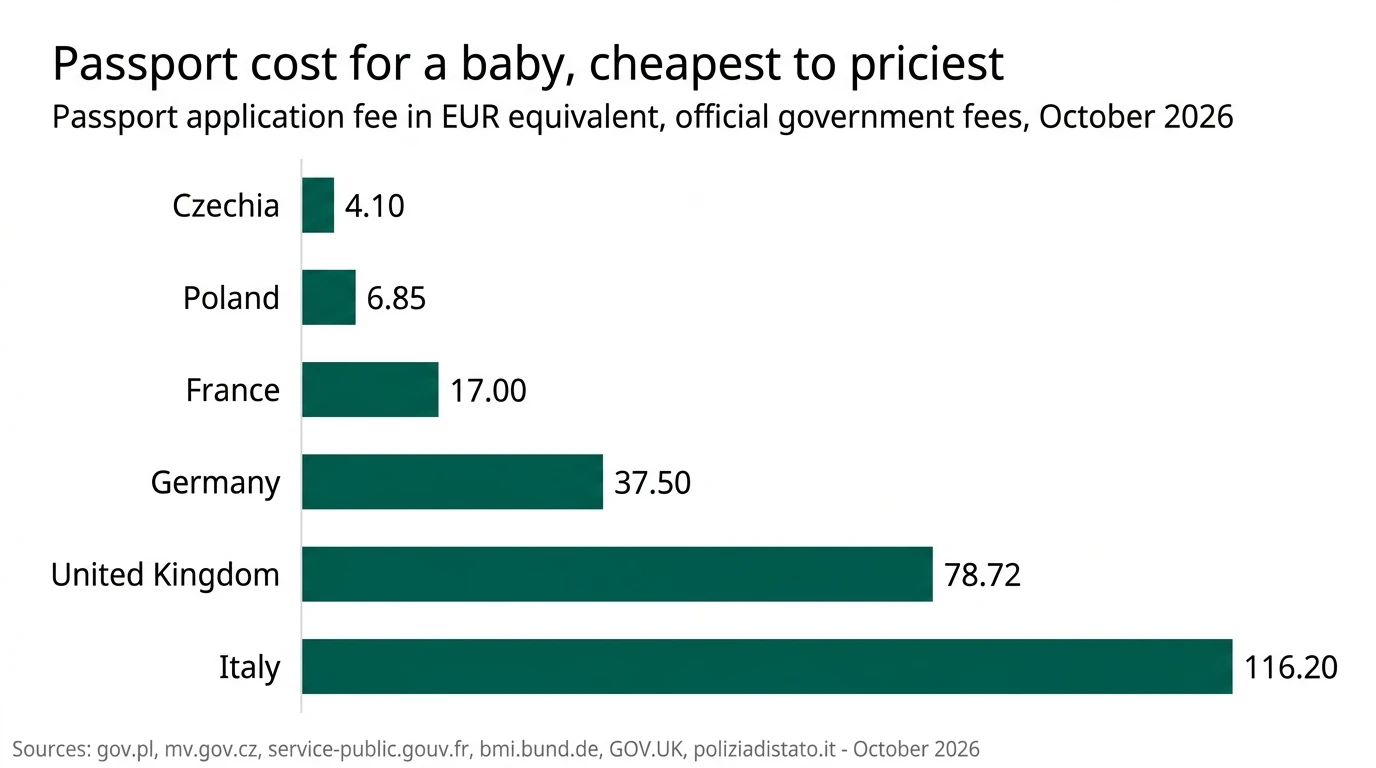
Use this table to find out exactly when babies need passports.
| Country | What a baby can travel on | How long it lasts for a baby | Cost (as of October 2026) | Official source |
|---|---|---|---|---|
| United Kingdom | Passport only (the UK has no ID card) | 5 years | £66.50 (€78.72) online, £80 (€94.70) paper form | GOV.UK |
| Germany | Passport (Reisepass) or ID card (Personalausweis) | 6 years (under 24) | Passport €37.50, ID card €27.60 | bmi.bund.de |
| France | Passport or national ID card (CNI) | Passport 5 years, ID card 10 years | Passport €17 (age 0-14), ID card free | service-public.gouv.fr |
| Spain | Passport or DNI (can be issued from birth) | 2 years under age 5 (both documents) | Passport €30; DNIe fee €12 | interior.gob.es / dnielectronico.es |
| Italy | Passport or electronic ID card (CIE) | 3 years under age 3 (both documents) | Passport €116.20 (€73.50 contribution + €42.70 booklet); CIE fee €16.79 | poliziadistato.it |
| Netherlands | Passport or ID card | 5 years (under 18) | Passport €67.05, ID card €43.20 | rijksoverheid.nl |
| Poland | Passport or ID card (dowód osobisty) | Passport 5 years (under 12); ID card 5 years for under-12s | Passport 30 zł (€6.85), ID card free | gov.pl |
| Czechia | Passport or ID card (občanský průkaz) | 5 years (under 15) | Passport 100 CZK (€4.10); ID card 100 CZK (€4.10) | mv.gov.cz |
Remember, you’re only able to use an EU national ID card to travel to countries where it’s accepted (the EU and Schengen area). It won’t be enough for places like the UK. If you’re travelling to the UK , bring your baby’s passport, or they won’t be allowed to enter.
Because children grow up so quickly, their faces can change quite a bit while their passports are still valid. Spain and Italy address this issue by issuing baby documents valid for only two and three years respectively.
Applying from abroad can also cost more. Many countries charge extra when you apply through an embassy or consulate, so compare your options before deciding where to apply. For a lighter look at the topic, see our guide to passport colours around the world .
How to Get Your Baby’s First Passport or ID Card
Step 1: Register your baby’s birth and apply for a birth certificate. You’ll be asked for both when submitting the application, so the relevant authorities can see who the parents are and where they’re from. In the UK, the parents’ information on the birth certificate is needed for the application.
Step 2: Prepare passport photos that meet the official requirements. One way to take them at home is to photograph your baby’s head from above while they lie on a white blanket. Keep their hands and feet out of the frame, and make sure only their head is visible. According to the UK government, babies under one can keep their eyes closed in passport photos, but the picture must have a plain background.
Step 3: A parent or guardian provides consent. Someone with parental responsibility must sign the application (UK rules), and the child signs too once they’re 12 to 15.
Step 4: File the application at a local office or online. Submit it online or in person. For a UK paper application, you must also provide a countersignatory.
Step 5: Pay the application fees. Pay the relevant fee for your baby’s passport. Use the table above to check the latest application costs.
For a full walkthrough, see the GOV.UK first child passport guide .
How Long a Baby Passport Takes (and When to Apply)
- UK: Usually within three weeks, but delays can happen with a first passport.
- Czechia: You’ll receive your child’s passport within 30 days. If you’re applying from Czechia on a tight schedule, expedited options (24 hours or 5 working days) are available at extra cost.
- Other EU countries: Each country has its own rules, and where you’re from within that country matters. So does the time of year you apply; summer and Christmas can have longer wait times.
- Newborn rules: You can’t submit an application until you register the child’s birth and get a birth certificate. Start the process as soon as they’re born to avoid delays.
Europe’s New 2026 Border Rules and What They Mean for Babies
Since 10 April 2026, the new EES (Entry/Exit System) has been in place for Europe . It applies to non-EU passport holders (including UK and US) arriving for a short stay in the Schengen zone and removes the need for passport stamps. Children under 12 are exempt from the fingerprint scan, but they may be asked for a photo.
Each child will also need an ETIAS (the EU’s official travel authorisation for visa-free travellers) once it launches. ETIAS is not in operation yet, and the EU has not confirmed a start date, so don’t try to apply until it’s officially announced. The parent or guardian can apply and sign on the child’s behalf if they are under 18, and there is no fee for under-18s. For guidance, check the ETIAS rules for applying on behalf of children .
 Inspiration
Essential Travel Guide: Navigating Domestic, International, and Schengen Trips with Confidence
Plan your next trip with ease. Learn the key rules, documents, and tips for smooth domestic, international, and Schengen travel in this complete guide.
Read the guide
Inspiration
Essential Travel Guide: Navigating Domestic, International, and Schengen Trips with Confidence
Plan your next trip with ease. Learn the key rules, documents, and tips for smooth domestic, international, and Schengen travel in this complete guide.
Read the guideHow does this affect UK passport holders? Children from the UK will need a passport issued within the past 10 years, and it must be valid for at least 3 months after they leave the Schengen zone.
For EU citizens and anyone else travelling visa-free to the UK, even though a visa isn’t required, you still have to get a UK ETA, which costs £20 (€23.68) and applies to children too.
How to Book Your Baby’s Flight Before the Passport Arrives
Booking a child’s flight tickets isn’t as hard as you think. Visit Kiwi’s website, choose your route, and enter the number of passengers under 2 or between 2 and 11. You can add one infant per adult, like most carriers. You can also read these tips for finding cheap family flights .
Although you might have booked through Kiwi, note that all airlines have their own rules on baggage, seats and child ages. For example, Ryanair doesn’t accept infants under eight days old on its flights, so keep that in mind. Visit the Kiwi.com Help Centre for further guidance.
Even if you don’t have your child’s passport yet, still book the flights, then go back and add their details. Corrections can be made up to 48 hours before departure, though it depends on the carrier and may involve a fee. That way, you won’t miss out on those cheap airfares you’ve had your eye on.
When booking, confirm that your child’s name on the ticket matches their documents, because if it doesn’t, they may not be able to board. If you need to make changes, read Kiwi.com’s guidance on correcting traveller details .
One more thing to watch out for: during online check-in, adding your kid’s documents can check them in automatically and send the boarding passes right away. So don’t do anything until their passport has been issued.
Should your document arrive late, it’s safer to book a fare that can be changed. The Kiwi.com Guarantee protects covered itineraries against delays and cancellations, but it doesn’t cover missing travel documents.
Flying From the US? The Short Version
- For all international flights, babies in the US must have their own passport. Passport cards won’t be accepted. Passport rules for US domestic flights are different; babies don’t need a passport.
- Got a child under 16? They apply in person using Form DS-11, and it’s best that both parents are present. It costs $100 (€89.36), plus a $35 (€31.28) acceptance fee. It will be valid for five years.
- Expect the processing time to be 4 to 6 weeks, and account for additional postage time.
Plan Your Baby’s First Flight with Kiwi.com
You know the steps by now: get their birth certificate, submit a passport application, review our country table and book flights to family-friendly holiday destinations once you’re good to go.
Kiwi makes it easy to add newborn kids to your itinerary. Start searching and compare prices across Europe’s low-cost carriers. When you’ve settled on a route, book the cheap flights , and you can always go back later and update your child’s passport details when you have them.
Find flights for this trip
Baby Passport FAQs
Can my baby travel abroad with only one parent?
It comes down to the policy in your destination country. EU nations have their own rules for one parent travelling with a child. Some may require prior authorisation, while others may not want to see it at all.
For the most up-to-date information, review the rules for departing and arriving in the countries you’ll be visiting and, as an extra precaution, carry the birth certificate with both parents’ details on it.
Do babies fly free in Europe?
Not entirely free, but usually lap infants (under the age of two) pay what is called an ‘infant’ fee, which is a reduced price rather than a full seat. The actual cost differs between airlines, so it’s important to compare all the available options to find the best fit for your plans.
Can a baby fly within the UK without a passport?
Legally, you don’t need a passport to board a domestic flight in the UK, but airlines also have their own policies for travel documents. For instance, British Airways says anyone under 16 doesn’t need to show ID for domestic flights, but the adult travelling with the child must have valid ID and provide proof of the child’s identity.
Never assume it’s okay just to board; confirm the details with the airline before deciding.
Does my baby need a new passport as their face changes?
Your baby’s document will remain valid until the expiry date listed on it; however, at border control, they still have to be able to verify who the child is.
The validity periods for young children are listed in our country table above, so you can use it as a reference and check back before the passport expires if you think your child’s appearance has changed significantly.
Does my baby need a visa too?
If an adult with your child’s nationality needs a visa to enter the country you’re visiting, your child will have to obtain one as well.
Always follow the official passport requirements, rather than the child’s age. The good news is that kids’ visa fees are often lower than adults’, so you may end up paying less.
Ahead of your trip, check the country’s official immigration website to learn more about visa fees and entry policies.
What if the passport doesn’t arrive in time?
It depends on where you’re from. UK citizens can use the 1-week Fast Track service to get a passport delivered within a week of their appointment, provided their application is approved.
EU citizens should check with their country’s local passport office, as the rules vary widely. In Germany, for example, an express passport is usually ready on the third working day after ordering, and a temporary passport can be issued on the spot.
If you don’t get yours in time, the next best option is to change your flights rather than arriving at immigration without anything.