







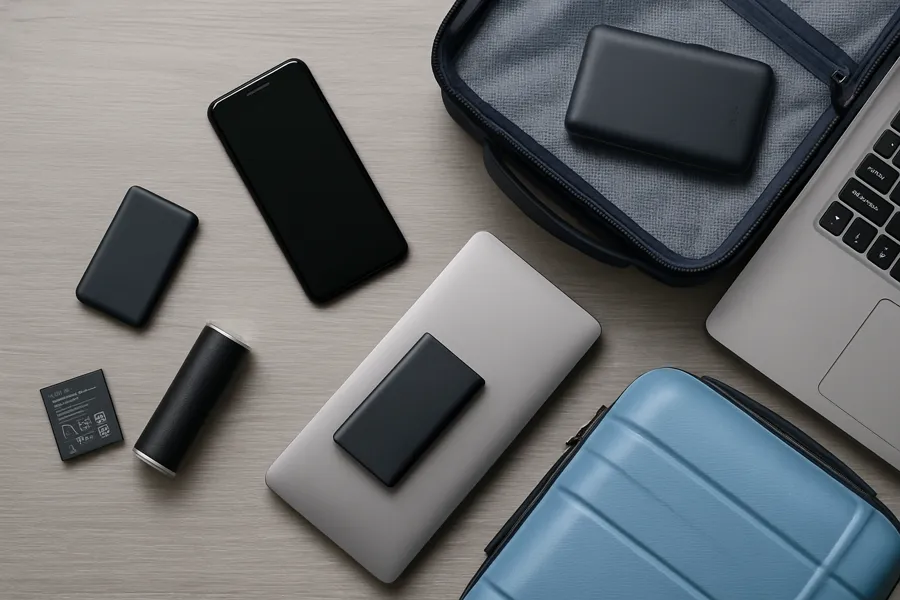
Lithium-ion batteries are regulated on flights due to fire risk from overheating or short-circuiting. Batteries up to 100 Wh are allowed in carry-on bags; those between 101–160 Wh need airline approval, and anything above 160 Wh must go as cargo. Lufthansa and KLM ban batteries over 160 Wh entirely, and damaged or recalled units are prohibited. Always check watt-hour ratings and battery condition before flying.
You calculate the watt-hour (Wh) level of your batteries by multiplying the battery’s voltage (V) by its amperage (Ah). For example, a 12-volt battery with an 8 Ah rating has 12 x 8 = 96 Wh. For milliamp hours (mAh), divide by 1000 to get Ah, then multiply by voltage.
To find the voltage and amperage of your laptop or smartphone battery, you can check the device itself or its charger. Some laptops have a label on the bottom or side indicating the voltage and amperage required. You can also find this information by looking up your laptop’s or smartphone’s device’s specifications online.
The Restrictions
According to Watt-hours (Wh)
Up to 100 Wh
These batteries are permitted in carry-on baggage without requiring special approval.
101-160 Wh
Batteries in this range require airline approval, are limited to two per passenger, and must be carried in carry-on baggage. Contact your airline well before your flight to ask for approval.
Over 160 Wh
Batteries exceeding 160Wh are typically forbidden in passenger baggage. They may be transported as cargo, but require separate handling and approval.
Battery Protection
Batteries should always be protected from short circuits. This can be done by keeping them in their original packaging, covering terminals with non-metallic tape, or using a battery case.
| Watt-Hour (Wh) | Allowed? | Airline Approval Needed? | Carry-On | Checked Bag | Notes |
|---|---|---|---|---|---|
| 0 – 100 Wh | ✅ Yes | ❌ No | ✅ Yes | ✅ Yes (if installed) | Must be protected |
| 101 – 160 Wh | ✅ Yes | ✅ Yes | ✅ Yes | ❌ No | Max 2 per passenger |
| >160 Wh | ❌ No (onboard) | ✅ Yes (for cargo) | ❌ No | ❌ No | Cargo only with approval |
Lithium Metal Batteries
All airlines restrict the lithium content of lithium metal batteries to 2 grams per battery.
Damaged Batteries
Batteries that show signs of damage are not allowed on board.
Spare Batteries
Spare batteries, including power banks, must be carried in carry-on baggage. Delta Airlines urges passengers to keep spare batteries in the original retail packaging to prevent unintentional activation or short-circuiting. If original packaging is not available, you should insulate the battery terminals by isolating spare batteries from contact with other batteries and/or metal.
Installed Batteries
Lithium batteries installed in devices like laptops or phones are subject to different regulations that are based on their type (lithium-ion or other) and watt-hour (Wh) rating . Generally, batteries installed in devices such as laptops or phones are allowed in both carry-on and checked baggage, provided they are fully powered off and protected from accidental activation. However, spare uninstalled batteries must usually be carried in carry-on baggage.
E-cigarettes, e-cigars, e-pipes and other inhalers with integrated batteries
They are not permitted in checked baggage but are permitted in or as carry-on baggage in the cabin.
Non-spillable Batteries
Non-spillable batteries, either sealed lead-acid (SLA) or valve-regulated lead-acid (VRLA) batteries, are designed to prevent the leakage of electrolyte, even when the battery is damaged. Their primary advantage is the reduced risk of electrolyte leakage, which can be corrosive and harmful. They can be used in a wide range of applications, including those in which the battery might be subjected to vibrations.
Most airlines allow a maximum of two spare non-spillable batteries in carry-on baggage if they are 12 volts or less and 100 watt-hours or less. The battery terminals must be protected with non-conductive caps or tape to prevent short circuits.
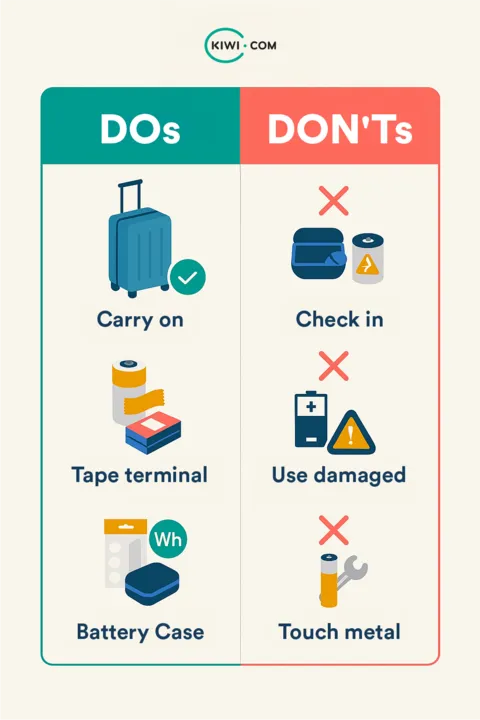
Follow these simple dos and don’ts to pack your batteries safely and comply with airline regulations © Kiwi.com
Devices With Batteries Stronger Than 100 Wh
Digital devices that often use batteries stronger than 100 Wh include some larger laptop batteries, professional audio/visual equipment, and some specialized medical devices. In addition, many electric vehicles and larger power tools may also utilize batteries exceeding this capacity. These are generally banned. Some airlines may allow them, but only as cargo and with airline permission.
Laptop Batteries
Extended-life laptop batteries, which are often aftermarket replacements, can exceed 100 Wh in order to provide extended usage times.
Professional Audio/Visual Equipment
Specialized equipment such as high-end cameras or lighting systems used in professional settings may require batteries larger than 100 Wh.
Electric Vehicles
Electric vehicles, including cars, scooters, and ebikes, often have battery packs with capacities far exceeding 100 Wh. They will usually require permission from the airline.
Power Tools
Some larger power tools, such as high-powered drills or saws, may utilize batteries with capacities greater than 100 Wh.
Medical Devices
Certain portable medical devices, particularly those that are used in emergency situations, such as defibrillators, may require batteries above 100 Wh to ensure reliable operation. Again, if you’re traveling with such equipment, ask your airline for permission and where they will be stored.
Power Banks
While many portable power banks are designed to be under 100Wh for airline regulations, some larger, high-capacity power banks can exceed this limit, especially those intended for powering larger devices or multiple devices simultaneously.
Other Equipment/Devices
Various other digital devices, such as high-end drones, robotics, or scientific instruments, may also utilize batteries exceeding 100 Wh for their specific power requirements.
Smart Bags
Smart bags are a recent innovation. Therefore, there are no industry-wide restrictions for these pieces of luggage yet. The original intent behind the development of smart bags was to offer GPS tracking to ensure that no luggage would be lost. But soon they came with additional digital features, such as USB charging, remote locking, and more. Some even have the ability to weigh themselves to ensure that travelers are compliant with airline weight restrictions.
To power all these features, smart bags come with lithium-ion batteries, which can pose a fire hazard if damaged or exposed to extreme temperatures in the cargo hold. Of course, this poses a worrying risk on planes, one that was addressed several years ago when the Samsung Galaxy Note 7 was banned from airlines because its batteries had a high risk of overheating and catching fire. If you’re still using that smartphone model, leave it at home.
Restrictions on Smart Bags
Several airlines are now restricting smart bags or banning them altogether. Others allow them on, so long as the battery is removed and stored with carry-on luggage. Unfortunately, some smart bags don’t easily allow their batteries to come out, which means that some travelers were forced to use screwdrivers to save their holiday. Other airlines allow passengers to bring smart bags onboard as a carry-on so long as the battery is turned off, and some still allow smart bags to be brought aboard without any special requirements.
Lufthansa , for example, allows smart bags with removable batteries up to 100 Wh to be taken into the cabin, but does not permit it to travel as check-in baggage. Permission must be granted by the airline if the Wh exceeds 100. Smart bags with non-removable batteries are allowed as carry-on or as checked baggage if the battery power output does not exceed 2.7 Wh. If the non-removable battery exceeds that level, the bag is banned. If you plan on traveling with a smart bag, contact your airline.
| Smart Bag Type | Carry-On | Checked Baggage | Conditions |
|---|---|---|---|
| Removable battery ≤100 Wh | ✅ Yes | ❌ No | Battery must be removed & in carry-on |
| Removable battery >100 Wh | ✅ Maybe | ❌ No | Airline permission required |
| Non-removable battery ≤2.7 Wh | ✅ Yes | ✅ Yes | Must be OFF |
| Non-removable battery >2.7 Wh | ❌ No | ❌ No | Banned by most airlines |
Some Specific Airline Restrictions
The Dutch carrier KLM , for example, allow passengers to bring aboard 15 electronic devices with a lithium battery up to 100 Wh, and 20 spare lithium batteries or power banks up to 100 Wh. Permission must be requested for bringing lithium batteries up to 160 Wh into the aircraft’s cabin, either in a device or as a spare. Batteries larger than 160 Wh are banned. Devices and batteries should not be damaged, defective, or recalled.
The airline also prohibits the placing of power banks in the overhead compartments. They must always remain under passenger supervision and quickly accessible at all times. Using and recharging power banks on board is prohibited. KLM has no restrictions on smart bags with removable batteries, but bans those with batteries that cannot be removed.
Interestingly, KLM has country-specific restrictions on batteries and devices. For example, it is forbidden to bring e-cigarettes, e-cigars, e-pipes and other personal vaporizers into India and it is also forbidden to bring pagers and walkie-talkies into Dubai airport, even for a stopover.
Battery Travel Questions – What You Need to Know Before You Fly
Why do airlines place restrictions on portable batteries?
Airlines restrict lithium-ion batteries because they can overheat, short-circuit, and cause fires—especially if damaged or defective. All airlines, for example, ban the Samsung Galaxy Note 7 due to fire risk. While general rules apply, specific restrictions vary by airline and battery type. Travelers should check their airline’s battery policy before flying to avoid delays or confiscation.
What determines the restrictions placed on the batteries?
Restrictions on portable batteries with lithium-ion or lithium metal cells are based on their watt-hour (Wh) rating. Batteries up to 100 Wh are allowed in carry-on baggage, while those between 101 and 160 Wh require airline approval and are limited to two per passenger. Batteries exceeding 160 Wh are generally prohibited. Travelers should determine the Wh rating of their batteries before flying.
What is a watt-hour and how is it determined?
The watt-hour rating determines the power output of the battery. It is calculated by multiplying the battery’s voltage (V) by its amperage (Ah). For example, a 12-volt battery with an 8 Ah rating has 12 x 8 = 96 Wh.
How can I find out the voltage and amperage of my laptop or smartphone’s batteries?
Check the device itself or, more often, its charger. You can also find this information by looking up your device’s specifications online. Some laptops have a label on the bottom or side indicating the voltage and amperage required.
Can I bring spare batteries aboard?
Yes, but only in your carry-on bag, and they must be protected from short circuits, either in original packaging, individual cases, or with taped terminals. British Airways limits you to four spare batteries or power banks, while others like Lufthansa allow only two. Always check your airline’s limit and pack spares safely to prevent incidents or delays at security.
What batteries or devices are banned from airlines?
Airlines ban any damaged or recalled lithium batteries, as they pose a serious fire risk. Devices like the Samsung Galaxy Note 7 are prohibited on all flights due to their history of battery fires. Most airlines also ban smart luggage with non-removable batteries. For example, American Airlines allows smart bags in carry-on baggage only if the battery is removable and carried separately, but does not allow them in checked luggage. Always check your device’s battery status and airline rules before you travel.