



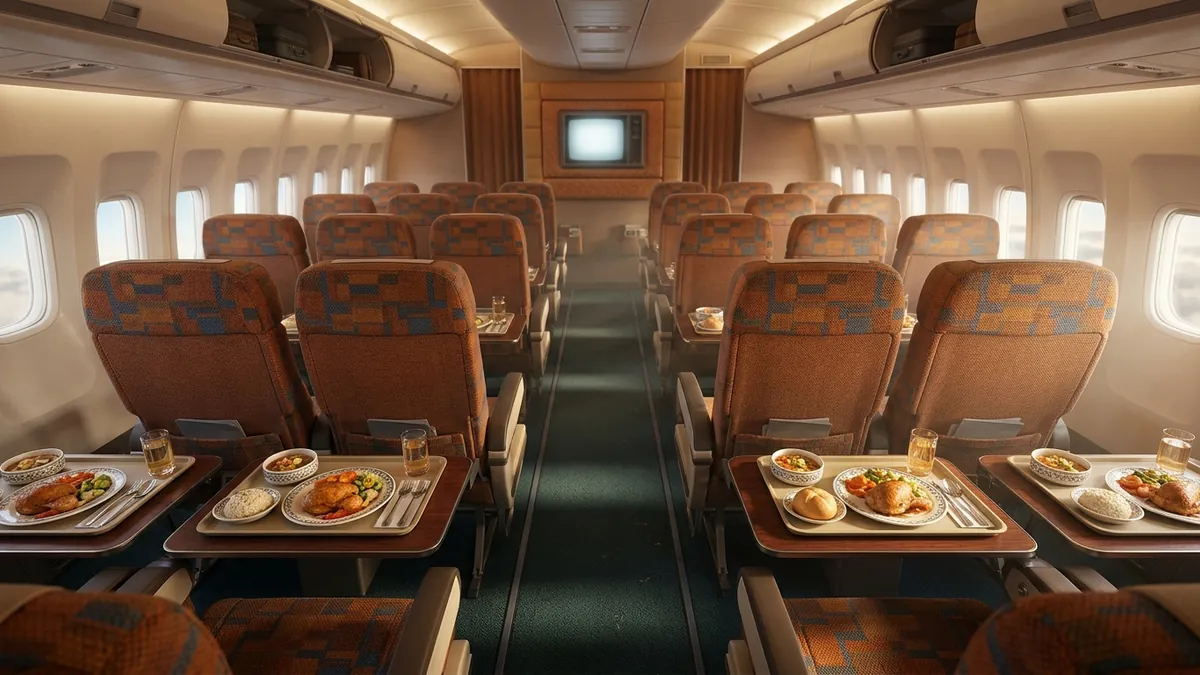
Economy class in 1986 reclined further and fed you better. Its pricing logic was something else entirely. To see how far the seat has travelled, it helps to see what it replaced. The comparison is not flattering in either direction.
In this article
In the 1980s, an economy seat came with 33 to 35 inches of pitch. On most full-service airlines today, the same seat gives you 30 to 31. That is the size of the trade in one line, and the rest of this piece is the detail behind it: how far the seat went back, what came free on the tray, and what the fare did to a month’s pay.
Key takeaways
Economy seats were bigger. In the 1980s economy pitch measured 33 to 35 inches; on most full-service airlines today it is 30 to 31.
The cutlery was real. Economy meals came with metal cutlery on reused crockery, and in 1987 one US carrier saved $40,000 a year by removing a single olive from each salad.
You could smoke on board. Smoking sections existed in economy in 1986. US airlines banned smoking on flights under two hours in 1988, under six hours in 1990, and on all flights in 2000.
The seats reclined further. Air France economy seats reclined to 126 degrees in the 1980s; the same seats today reach about 118 degrees.
The seat: more pitch, more recline
Start with the numbers, because they settle the nostalgia argument faster than any adjective. Economy pitch in the 1980s - the distance from your seat back to the one in front - ran 33 to 35 inches. Seat width held near 18 inches. Recline travel, how far the seat back actually moves, was 5 to 6 inches. On most full-service airlines today, pitch is 30 to 31 inches, width has narrowed to 16.5 to 17, and recline travel is down to 2 to 3 inches. On budget carriers, pitch reaches 28 inches. Every dimension of the chair moved in one direction.
Recline angle tells the same story from a different end. Air France’s economy seats in the 1980s reclined to 126 degrees; the airline’s economy seats today stop at about 118 degrees. Those figures are specific to Air France, but the gap is typical of the era: the seat back simply went further before the low-cost squeeze.
There was one place where even 1986 had already given up. The 747’s upper-deck lounges, which seated about 15 passengers in armchairs, had been converted by the mid-1980s: the same floor space carried 40 seats instead. The lounge was the first casualty of the arithmetic that later reached the whole cabin.
| Seat dimension | In the 1980s | Today (most full-service airlines) |
|---|---|---|
| Pitch | 33-35 in | 30-31 in |
| Width | ~18 in | 16.5-17 in |
| Recline travel | 5-6 in | 2-3 in |
| Air France recline angle | 126° | 118° |
The service: hot meals, metal cutlery, free drinks
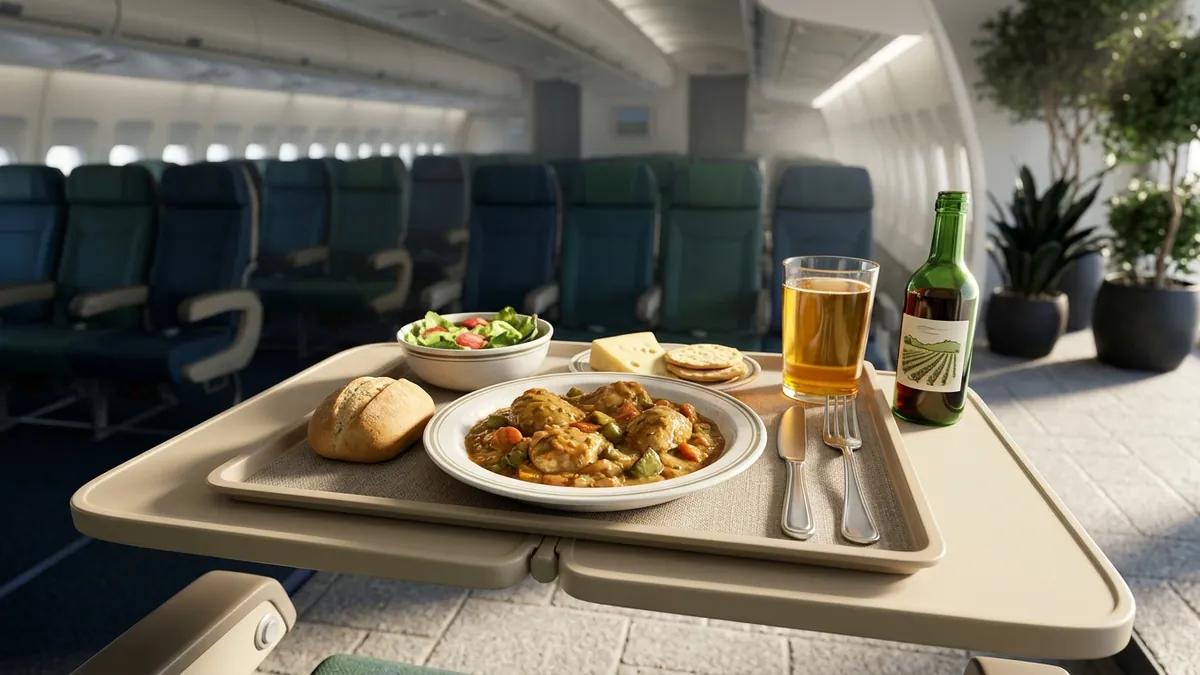
The seat was only half of it. On nearly all daytime flights in 1986, including hops as short as Paris to Rome, economy passengers got a hot meal. It arrived on reused crockery with metal cutlery. Disposable trays were already spreading through the industry, but in 1986 the standard economy service still looked like a restaurant’s idea of a lunch, not a vending machine’s.
Drinks were part of the fare. Alcohol was free as standard in economy, US domestic flights included. On long-haul routes, wine and champagne came as quarter bottles. Entertainment completed the picture: one film on a central screen that the whole cabin watched together, plus roughly a dozen music channels. The headphones were pneumatic, and they hissed unless you squeezed the tube.
The scale of what was free becomes clear from what it cost the airlines to keep it. In 1987, one US carrier famously saved $40,000 a year by removing a single olive from every salad in its lounge service. Note the date: the olive story is 1987, not 1986. Itemised cost-cutting of the kind that defines economy service today started while the free meals were still on the tray.

What it cost: the salary math
Here is the part the nostalgia leaves out. Fares were regulated, and regulation worked in the airlines’ favour. The cheapest tickets had high floors, and the rules stacked on top: a Saturday-night stay requirement on many discounted fares, plus minimum-stay rules and age-restricted discounts (under 26 or over 60). You could not shop your way around them the way you can now.
The honest way to state the cost is as a share of income, not a figure in pounds: no verified 1986 fare for a specific route survives in a checkable source, so this piece will not print one. Relative to income, golden-age-era flying cost four to five times today’s fares. A ticket could take up to 5 percent of an annual salary; the equivalent purchase today sits below 1 percent. The comparison covers the era rather than the year 1986 specifically, and it reframes everything above: 1986 economy gave you more seat and worse everything else, and “worse” includes the price.
The direction of travel since then has been one long unpacking of the fare. Checked bags flew free on US carriers until 2008; today they cost $35 to $50 each way (US airlines, charged in dollars). The 1987 olive was the small start; the bag fee was the arrival.
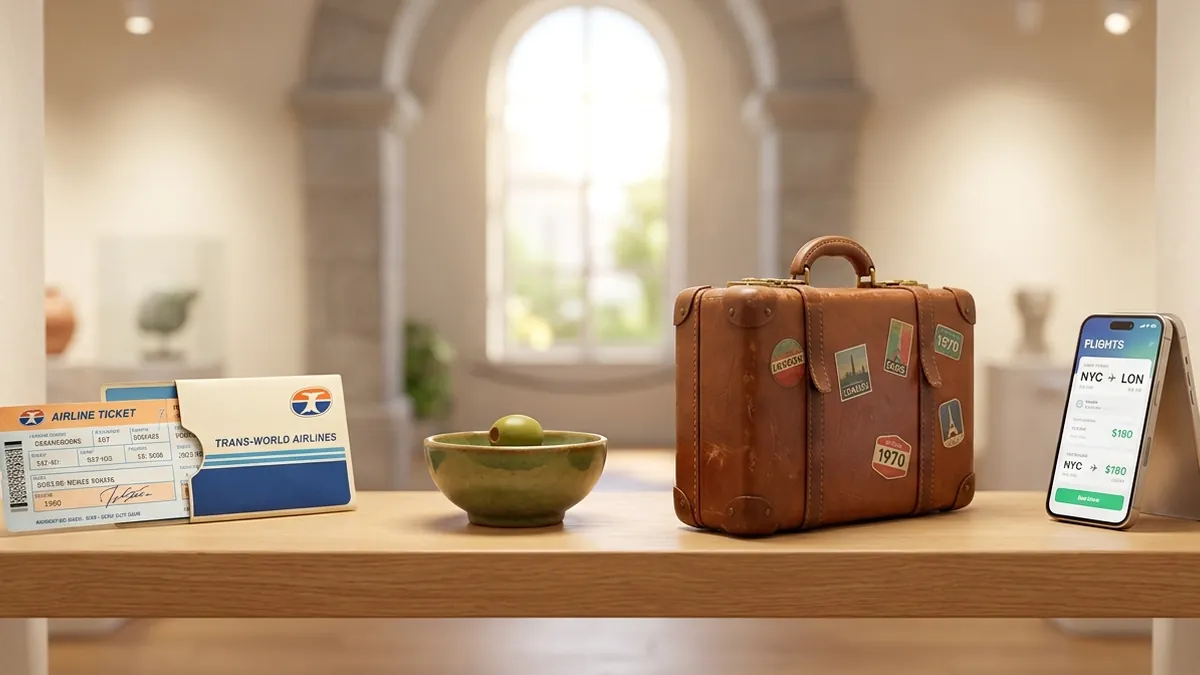
So was it actually better? If “better” means the chair and the lunch, yes: by the inches above. If it means what the ticket did to your monthly budget, no: by a factor your grandparents would not have called a bargain. The fair verdict is the uncomfortable one: the old economy was generous with everything except your money.
What stayed free the longest
Not every perk died with the decade. Each entry below is ranked by how long it survived after 1986, with the catch that kept it from being a pure win.
 Travel hacks
Round Trip vs One-Way Flights: Which Is Cheaper in Europe?
Round trip vs one-way flights in Europe: see real prices on three routes, when a return ticket is cheaper, and when two one-ways win.
Read the guide
1. Checked baggage - free until 2008. The longest holdout by two decades: US carriers included checked bags in the fare until 2008. The downside for the comparison: that is a US record, and European budget carriers had already been charging for bags for years before the Americans joined in.
2. Hot meals - faded through the 1990s. Full-service airlines kept meal service on long-haul into the 2000s, but disposables replaced the crockery and cutlery through the late 1980s and 1990s, and short-haul economy moved to buy-on-board. The meal survived; the restaurant did not.
3. Free alcohol - still alive on long-haul. Major full-service carriers still pour free wine with long-haul economy meals, which makes it the only 1986 perk you can order today. The catch is who gets it: on short-haul and budget services, the free drink vanished entirely.
4. The wide seat - gone by degrees. Pitch narrowed gradually rather than in one cut, which is why nobody remembers the year they lost the room. Four to five inches of pitch have disappeared since the 1980s without a single announcement.
5. Smoking - banned in stages. The shortest survival of all, and the one improvement on the list. US airlines banned smoking on domestic flights under two hours in 1988, extended it to flights under six hours in 1990, and banned it on all flights in 2000. The smoking section at the back of the 1986 cabin is the detail nostalgia edits out first, and the one your lungs miss least.
Flying today: what £15 buys
The comparison above is history, but the price half of it is live. The regulated fares and minimum-stay rules are gone, and the numbers on today’s routes make the salary math concrete from your own city. Flights from London to Dublin start at £17 one way, and Manchester to Dublin at £15 (Kiwi.com, checked 10 November 2026). Edinburgh to Madrid starts at £15 and London to Tenerife at £60, with Birmingham to Dublin at £36. Those are starting fares without hold bags or seat selection, and they move day to day - but a weekend in Dublin for less than the cost of the 1986 salad service is the trade the last forty years actually made.
Whether a return or two one-ways works out cheaper on a route like this depends on the airline: budget carriers price each leg on its own, while full-service carriers often package the return, so it is worth checking both before you book. And if you are browsing rather than committing, the whole cheap flights index shows starting fares from your city in one place.
The old seat was better. The old price was not. What today’s economy lost in inches it made back in access, and that, more than the cutlery, is the real story of the last forty years.
Find flights for this trip
FAQ
Was smoking really allowed in economy in 1986?
Yes. Smoking sections existed across economy cabins in 1986; US regulators had mandated separate sections since 1973. The US bans came in stages: domestic flights under two hours in 1988, flights under six hours in 1990, then all flights in 2000. Other countries followed on similar timelines, and by the early 2000s, smoking flights had effectively disappeared.
How much smaller are economy seats now than in the 1980s?
In the 1980s, economy pitch ran 33 to 35 inches with seat width near 18 inches; today, most full-service airlines give you 30 to 31 inches of pitch and 16.5 to 17 inches of width, and budget carriers go down to 28 inches of pitch. Recline travel has roughly halved, from 5 to 6 inches to 2 to 3. The change came gradually, which is why no one remembers losing it.
Did economy food in 1986 cost extra?
No. A hot meal was included on nearly all daytime flights, including short European hops such as Paris to Rome, served on reused crockery with metal cutlery. Alcohol was free too, including on US domestic flights, with quarter bottles of wine and champagne on long-haul. The cost was built into the regulated fare, which was far higher than today’s.
Was flying in 1986 actually more expensive?
Yes, relative to income. In the golden-age era, a ticket could take up to 5 percent of an annual salary, against below 1 percent for the equivalent purchase today, and fares cost four to five times more relative to income. That comparison covers the era rather than 1986 specifically, since no verified 1986 fare figure survives in a checkable source. The cheaper seat and the cheaper ticket have never existed at the same time.
Do any airlines still serve free alcohol in economy?
Some do. Several full-service carriers still include free wine and beer with long-haul economy meals, making it the longest-surviving 1986 perk on the list. On short-haul and budget services, it has disappeared completely, along with the included meal.