






You arrive and immediately think:
- Why does everything look haunted but expensive?
- Why is there a castle just casually on a rock?
- Why is the wind attacking me specifically?
This is not a beach city. This is a cloak-and-dagger-with-a-coffee city.
Let’s go.
From Airport to City: Your First Scottish Wind Slap
Edinburgh Airport is efficient, compact, and immediately colder than your personality.
Tram (the sensible choice)
£6–7 • 30 minutes Smooth, direct, reliable. Drops you right into the city centre like a well-organised adult.
Bus (Airlink 100)
£5–6 • 25–35 minutes Cheaper, frequent, deeply backpacker-approved.
Taxi / Uber
£20–30 • 25 minutes Use if you’re tired or emotionally fragile.
Walking? No. Respect yourself.
Getting Around Without Twisting an Ankle
Edinburgh is compact but aggressively vertical. It is not flat. It is never flat. It was built by people who said, “Leg day builds character.”
Walking is the main event. The Old Town and New Town are both easily explored on foot. Just prepare for: steep hills, unexpected staircases, cobblestones designed to humble you.
Buses are cheap (£1.80–2 per ride), frequent, and surprisingly pleasant. You tap your card like a civilised person and continue uphill.
Budget Bliss: Edinburgh Is Expensive, But the Drama Is Free
Yes, Scotland costs money. But the views? Free. The atmosphere? Free. The feeling that you’re in a gothic novel? Free.
Let’s explore.
Edinburgh Castle (Look at It, Don’t Mortgage Yourself for It)
The castle doesn’t merely sit on the skyline, it dominates it. Perched on an ancient volcanic rock like it won a centuries-long staring contest with gravity, it watches over the city with deeply judgmental energy. Every street seems to angle toward it eventually. You can’t ignore it. It knows.
Walking up to the esplanade is free, and honestly, half the experience. The incline builds anticipation, the wind intensifies for dramatic effect, and suddenly you’re standing in front of thick stone walls thinking, “Yes. This feels historically expensive.”
Going inside will cost you £18–20, and what you get is crown jewels, military history, and panoramic views that make you feel like a medieval monarch surveying your kingdom. It’s worth it if you love castles. If you’re budget-minded, though, simply circling it, photographing it from Princes Street Gardens, or watching it glow at sunset delivers most of the cinematic payoff without the ticket price. The wind, once again, provides free immersion.
The Royal Mile (Touristy, Yes. Iconic, Also Yes.)
The Royal Mile is chaotic theatre disguised as a street. Yes, there are tartan shops aggressively selling clan pride you may or may not possess. Yes, shortbread appears in decorative tins that cost more than you emotionally prepared for. Yes, someone will attempt to sell you whisky before lunch.
But it’s also cobbled, atmospheric, and alive. Street performers rotate through bagpipes, fire tricks, and slightly questionable magic. The buildings lean in close, layered with centuries of stories that feel almost tangible.
The real magic is in the closes: the narrow alleyways branching off the main road. Slip into one and everything changes. The noise drops. The light shifts. You suddenly feel like you’ve entered a secret level of the city. Wander slowly. Read plaques. Pretend you’re being followed by a ghost named Agnes. It’s immersive in a way few cities manage.
Arthur’s Seat (The Free Main Character Moment)
Arthur’s Seat is less “walk” and more “character arc.” It rises out of Holyrood Park like a gentle challenge. The climb takes anywhere from 30 to 60 minutes depending on your fitness, footwear, and tolerance for wind that feels personal.
At some point on the ascent, you will question your cardio choices. The wind will absolutely attempt to rearrange your hairstyle into something medieval. But when you reach the top and see the entire city laid out below — castle, sea, rooftops, distant hills — the effort dissolves.
It’s free. It’s windy. It’s dramatic. And it makes you feel like the protagonist in a historical epic who has just realised their destiny.
Calton Hill (Arthur’s Seat for People Who Hate Arthur’s Seat)
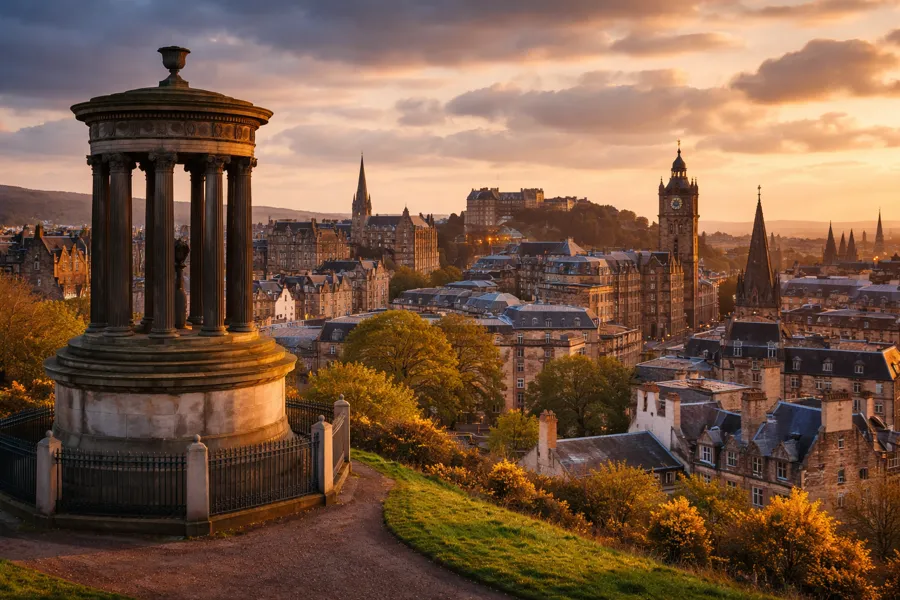
If Arthur’s Seat feels like commitment, Calton Hill is the low-effort alternative. The climb takes minutes, not negotiations with your lungs. At the top, you’re greeted by neoclassical monuments that make Edinburgh look like it briefly tried to become Athens.
The unfinished National Monument adds a charming “we meant well” energy, and the views across the city are still elite. At sunset, the skyline softens into gold and shadow, and everything feels painterly. It’s the perfect option for those who want the drama without the sweat.
Dean Village (Accidentally Wholesome)
Five minutes from the city centre and suddenly you’re in a riverside pocket of calm that feels almost suspicious. The buildings are charming, the Water of Leith moves gently past old stone walls, and the city noise fades into background hum.
It’s small. It’s quiet. It feels like a film location where someone in a wool coat would walk thoughtfully with a book under their arm. There are no crowds, no chaos, no bagpipes in sight. Just soft water sounds and a reminder that Edinburgh isn’t only dramatic. It can be gentle too.
Free therapy. No appointment needed.
Eating Your Feelings (The Scottish Way)
Scottish food is not delicate. It is not light. It is not interested in being photographed at flattering angles. It is hearty, unapologetic, and clearly designed by people who looked at the North Sea and said, “We will need calories.”
This is food built for wind. For stone cities. For long walks uphill. For surviving winter and then celebrating the fact that you did.
Haggis (Trust the Process)
Yes, you’ve heard the rumours. Yes, you’ve googled it. Yes, you may still feel mildly nervous.
But here’s the truth: haggis is delicious.
It’s rich, savoury, warmly spiced, and deeply comforting — like a peppery, meaty crumble that accidentally became iconic. Served traditionally with neeps (turnips) and tatties (potatoes), it’s soft, hearty, and surprisingly balanced.
You’ll find it in pubs for £8–12, often with a whisky sauce that gently convinces you this was a wise life choice. You can also try it in a haggis roll for a cheaper, less ceremonious introduction.
You will survive. You may even become smug about it.
Fish & Chips (Wind-Resistant Cuisine)
Fish and chips in Edinburgh taste better because of the weather. Something about cold air, grey skies, and salty breeze makes the golden batter hit harder.
Expect flaky white fish, crispy coating, thick chips, and salt applied with confidence. It’ll cost around £8–12 depending on location. And yes, you should absolutely eat it near the water or in a park.
Just know this: gulls are organised. They are not scared of you. Maintain situational awareness at all times.
Scottish Breakfast (Commitment Required)
A Scottish breakfast is not a suggestion. It is a declaration.
Eggs, sausage, bacon, black pudding, baked beans, grilled tomato, mushrooms, and the unsung hero — the tattie scone. It arrives heavy. It stays heavy. It fuels you for hills, castles, and possibly emotional growth.
Is it excessive? Yes. Is it necessary on at least one morning? Also yes.
Afterwards, you will walk slower. This is part of the design.
Bakeries & Scones (Softness in a Hard Landscape)
Among all the stone and wind, Scottish bakeries feel like small pockets of warmth. Scones (plain or fruit-filled) served with jam and cream, are affordable (£2–4) and deeply comforting. Pair with tea and suddenly everything feels manageable.
You’ll also find traybakes, empire biscuits, shortbread that crumbles dramatically, and pastries that taste like they were designed specifically for rainy afternoons.
It’s not flashy food. It’s reassuring food. And in Edinburgh, that’s exactly right.
Big Nights, Small Prices (Scottish Edition)
Edinburgh nightlife isn’t neon chaos or mega-club mayhem. It’s pub energy. It’s storytelling energy. It’s “one more pint” energy that somehow becomes four. The city does cosy extremely well — with occasional bursts of dramatic chaos when someone starts singing.
Traditional Pubs
This is where Edinburgh shines after dark. Think wood panelling dark enough to absorb secrets, low ceilings that force intimacy, and fireplaces that make you briefly consider moving here permanently.
Pints sit around £4–6 depending on where you are, which feels reasonable given the atmosphere is doing most of the work. Order something local. Sit near the bar. Listen to conversations that range from football to philosophy to very strong opinions about weather.
The vibe isn’t flashy. It’s warm, layered, and deeply Scottish. You’ll leave slightly happier than you arrived.
Grassmarket
Grassmarket is historic drama turned nightlife hub. It sits beneath the castle, which looms overhead like it’s supervising your decisions.
By day, it’s charming and photogenic. By night, it shifts into lively mode. Pubs spill onto the street, groups gather outside, laughter gets louder. It’s energetic without tipping into full club trauma. Just perfect if you want buzz but still want to hear yourself think.
Bonus: looking up at the castle at night from here feels unfairly cinematic.
Live Folk Music
Some pubs host free folk sessions. No stage, no big announcement, just musicians quietly assembling with fiddles, guitars, maybe a bodhrán. Then suddenly, music fills the room.
It’s intimate. It’s slightly chaotic. Someone sings in a voice that feels older than the building. You weren’t planning to feel emotional, but here we are.
No ticket needed. Just show up, order a drink, and let it happen.
Off-the-Map Edinburgh (For Moody Main Character Energy)
When you step away from the busiest streets, Edinburgh shifts tone. It softens. It gets cinematic.
Circus Lane
Tucked away in the New Town, Circus Lane looks like a film set that forgot to pack up. Perfectly arranged houses, climbing plants, soft light bouncing off stone. It’s absurdly pretty.
You’ll question whether it’s real. It is. And it’s one of those places where you instinctively lower your voice for no reason.
The Water of Leith Walkway
This riverside path winds quietly through parts of the city most tourists miss. It’s green, calm, and refreshingly unbothered.
You can walk for miles along it, passing under bridges, beside old buildings, through pockets of unexpected woodland. It feels like discovering a secret Edinburgh, one that isn’t posing for photos.
Peaceful. Slightly poetic. Deeply underrated.
Greyfriars Kirkyard
Yes, it’s a graveyard. Yes, it’s stunning. Yes, it helped inspire parts of Harry Potter (names included). But beyond the trivia, it’s genuinely atmospheric.
Old stones lean at angles. Moss settles into carvings. The city noise fades into a low hum. It’s moody without being gloomy. A reminder that Edinburgh wears its history openly.
And like so much of the city’s best atmosphere, it’s free.
Travel Hacks: Edinburgh Edition
Bring layers. The weather lies.
Wear good shoes. Cobblestones show no mercy.
Book festival tickets early (August is chaos season).
Supermarkets > tourist shops.
Say “cheers” confidently.
How Expensive Is Edinburgh?
Coffee: £3–4 Meal: £10–15 Pint: £4–6 Hostel: £20–30 Hotel: £80–150
It’s not cheap. But it’s cinematic.
After Edinburgh
You’ll leave slightly wind-burned, emotionally attached to stone buildings, and convinced you could survive in a medieval novel.
Edinburgh doesn’t try to impress you. It just stands there dramatically until you fall in love.
And you will.
Popular routes on Kiwi.com
- Cheap flights from London to Barcelona
- Cheap flights from London to New York
- Cheap flights from London to Asturias
- Cheap flights from London to Pattaya
- Cheap flights from London
- Cheap flights to Spain
- Cheap flights to Italy
- Cheap flights to Thailand
- Cheap flights to the United States
- Cheap flights to the United Kingdom
- Cheap flights from London Luton Airport
- Last minute flights
People Also Read



How to Travel Patagonia: A First-Timer's Guide to Chile & Argentina's Wild South