




If you’re a pet owner thinking about traveling with a dog or cat on a plane to Asia, you’ve come to the right place!
In this article
Unlike traveling with a dog to Europe , where many countries share import policies for pets, flying with animals to Asia can be a little more complex, as each country has its own specific requirements and regulations.
We’re hoping we can make your trip to Asia as fuss-free as possible with our detailed travel guide, where we’ll fill you in on Asia’s most dog and cat-friendly destinations, let you in on the best airlines for traveling with dogs, and how to go about flying with big dogs in the cabin.
Can I Fly With My Pet To Asia?
In short, you can travel with your pet to Asia. Fortunately, most Asian nations allow pets to travel into the country. However, how straightforward this process will be depends largely on which country you’re flying to and where you’re flying from.

Planning on taking your chihuahua to a holiday in Asia? © Getty Images
Should you be arriving from a country where rabies is prevalent, you might find that you have a few extra steps to complete in advance of your trip, or your pet may need to spend a period in quarantine on arrival.
Can I Bring Dogs To Asia For Vacation?
You’ll quickly find that many Asian countries love their pet dogs and cats, with countries like Thailand and the Philippines having high rates of pet ownership . Japan is filled with cafes where you can bring along your pup, while Malaysia’s capital, Kuala Lumpur , has plenty of hotels that welcome pets.
Although most Asian nations are very fond of their furry friends, they may not always be the most dog-friendly travel destinations. You might often struggle with getting around with your pup unless you’re traveling on foot, as many metros, buses, and taxis don’t allow animals. For this reason, it’s best to consider whether your holiday is suitable for your pooch.
On another note, you must research which areas are deemed high-risk for rabies, as your pup may encounter infected stray dogs in many Asian countries, including Thailand, Indonesia , and India .
How Hard Is It To Bring A Pet To Asia?
There are a number of factors that will determine how difficult it is to bring your pet to Asia. These include:
- Where you’re traveling from
- What Asian country you’re flying to
- What kind of animal you’re traveling with
- The airline you’re flying with
- If you’re flying with a large dog or other pet
For example, bringing an exotic animal to Singapore from India will probably be more complicated than flying with small dogs from the U.K. to the Philippines. Also, check each airline thoroughly, as you might be planning on flying with your dog with JetBlue, only to find out they don’t fly to Asia!
Which Pets Are Allowed In Asia?
This brings us to one of the most important questions about pet travel: Which animals are permitted to enter Asian countries?
It’ll come as no surprise that those who own dogs and cats will generally have a much higher chance of traveling with their pet than those flying with other animals. At the same time, household birds, rabbits, ferrets, and amphibians are often allowed in many countries.
Be careful if you’re flying with a large dog considered an aggressive breed, such as pit bulls and mastiffs, or with cat breeds like Savannahs or Bengals, as there’s a good chance they won’t be granted entry into many Asian countries. Every country has its own policies and protocols, which we’ll look at in more detail a little later.
What Documents Will I Need To Bring My Pet To Asia?
Though each country’s requirements will vary, you’ll likely be asked to provide some of the following when visiting Asia with your pet.
- An international pet health certificate from a licensed vet, usually dated no more than 10 days before your departure.
- Proof of two rabies vaccinations.
- An ISO-compatible microchip.
- Negative rabies titer test results.
- Additional vaccine records.
- Photographs of your pet.
- Import permit.
You might find that you need more or fewer documents depending on where you’re visiting from and the type of animal your pet is.
What Vaccines Will My Pet Need?
Though animals like amphibians and birds often don’t require any shots when entering Asia, this is not the case for cats, and especially not for dogs.
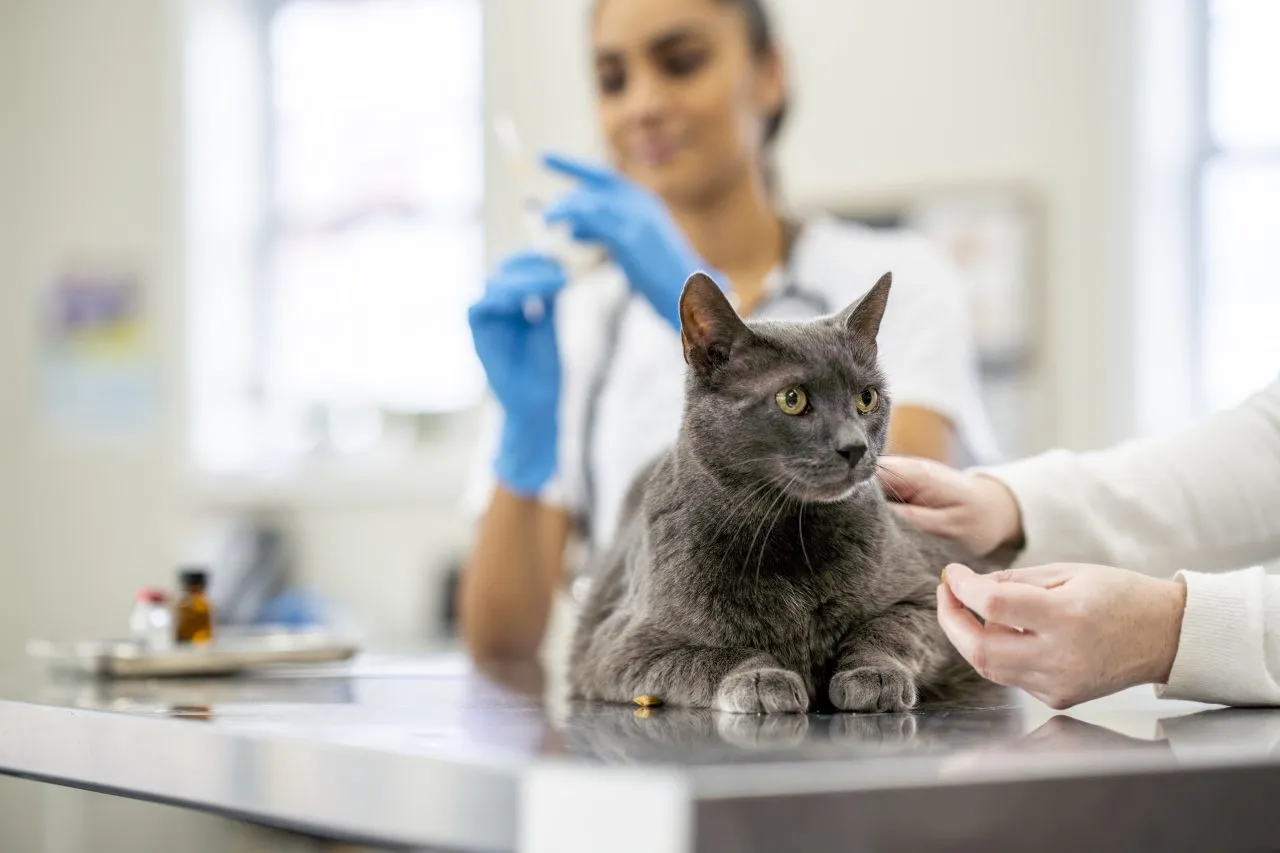
It’s important to make sure your pets have all the immunization shots they need before traveling © Getty Images
Most Asian nations will demand proof of up-to-date rabies vaccinations unless you’re visiting from specific rabies-free countries. Usually, animals will need to have received two doses of this vaccine to travel to Asia.
Some other vaccines that are commonly required include:
For dogs
- Canine distemper
- Parvovirus
- Hepatitis
For cats
- Feline distemper
- Feline panleukopenia virus
- Feline viral rhinotracheitis

Pets can join you in activities like surfing during your vacation! © Getty Images
What Are The Pros And Cons Of Flying With Pets to Asia In The Cabin, As Checked Baggage Or As Cargo?
Ask any pet owner who’s flown with their pet how they prefer to travel with animals, and there’s a good chance they’ll stay in the cabin.
Flying with your cat or dog in the cabin is often the most stress-free experience for both you and your pet, but is regrettably not always an option with some airlines. As a result, many animals must travel as checked baggage or cargo. This is often the case for those traveling with large dogs on planes.
Let’s look at what each of these transportation methods entails and how they weigh up against one another.
Cabin
If your pet can fly in the cabin, it means that your companion can join you on the flight, where they must stay in a crate that meets the airline’s dimensions requirements for the duration of the journey.
Pros
- Your pet can fly with you, helping reduce anxiety for you and your animal.
- If you’re flying with therapy dogs, your pet may help you keep calm, particularly if you’re uncomfortable with flying.
- It’s often cheaper to fly with your pet in the cabin with some airlines.
Cons
- Cabin travel is usually confined to small pets unless you’re flying with service dogs.
- Even in the cabin, some pets will find flying very unnerving.
- Some passengers may have allergies or a fear of animals.
- Your pet may soil or be sick in their kennel.
Checked Baggage
Animals traveling as checked baggage fly in a temperature-controlled part of the hold on the same flight as you. You’ll usually drop them off after check-in at a selected point of the airport and collect them an hour or two after the flight.
Pros
- Airline staff members are specially trained to ensure animals have the best care available.
- If your pet can become overwhelmed by ever-changing environments, smells, and people, the hold may be a calmer place.
- This gives larger pets the chance to travel with you.
Cons
- Though the chances are very slim, your pet is more likely to be unwell or injured when flying in the hold.
- Your pet may become incredibly anxious while separated from you in unfamiliar surroundings.
- Older pets are often not permitted to travel in the hold.
Cargo
Airlines requiring animals to travel as cargo will find a separate flight for your pet, similarly timed to yours, where possible. You’ll meet your pet after they land at the airport, sometimes the day after you arrive.
Pros
- You can track your pet throughout the whole journey.
- Many pet relocation companies work with airlines to ensure the animals’ safety onboard.
- More routes and destinations are available to you when flying this way.
Cons
- You’ll likely be apart from your pet for longer than with the other options.
- It can sometimes be the costliest way for animals to travel.
- Flights can be challenging to organize as you try to find flights for you and your pet on similar dates.
Which Asian Airlines Allow Pets In The Cabin?
Some pet-friendly airlines in Asia that allow animals to travel in the cabin include Korean Air , Asiana Airlines , and Bamboo Airways .
When it comes to animals flying in the cabin, it’s important to compare different airline pet policies, as some only permit animals to fly in the hold, while others allow pets who fit specific criteria.

Pets travel in style on vacation, keeping you company © Getty Images
Though it tends to vary between airlines, pets in the cabin usually must be:
- Odorless and well-behaved.
- Less than 9kg in weight.
- Kept in a rigid or soft-sided carrier that fits under the seat.
How Much Does It Cost To Fly A Pet To Asia?
By now, you’re probably wondering how much all of this will cost! The cost of flying with your pet to Asia can sometimes be quite reasonable if you select a pet-friendly airline, though the fees can quickly add up if your pet is flying as cargo on a long-distance flight. Let’s look at some of the fares in place from some popular airlines.
| Airline | Cabin | Checked Baggage/Cargo |
|---|---|---|
| Singapore Airlines | Unavailable | Calculated as extra baggage from between €7.50 and €33.50 per kg. Additional fees may apply for flights to the U.S.A. or Canada. |
| Korean Air | €140-280 (if flying with a dog or cat internationally) | €140-560 (also for international flights) |
| Bamboo Airways | €161-428 | €47-257 |
| Delta | €186 | Varies depending on distance, size and destination. |
| United Airlines | Starting from €112 | Unavailable |
| Lufthansa | Medium intercontinental: €110 Long intercontinental: €120 | Varies depending on distance, size and destination. |
What Are Asian Airlines Pet Policies?
Now that we’ve gone through the prices you can expect, we’ll get into the policies in place from these airlines.
Air Asia
- Only assistance dogs are allowed on board and are limited to flights operated by AirAsia, India and AirAsia Japan.
Singapore Airlines
- Service dogs can travel in the cabin, providing you avoid seats in the exit rows.
- Most dogs and cats can travel as checked baggage and must not weigh more than 32 kg, including their carrier.
- Animals above 32 kg in weight must travel on a cargo flight.
- Kennels must be less than 24-44" in height depending on the aircraft.
Korean Air
- Passengers can bring one pet on board or two as checked baggage.
- Birds, small dogs, and cats can travel on board if they weigh less than 7 kg when combined with their carrier.
- Carriers in the cabin must be less than 12.5"x17.5"x7.5".
- Larger animals flying as checked baggage must have a combined weight of 45 kg or less and travel in carriers less than 33" in height.
China Airlines
- Only dogs and cats can travel as checked baggage.
- Up to 8 carriers are permitted for flight.
- Pets must be at least 10 weeks old.
- Crates must be no more than 28" in height and 35" in width.
Bamboo Airways
- Dogs and cats can travel in the cabin on direct flights so long as they weigh no more than 10 kg when combined with their kennel.
- Only 2 pets can travel in the cabin at one time.
- Dogs, cats, and birds weighing less than 32 kg in their kennel can travel as checked baggage.
- Up to 9 pets can fly in the hold.
Will My Pet Need To Be Quarantined?
Your pet’s likelihood of being quarantined differs based on where you’re traveling from and where you’re flying to. It can usually be avoided once your pet is fully vaccinated against rabies and presents a negative titer test, but let’s look at some destinations where your beloved companion may need to be quarantined.
Malaysia
Unless you’re flying from Singapore , New Zealand , Japan, Ireland , or the United Kingdom, your dog must go into quarantine for a minimum of 7 days.
Singapore
Dogs and cats will be placed in quarantine for 10-30 days, except for pets from Ireland, the United Kingdom, Australia , New Zealand, Japan and most European countries. Check the list here .
Japan
If your pet meets all the requirements, they’ll be released in 12 hours. Animals who don’t can spend up to 180 days in quarantine.
Hong Kong
Dogs and cats not listed on Hong Kong ’s official website must remain in quarantine for 120 days.
What Are Some Other Regulations I Should Be Aware Of?

The whole family is ready to go backpacking with their pet © Getty Images
What Animals Are Not Allowed To Travel To Asia?
Depending on your destination country and airline, this list may look a bit different, but the following animals and breeds are frequently prohibited from traveling to Asia.
- Large exotic animals.
- Dangerous dog breeds, usually referring to dogs like pit bulls, Staffordshire bull terriers, mastiffs, Japanese tosas, chow chows, and fila Brasileiros.
- Certain cat breeds, including Savannahs and Bengals.
- Snub-nosed dogs and cats may be banned from flying with certain airlines due to their heightened risk of breathing difficulties during a flight. This extends to dogs like boxers, pugs, and Shit Tzus and cats, such as Himalayan, Persian, and English shorthair breeds.
- Older pets can’t travel unless a vet deems it safe to do so.
What Are The Size Limitations On Pets Traveling To Asia?
- Most airlines allow dogs of up to 45 kg to travel as checked baggage, though some airlines permit dogs of up to 100 kg to fly as cargo!
- The size requirements for pets traveling in the cabin usually lie with the airline, but they generally must be 9 kg or less and be small enough to fit in their carrier under the seat.
When Do I Need To Make A Reservation For My Pet?
Each airline enforces cut-off points for adding a pet to your booking. Below are the reservation deadlines for a range of airlines.
Singapore Airlines - 2 weeks Bamboo Airways - 24 hours Korean Air - 24 hours (domestic), 48 hours (international) China Airlines - 48 hours (from September 18th)

Grumpy white cat in a transporter at the airport lounge © Getty Images
What Can I Expect When Traveling To Asia From The U.S.A.?
- You’ll likely need to obtain an import permit for your pet from your destination’s authorities.
- When you’ve received your pet’s health certificate, you must get it endorsed by the USDA before departure.
- Your pet will need an ISO microchip that’s linked to their vaccination history. Alternative microchips are often used in the U.S.A. , so you may need to get your pup fitted with a new chip if this applies to you.
- Without the correct documentation, your pet will likely have to undergo quarantine in the likes of Singapore and Hong Kong. In Malaysia, your dog or cat will need to be kept in quarantine for 7 days, provided you have all the necessary paperwork.
What Can I Expect When Traveling To Asia From The U.K.?
Much like the U.S.A., you’ll need to source an import permit and health certificate from a certified vet.
Your pet won’t need a rabies vaccine to enter countries like Singapore, but it’s best to keep your dog or cat up-to-date regardless.
As long as you’ve ensured your pet meets the criteria, you won’t have to worry about quarantine.
Although pets can’t fly in the cabin on a flight to the U.K., it’s possible to travel out of the U.K. with your pet on board if your departing airline permits it.
What Can I Expect When Traveling To Asia From Europe?
- Rabies vaccinations are sometimes not required from animals entering from Ireland, though most other European countries will need to present vaccine records and often a negative titer test.
- Valid health certificates are required by all countries, and some will request you to get an import permit.
- Most pets from Europe will be able to steer clear of quarantine as long as you have all the relevant documents.
What Are Country-Specific Rules I Need To Know When Traveling With My Pet To Asia?
To give you a clearer picture of what you need to know before your trip to Asia, we’ll delve into the specific requirements of several popular Asian travel destinations.
Singapore
Singapore requires travelers to provide quite a bit of paperwork. You’ll need to present:
- An import license
- An indemnity form
- A health certificate endorsed by your departing country’s government
- Vaccination records
- Details of your pet’s microchip
Some of Singapore’s other pet importation rules include:
- Animals must have been in your departing country for the last 6 months or since birth.
- Dogs and cats must be at least 12 weeks old.
- In addition to rabies, dogs must be vaccinated against canine distemper, canine hepatitis, and canine parvoviral infection.
- The same goes for cats, who also need to get protected against cat flu (feline calicivirus and feline viral rhinotracheitis) and cat enteritis (feline panleukopaenia or feline parvovirus)
- Dog owners must get a dog license, as well as an import permit.
China
The documents you’ll need for China are as follows:
- Import permit (if pets are traveling as cargo)
- A health certificate dated no more than 10 days before entering China
- A health certificate endorsed by your departing country’s government.
- A Carrier’s Immigration Pet Information registration form (dogs and cats)
- A negative rabies titer test (unless you’re visiting from selected countries)
Additional rules include:
- Only one dog or cat per person is permitted.
- If your pet doesn’t have an ISO microchip, they’ll likely face quarantine for 30 days.
- Quarantine can only be completed in Beijing , Shanghai , or Guangzhou , so ensure you fly into one of these airports if there’s a chance your pet will need quarantine.
- Your pet must pass a health check after landing to leave the airport.
- Dogs and cats must be registered with the local police within one month of arriving.
Hong Kong
Anyone headed to Hong Kong with their pup must have the following documents:
- Application forms for your pet permit (found on their official site )
- Your pet permit
- Vaccination records for rabies and other applicable vaccinations (see below)
- Your pet’s ISO microchip details
Other important rules to keep in mind:
- Your pet must have up-to-date vaccines (Dogs - canine distemper, canine hepatitis, and canine parvoviral infection) (Cats - cat flu (feline calicivirus, and feline viral rhinotracheitis) and cat enteritis (feline panleukopaenia or feline parvovirus).
- You must contact the Import and Export Station officer 24 hours before arrival.
- You’ll be discouraged from arranging your flights until the pet permit is granted.
- Dogs and cats must be registered with the local police within one month of arriving.

Even dogs enjoy some sun at the beach © Getty Images
Thailand
Make sure you arrive with these documents:
- Import permit
- Validated health certificate
- Details of your pet’s ISO microchip
- Proof of required vaccines (see below)
Thailand also enforces the following rules (using pets from the U.S.A. as an example):
- Dogs must be at least 16 weeks old to enter.
- A negative leptospirosis test within 30 days of your departure (if unvaccinated)
- Cats must be vaccinated against rabies and feline panleukopenia, while dogs must have received vaccines for rabies, leptospirosis, canine distemper, hepatitis, and canine parvovirus.
The Philippines
Be prepared with each of the following:
- Import permit from the Philippine Bureau of Animal Industry
- An endorsed health certificate
- Vaccination records
- ISO microchip details
Some of the Philippines’ rules to prepare for:
- Up to three pets can travel on a pet permit.
- Dogs will require rabies, leptospirosis, canine distemper, hepatitis, adenovirus type 2, and canine parvovirus vaccines, while cats need shots for rabies, herpes, calicivirus, panleukopenia, and feline panleukopenia.
- Pets must arrive in Manila or Cebu airports.
Cambodia
Ensure you’re prepared with each of these documents before your trip to Cambodia :
- An import permit if your pet arrives as cargo
- Valid health certificate
- ISO microchip details
- Proof of required vaccines
- Photo of your pet
Cambodia also applies the following rules:
- Rabies vaccinations must be dated between 30 days and 12 months, as multi-year shots are not accepted.
- Animals without such rabies vaccinations will face quarantine.
- Cats should be protected against calicivirus, herpes, and panleukopenia, and dogs should have received distemper, hepatitis, and parvovirus vaccines.
What Are The Best Tips For Flying With Your Pet To Asia?
- Try to stick to direct routes rather than connecting flights to make the journey as comfortable as possible for your pet unless you’re taking a flight longer than 12 hours. If you’re flying with your dog with American Airlines or flying with your cat with Delta, you can try to catch a direct flight. You can also travel with animals directly to select Asian countries if you’re flying with your dog with United.
- Set aside plenty of time for planning well in advance of your trip, as you’ll need to stick to the regulations for both your airline and destination.
- The best airline to fly to Asia with will depend on where you’re traveling from, but many large carriers like Singapore Airlines fly to and from Europe, the U.K., and the U.S.A. If you’re usually someone who likes flying with a dog on Southwest, you’ll need to find a different airline!
- If it’s your first time flying with pets, add accessories and travel essentials like a suitably sized crate, leak-proof bedding, and food and drink containers that can be refilled from the outside to your packing list.
- After you’ve arrived in Asia with your pet, your companion will likely undergo a short health inspection. Provided they don’t need quarantine, you can head to your pet-friendly accommodation. If you’re visiting the likes of China or Hong Kong, you’ll need to check in with the local authorities within one month of your arrival.