







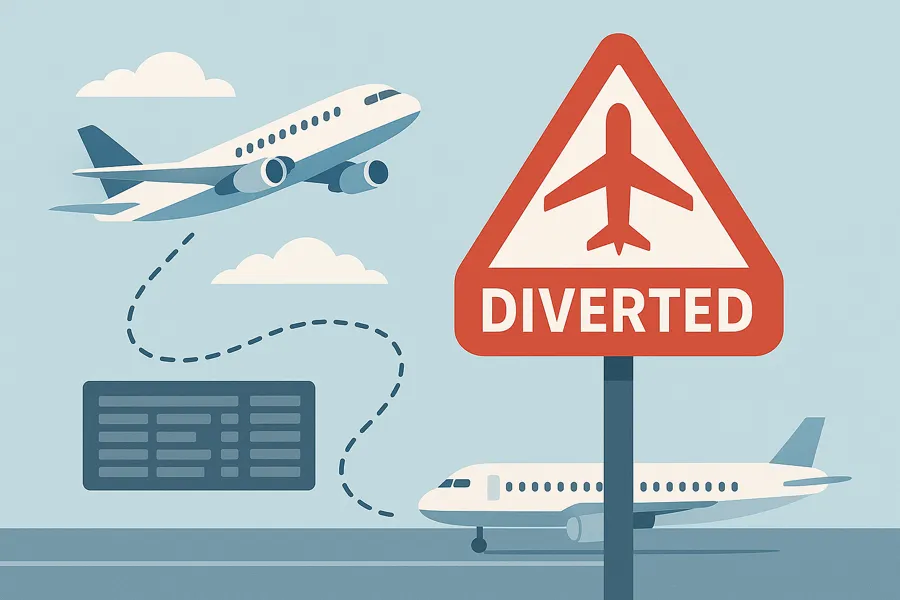
Approximately 0.2%–0.3% of flights are diverted, though risk varies by airline and route. For instance, long-haul carriers like British Airways or Lufthansa handle diversions differently from low-cost carriers. Regulations on delays and cancelations caused by diversions differ by country, but airlines must ensure passengers reach their final destination. In the EU and UK , passengers arriving more than three hours late can claim refunds or compensation. Check your airline’s policy before flying to know your rights.
General Guidelines on Passenger Rights
Airlines have several general responsibilities in case of long delays caused by diversions. They are required to rebook you on the next available flight to your destination free of charge or provide a full refund for the unused portion of your ticket if the disruption is significant. In addition, while awaiting alternative travel and the delay is long enough, the airline must provide care and assistance, which can include meals and, in case of an overnight delay, hotel accommodation and transportation to and from the hotel. Passengers may also receive a full or partial refund, usually depending on the length of the delay, and even cash compensation if any portion of a trip is canceled and if the airline was at fault.
Why Flights Are Diverted
Airplane diversions happen due to weather emergencies, medical emergencies, technical issues, security threats, and air traffic or airport closures.
Common Reasons for Diversions
Weather
Severe weather like thunderstorms, fog, heavy rain, or dangerous crosswinds at the destination can make a landing unsafe.
Medical Emergencies
A serious medical issue affecting a passenger or crew member may require the flight to land at the nearest airport with appropriate medical facilities.
Technical Issues
Unexpected mechanical problems, system malfunctions such as engine, electrical, or hydraulic problems, or other component failures could require landing at the nearest airport.
Security Threats
On-board threats, suspicious items, or unruly passengers create a security risk and can lead to a diversion to remove the threat or person safely.
Air Traffic or Airport Issues
Air traffic congestion, runway closures, or even incidents at the destination airport such as a strike can block access or make landing unsafe.
Insufficient Fuel
Unexpected delays or longer routes can sometimes lead to situations where the aircraft doesn’t have sufficient fuel to reach its intended destination safely.
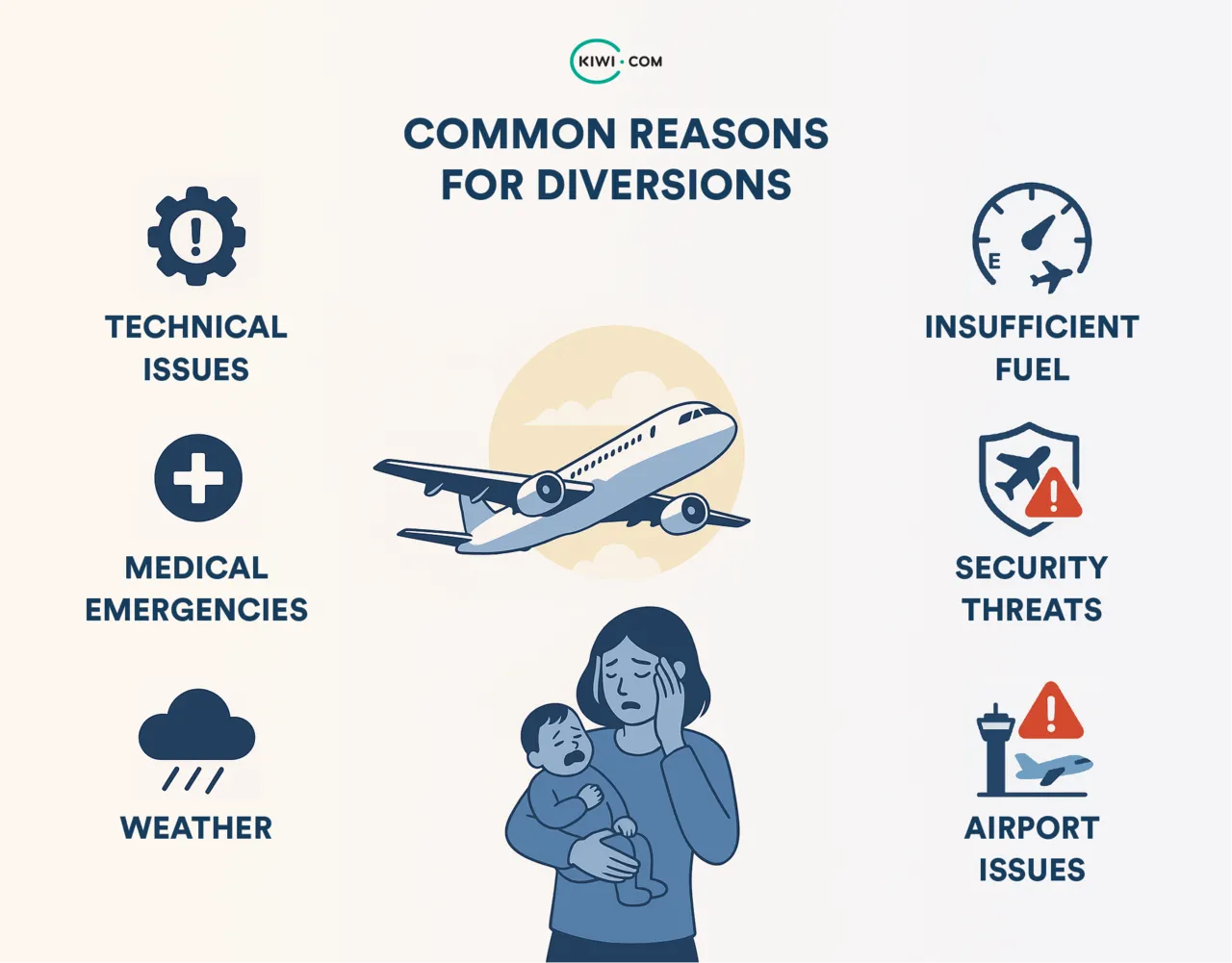
Flight diversions can happen due to various reasons such as technical problems, medical emergencies, bad weather, low fuel, security threats, or airport-related issues © Kiwi.com
What Happens During a Diversion
Pilot’s Decision
The pilot-in-command makes the decision to divert, prioritizing the safety of the passengers and crew above all else. The pilot then coordinates with air traffic control (ATC) to find a suitable alternate airport for landing.
Passenger Impact
For passengers, a diversion means landing at an unplanned airport, which can lead to missed connections and delays to their travel plans.
Airline Support
Airlines are responsible for providing necessary support, which usually includes rebooking options and may include meals and accommodation, with the level of support varying by country and the length of the delay.
Flight Diversion Regulations by Region/Country
Globally, there are more than 200 national or regional transportation or aviation agencies, and many if not most of them have different regulations related to flight delays or cancelations caused by diversions. In Europe, passengers have significant rights to compensation and care, while in the US each airline has its own policies about what it will do for delayed or canceled passengers. Airlines are always responsible for ensuring that passengers arrive at their destination.
United States
The US Department of Transportation (DOT) requires airlines to provide automatic and prompt refunds in the original form of payment for any portion of a trip that is canceled due to a diversion. While airlines are obligated to get passengers to their destination, there is no federal mandate for additional compensation.
Level of care
Airlines are required to adhere to the promises that they make in their customer service plan, including commitments to care for customers in the event of controllable delays or cancellations. The DOT will hold airlines accountable if they fail to do so. Airlines are generally required by the DOT to provide meal vouchers, overnight accommodation and transportation to the hotel if you’re delayed by several hours or overnight, as well as rebooking to your destination at no cost.
EU and the UK
Regulation EC 261/2004 and its UK equivalent, UK261, provide passengers with strong rights, including compensation for delays of over three hours, unless the diversion was caused by extraordinary circumstances beyond the airline’s control, such as severe weather.
Under Article 9 of EU Regulation 261, an airline is legally responsible for providing free of charge: meals and refreshments in a reasonable relation to the waiting time; hotel accommodation in cases a stay of one or more nights becomes necessary and transport between the airport and place of accommodation. It also requires airlines to pay special attention to the needs of the disabled and unaccompanied children.
Level of Care
The level of care depends on the length of your delay and how far you are travelling, as laid out in the table below:
| Flight Distance | Length of Delay |
|---|---|
| Up to 1,500km | After 2 hours |
| 1,500km-3,500km | After 3 hours |
| Over 1,500km and between two EU States | After 3 hour |
| Over 3,500km | After 4 hours |
Canada
The Canadian Transportation Agency (CTA) has regulations for diverted flights that require airlines to transport passengers to their original destination and provide assistance, which may include meals and accommodation, depending on the circumstances.
Rebooking, Refunds, Compensation
Airlines are generally required to rebook you on the next available flight to your destination, either on one of their own planes or with another airline, or provide a full refund for the unused portion of your ticket if the disruption is significant.
United States
Refunds
If an airline cancels a flight or makes a “significant change” such as a diversion that fails to get you to your destination, you’re entitled to a prompt refund if you don’t accept the alternative transportation or compensation offered. However, each airline has its own policies about what it will do for delayed or cancelled passengers. For example, Alaska and Hawaiian airlines offer credit or travel vouchers when a delay exceeds three hours; American and Delta do not. If an airline has made a commitment to provide a particular service or compensation, then the DOT can hold the airline accountable.
Compensation:
No US airline will pay compensation for delays of more than three hours.
Rebooking
Airlines are required to provide free rebooking on the next available flight for significantly delayed or canceled flights caused by the airline. For a domestic flight, a significant delay is three or more hours, while for international flights it is six or more hours. If the airline can’t rebook you on their flights within 24 hours, they must rebook you with a partner airline.
European Union (EU)
Rebooking/Refund
If your flight is diverted due to a situation within the airline’s control, and not “extraordinary circumstances” such as severe weather, you are entitled to a free rebooking or a refund.
Compensation
In addition to rebooking or a refund, you are entitled to compensation if your arrival at your destination airport is delayed by more than three hours and the delay cannot be attributed to circumstances beyond the airline’s control, such as severe weather, political instability, strikes, and security risks.
Canada
Rebooking
In the event of a flight disruption outside of the airline’s control, the Canadian Transportation Agency (CTA) requires an airline required to rebook with a competing airline if the next available flight operated by them or a partner airline does not depart within 48 hours of the end of the event that caused the disruption.
Refunds
For disruptions other than those outside the airline’s control, a passenger would be entitled to a refund instead of rebooking if the arrangements offered do not meet their travel needs or there is no longer any purpose to the travel because of the disruption.
Compensation
The CTA has mandated that airlines must pay compensation to passengers depending on the length of the delay caused by a diversion:
| Large airlines must pay: |
|---|
| $400 if the passenger arrives three or more hours late, but less than six hours |
| $700 if the passenger arrives six or more hours late, but less than nine hours |
| $1,000 if the passenger arrives nine or more hours late. |
| Small airlines must pay: |
| $125 if the passenger arrives three or more hours late, but less than six hours; |
| $250 if the passenger arrives six or more hours late, but less than nine hours; and |
| $500 if the passenger arrives nine or more hours late. |
Brazil
Rebooking/Refund
On delays of 4 hours or more, you can choose from three options: a full refund, a free rebooking on the next available flight to your destination on the same or another airline or be re-accommodated on an alternate mode of transport, such as a bus.
Compensation
If your flight has been cancelled or delayed, you may be compensated up to €600, depending on the circumstances.
Flight Diversions and Passenger Rights FAQ
1. Why are flights diverted?
Diversions occur due to severe weather, medical emergencies, technical issues, security threats, and air traffic or airport disruptions or closures.
2. Is my airline obligated to rebook me if any part of my flight is canceled or I miss my connecting flight due to a diversion?
Yes. If your flight is canceled or you miss a connection due to a diversion, most airlines must rebook you on the next available flight at no extra cost. In the US, policies vary by airline: Alaska and Delta will rebook you on another airline if needed, while Southwest and Frontier usually will not. Always check your airline’s customer service plan before flying, as rules may differ internationally or for partner airlines.
3. What are an airline’s obligations in case of long delays due to diversions?
Airlines are generally required to cover the cost of care and assistance, including meals in case of a long delay and accommodation and transportation to the hotel in case of an overnight delay.
4. Am I entitled to a refund and/or compensation if my flight is canceled or delayed?
In the US, airlines generally do not have to compensate passengers for delays or cancellations, but you are entitled to a refund if the flight does not get you to your destination and you decline alternative transportation. In the EU, passengers may receive up to €600 for airline-controlled disruptions that cause arrivals over three hours late, and in Canada, you may still receive compensation even if you choose a refund over rebooking. No compensation is required for events beyond the airline’s control, such as severe weather, strikes, or security threats, so checking both airline policies and local regulations is essential.
5. What are circumstances beyond an airline’s control?
These include severe weather, political instability, strikes, and security threats. You will usually not receive compensation for flight cancellations caused by these events.
6. How can I best inform myself of my rights in case my flight is diverted?
Search online for the national transportation agency of the country or region you will be flying in and carefully read the appropriate sections. In the US, check your airline’s customer service plan.
Popular routes on Kiwi.com
- Cheap flights from London to Turkey
- Cheap flights from London to Barcelona
- Cheap flights from London to Japan
- Cheap flights from London to New York
- Cheap flights from New York to Paris
- Cheap flights to Spain
- Cheap flights to Italy
- Cheap flights to the United States
- Cheap flights to the United Kingdom
- Last minute flights
People Also Read

How to Travel Patagonia: A First-Timer's Guide to Chile & Argentina's Wild South

Where to stay in Palma de Mallorca: best areas for beaches, culture and nightlife