







This city is old. Like, very old. Ancient temples next to communist monuments next to French balconies next to someone grilling pork on the pavement like this is the most normal thing in the world.
In this article
Hanoi is made for slow wanderers , budget travellers with big appetites, people who romanticise chaos, early risers who never planned to be early risers, and travellers who care more about stories than skylines. This is not a checklist city. This is a vibe city.
From Airport to City: Your First Lesson in Patience
Noi Bai International Airport sits about 30 km from the city, which means your introduction to Hanoi includes a scenic lesson in traffic, scooters, and surrender.
Bus (Budget Hero Choice)
€1–2 45–60 minutes Air-conditioned, calm, deeply underrated. Drops you near the Old Quarter like a polite friend.
Grab / Taxi
€10–15 30–50 minutes depending on traffic and vibes. Comfortable, reliable, mildly hypnotic.
Shuttle Vans
€4–5 Somewhere between bus and taxi energy. Perfect if you like structure but still crave chaos.
Getting Around Without Losing Your Will to Live
Walking in Hanoi is both completely possible and deeply philosophical. In the Old Quarter especially, it’s the best way to move (at least in theory). Sidewalks exist mostly as a concept. You’ll walk in the street, scooters will stream around you like water around a rock, and the key is to keep moving slowly and confidently. Do not panic. Hanoi senses fear and responds accordingly.
For longer distances, GrabBike becomes your best friend. For about €0.50–1.50 you’re suddenly on the back of a motorbike, flying through traffic with a helmet provided and your trust issues gently tested. It’s fast, efficient, mildly terrifying for about three seconds, and then wildly addictive.
Then there’s the cyclo — the three-wheeled bicycle taxis that are equal parts charming and tourist trap. They’re slow, scenic, and absolutely overpriced at €5–10, but every now and then they’re worth it purely for the main-character moment of being pedalled through the city like you belong in a vintage postcard.
Hanoi on a Budget: Where Your Money Finally Gets to Rest
Hanoi is generous in a quiet, almost suspicious way. It doesn’t brag about being cheap; it simply is. You stop checking prices after the first day because everything keeps costing less than expected, and at some point you realise €10 has covered meals, coffee, snacks, and still left you with the unsettling feeling that capitalism has briefly loosened its grip on your life.
Hoàn Kiếm Lake (The City’s Living Room)
Everything in Hanoi eventually pulls you toward Hoàn Kiếm Lake, whether you mean to go there or not. It’s the city’s shared pause button. Locals circle the water from early morning until late at night, stretching, walking, chatting, flirting, thinking, and generally proving that public space can actually work.
Arrive early and the lake belongs to the locals. Aunties move slowly through tai chi routines with incredible focus. Uncles speed-walk with the intensity of people training for something important. Couples hold hands quietly, like it’s a ritual rather than a habit. Later in the day, the energy softens, and by evening the whole area glows: streetlights reflecting on the water, people strolling without urgency, musicians playing softly. It costs nothing, asks nothing, and somehow resets your nervous system.
The Old Quarter (Organised Chaos, Emotionally Supportive)
The Old Quarter is Hanoi at full volume. Narrow streets twist and overlap, each originally named after whatever trade once dominated there: silk, silver, paper, herbs. And while some still honour their origins, others have fully committed to chaos.
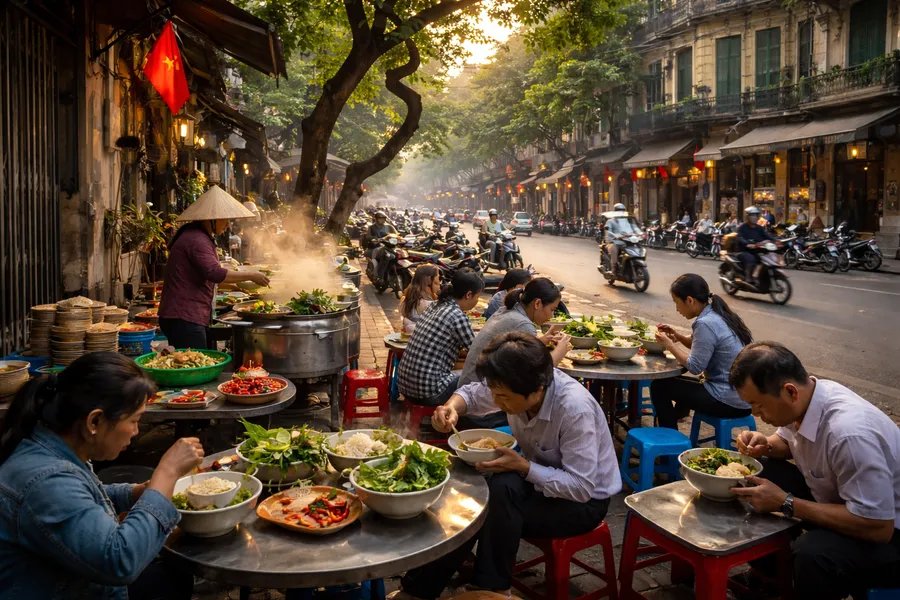
This is where Hanoi feels most alive. Street food stalls spill onto pavements, cafés stack themselves vertically into narrow buildings, vendors glide past carrying entire kitchens balanced on shoulder poles, and scooters park in formations that appear to defy both logic and physics. It’s loud, crowded, and overwhelming in exactly the right way. You’re not meant to understand it all. You’re meant to wander, get lost on purpose, and trust that something delicious or interesting will appear in front of you within minutes. It always does.
Train Street (Yes, That One)
Yes, the train really does run through a residential street. Yes, people really do live there. Yes, cafés really have tables inches from the tracks. And yes, the first time you see it, you will question reality.
Train Street exists in a strange state of constant change. Access rules shift, entrances open and close, and sometimes you stumble upon it accidentally while other times it feels impossible to reach. But if you do catch it at the right moment, it’s unforgettable: the quiet build-up, the sudden roar of the train passing through a place that looks far too intimate for machinery, and then life continuing as if nothing unusual just happened. It’s surreal, thrilling, and uniquely Hanoi.
Temple of Literature
When the city starts to feel loud, the Temple of Literature offers a reset. Vietnam’s first university sits quietly behind its walls, with courtyards, ponds, ancient trees, and a calm that feels almost ceremonial. The moment you step inside, the noise drops, your pace slows, and you get the sudden, irrational urge to become a more intelligent person.
Entry costs around €1–2, which feels almost offensive for how peaceful and beautiful it is. It’s a place to wander slowly, read plaques half-seriously, and enjoy the rare sensation of silence in the middle of a capital city.
Hỏa Lò Prison (“Hanoi Hilton”)
Hỏa Lò Prison is small, heavy, and deeply impactful. It doesn’t overwhelm you with space or spectacle, but what it does show stays with you. The exhibits are sobering, personal, and emotionally grounding. It’s a reminder of the country’s complex history and resilience.
Entry is cheap, the experience is powerful, and you’ll leave quieter than you arrived. This is not a place to rush. Give it the time it deserves, then do what Hanoi does best afterward: step back into the street, find a low plastic stool, and let a bowl of noodles gently bring you back to the present.
Northern Comfort Food, Done Properly (The Northern Vietnamese Way)
Hanoi food is quieter than southern food. Less sugar. More depth. More comfort. More “you’ll think about this later.”
Phở (The Original, No Notes)
€1–2
This is the phở. The baseline. The blueprint. The reason all other phở gets compared to something it will never quite be. Hanoi phở is quiet and confident — clear broth, delicate flavours, no sugar bomb, no unnecessary drama. It doesn’t need to impress you. It already knows it’s good.
Locals eat it early, usually before the city fully wakes up. You sit low on a plastic stool, steam rising into the cool morning air, and slurp respectfully alongside people who have been doing this their entire lives. It’s grounding in a way that’s hard to explain. One bowl and you feel aligned with the universe, or at least ready to face traffic.
Bún Chả (Obama-Approved Happiness)
€2–3
Grilled pork sizzling over charcoal, rice noodles, piles of fresh herbs, and a dipping sauce that ties the whole thing together like a perfectly written ending. Smoky, fresh, balanced — bún chả is the kind of meal where nothing needs changing and nothing could be improved.
You tear herbs, dunk noodles, mix everything in your own chaotic way, and somehow every bite works. There’s a reason it’s famous, and a reason people keep coming back for it. This is a perfect meal. No edits. No notes. No arguments.
 Kiwi.com news
Kiwi.com Reviews from Our Proud Flight Crew Members
Honest Kiwi.com reviews from real Flight Crew travelers. See how they book cheap flights, use price alerts, and travel with the Kiwi.com Guarantee.
Read the guide
Kiwi.com news
Kiwi.com Reviews from Our Proud Flight Crew Members
Honest Kiwi.com reviews from real Flight Crew travelers. See how they book cheap flights, use price alerts, and travel with the Kiwi.com Guarantee.
Read the guideBánh Mì (Still Elite, Slightly Different)
Hanoi bánh mì is crisp, savoury, and refreshingly restrained. Less sweet than southern versions, more focused on balance, crunch, and depth. It’s €1, eaten standing on the street, and somehow manages to feel both indulgent and practical.
You bite in, crumbs everywhere, flavours on point, and immediately understand why this sandwich has global influence. Still elite. Still life-changing. Just a little more serious about it.
Egg Coffee (Trust the Process)
€1–2
Yes, it sounds wrong. Coffee topped with fluffy egg foam feels like a dare. But Hanoi invented it, perfected it, and refuses to apologise — and once you try it, you’ll understand why.
The coffee underneath is strong and bitter, the egg layer sweet and airy, like tiramisu decided to reinvent itself as a beverage. You sip slowly, half suspicious, half delighted, until you’re fully converted. It’s warm, comforting, and weird in exactly the right way. Trust the process.
Street Food Culture (The Real Heart of Hanoi)
Street food in Hanoi is not a novelty. It’s infrastructure. Tiny stools, low tables, loud slurping, no menus, no explanations — just food appearing quickly and disappearing even faster. You don’t ask many questions here. You observe, you sit, you eat.
If a place is busy, you eat there. If locals are already seated, you join them. If plastic stools appear, you do not question their structural integrity or your life choices. This is how Hanoi feeds you — simply, generously, and without ceremony.
Big Nights, Small Prices (Hanoi Edition)
Hanoi nights aren’t about clubs or chaos. They’re social, slow, and quietly cosy. People gather to talk, drink, laugh, and linger — often longer than planned.
Bia Hơi Corner
Fresh beer costs about €0.30–0.50 and comes in tiny glasses that never seem to stay empty for long. You sit shoulder-to-shoulder with locals, travellers, and anyone who happened to walk past at the right moment. The energy is relaxed, friendly, and slightly chaotic in a good way. Conversations start easily. Evenings stretch on without anyone checking the time.
Rooftop Cafés (Not Bars, Just Vibes)
Hanoi rooftops aren’t about loud music or expensive cocktails. They’re about tea, coffee, soft lights, and watching the city breathe below you. Drinks are cheap, music is gentle, and the view does most of the work. Perfect for winding down, thinking a little, or pretending you’re in a film.
Old Quarter Bars
Small, friendly, and unpretentious, Old Quarter bars are places where you actually talk to people. Drinks are affordable, the atmosphere is easy, and nobody’s in a rush. Expect conversations, shared tables, and nights that end naturally rather than explosively.
Hidden Hanoi
This is the Hanoi you find when you stop trying to “see everything” and let the city come to you. Fewer horns, more space. Fewer crowds, more moments where you pause, breathe, and feel like you’re exactly where you’re meant to be.
West Lake (Tây Hồ)
West Lake feels like Hanoi stretching out and exhaling. It’s bigger, calmer, and greener than anywhere in the Old Quarter, with long paths that invite slow walks, unhurried cycling, and the kind of quiet thinking you usually reserve for long flights or late nights.
Locals jog, couples sit by the water, cafés drift in and out of view, and the lake changes colour depending on the time of day. Come in the late afternoon, loop the shoreline without a plan, and stay until sunset when the sky softens and the city noise fades just enough to feel human again. It’s the perfect place to do nothing very intentionally.
Long Biên Bridge
Long Biên Bridge is not polished or pretty in the traditional sense. It’s old, rusted, dramatic, and deeply symbolic. Built during the French colonial era, bombed during the war, rebuilt and still standing, it carries decades of history without asking for attention.
Crossing it at sunset is one of Hanoi’s most quietly powerful experiences. Trains rattle past, scooters drift by, the Red River stretches below, and the light turns everything gold and hazy. It feels cinematic in a way that sneaks up on you. It’s less “wow” and more “oh.” This is a place where you slow down without trying.
Hidden Cafés (Hanoi’s Best Kept Secret)
Hanoi doesn’t put its best cafés on the main street. It hides them behind gates, up narrow staircases, through courtyards, and down alleys you’d normally assume lead nowhere. Finding one feels like being let in on a secret.
You’ll push open an unmarked door, climb past laundry lines and motorbikes, and suddenly step into a quiet space filled with plants, low music, and people reading or staring out windows like they’re in a novel. You order coffee or tea, sit for longer than planned, and feel oddly accomplished, like you’ve unlocked something without needing a map.
When to Go
Spring (Mar–Apr): perfect Autumn (Oct–Nov): elite Summer: hot but lively Winter: cool, moody, romantic
How Expensive Is Hanoi?
Food: €1–3 Coffee: €1–2 Beer: €0.30–1 Transport: €0.50–3 Hostels: €5–10 Hotels: €15–30
Your wallet will feel safe here.
After Hanoi
Hanoi doesn’t shout goodbye. It doesn’t dazzle you into leaving. It just quietly stays with you.
Long after you’ve gone, you’ll remember the steam rising from soup pots, the sound of scooters at dawn, the taste of egg coffee, the way the city felt older than time but still completely alive.
Hanoi doesn’t demand your attention. It earns it.And somehow, gently, it keeps it.
Travel isn’t just about where you end up, it’s about the people who help you get there. If you’re curious how Kiwi.com supports travelers behind the scenes, these Kiwi.com reviews from our flight crew members offer a candid look at what flying with us is really like.