

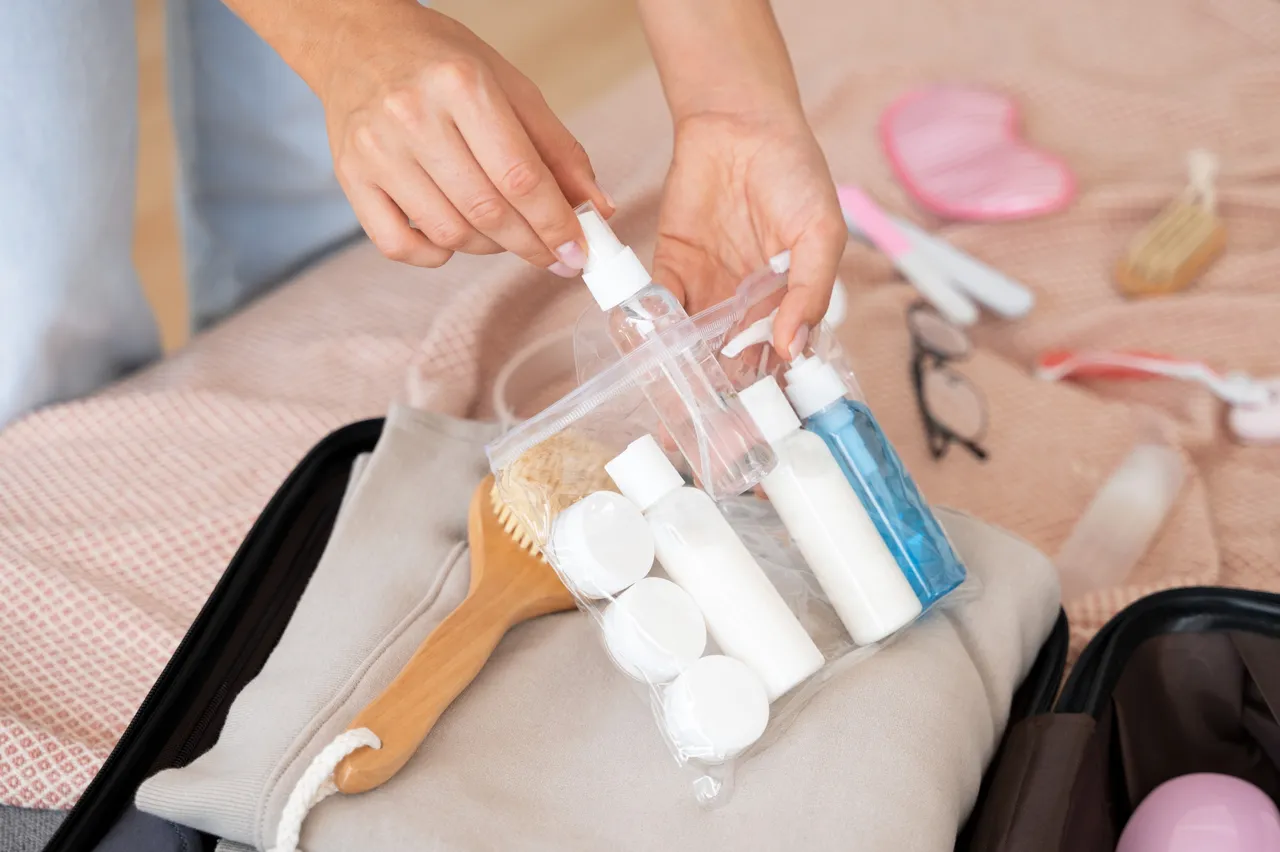
This guide breaks down everything you need to know about carrying liquids, aerosols, gels, creams, and pastes in your carry-on bag and checked baggage. Whether you are flying from New York or London , we’ll ensure you pack like a pro for your next adventure with any airline, including those found on Kiwi.com.
Quick Answer (TL;DR)
Under the TSA 3-1-1 rule, you can carry liquids in containers of 3.4 ounces (100 milliliters) or less. All containers must fit into one clear, quart-sized, resealable plastic bag. In Europe, the 100 ml liquid rule is still the standard at most airports, though some hubs now allow up to 2 liters.
How the TSA 3-1-1 Rule Works
The TSA 3-1-1 rule was established to protect passengers from potential threats, specifically liquid explosives. The name is a simple mnemonic for your carry-on baggage:
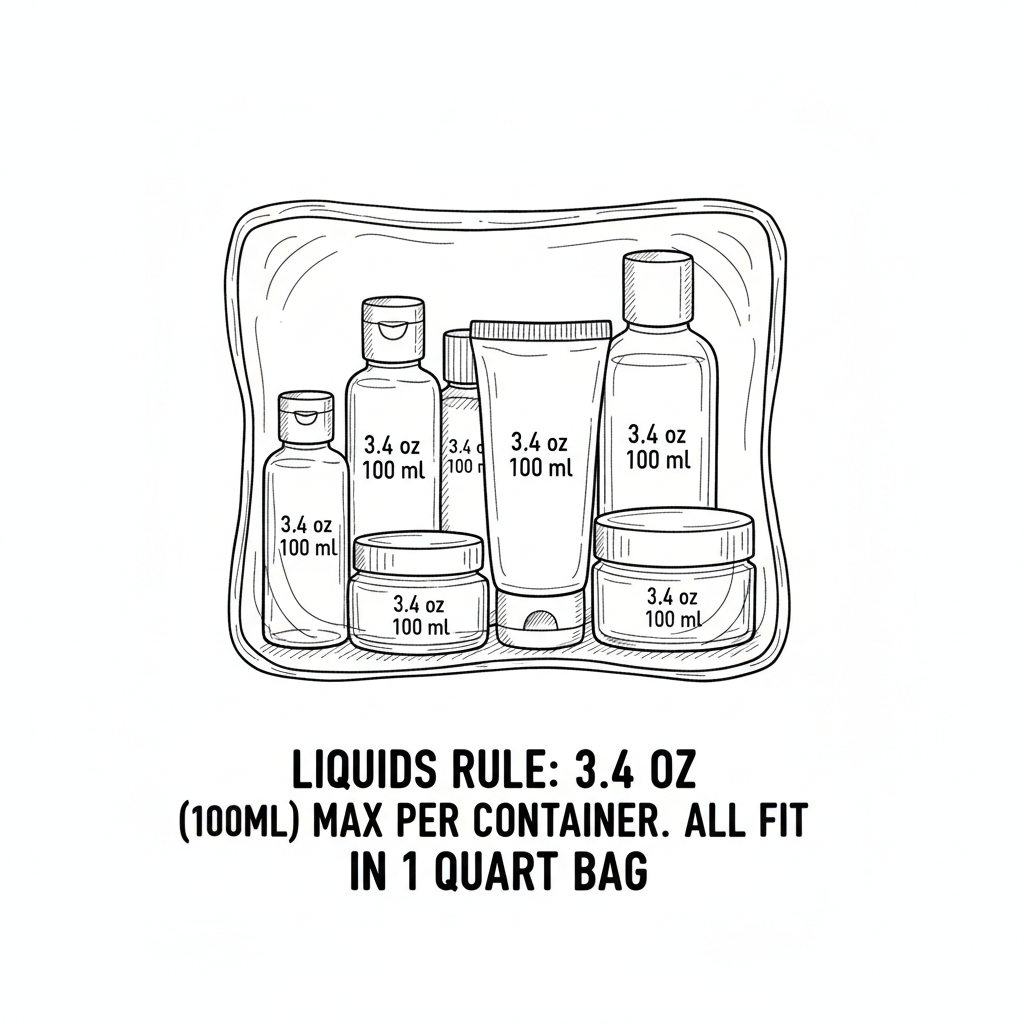
- 3: Each liquid container must be 3.4 ounces (100 milliliters) or less.
- 1: All containers must fit inside one clear, quart-sized bag (approx. 20cm x 20cm in Europe).
- 1: Each passenger is allowed only one small bag.
During the screening process at a TSA checkpoint, you typically remove this bag from your carry-on luggage for X-ray inspection. However, if you have TSA PreCheck, you can often keep these items inside.
The “European Patchwork” of 2025
In Europe, the situation is evolving. While the 100 ml limit was briefly reinstated for all EU airports in late 2024 due to technical scanner updates, 2025 has seen a return to relaxed rules at “C3” equipped airports. Hubs like Dublin , Rome Fiumicino , Amsterdam Schiphol , and London Gatwick now allow containers up to 2 liters. When it comes to food, the story is different, so always check what food you can bring and specific airport tech before you fly.
What Counts as a Liquid at Security
Many travelers are surprised by what TSA officers consider liquids, gels, and aerosols. The rule of thumb is: if you can spill it, spray it, spread it, pump it, or pour it, it is subject to the 3.4-ounce (100-milliliter) limit.
Common items considered liquids include:
- Toiletries: Shampoo, conditioner, toothpaste, and liquid makeup (mascara, foundation).
- Personal Care: Creams, lotions, perfumes, and aerosol deodorants.
- Food Items: Peanut butter, yogurt, jam, and even soft cheeses like brie.
To pack like a pro , treat any “spreadable” item as a liquid to avoid confiscation.
Rules for Carry-On vs Checked Bags
The size limit for liquids is much stricter for your carry-on bag than for your checked baggage.
- Carry-on Luggage: You are limited to travel-sized bottles in a quart bag. This is for essentials you need mid-flight.
- Checked Baggage: You can pack full-sized bottles of shampoo, large sunscreens, and even bottles of wine (subject to alcohol proof).
Warning: Flammable liquids, such as gasoline or lighter fluid, are strictly prohibited in both carry-on and checked bags regardless of the destination.
Tips to Get Through Airport Security Faster
Here’s a secret on getting past the security faster: be organized.
Organization is key to avoiding delays at the TSA checkpoint.
- Accessibility: Keep your quart-sized bag in an easy-to-reach pocket of your backpack or suitcase.
- Verify the Airport: If flying through Europe, check if your terminal uses C3 scanners. If so, you won’t need to remove your liquids or electronics at all.
- Use TSA PreCheck: This remains the fastest way to navigate US security without unpacking.
- Empty Water Bottles: You cannot bring liquids like water through, but you can refill an empty bottle post-security.
Planning ahead and knowing how early to arrive ensures you aren’t rushing when TSA officers need to perform a random check.
How to Pack Liquids the Smart Way
Efficient packing helps you save space in the overhead bin. Use high-quality travel-sized containers that are clearly labeled.
Smart Packing Steps:
- Group shampoo, conditioner, and creams together.
- Place them in a clear, plastic, quart-sized bag.
- Ensure the bag seals completely. If it’s bursting, TSA officers may ask you to discard items.
Example 3-1-1 Toiletry Sets:
- Set A: 3 oz Shampoo, 3 oz Conditioner, 1 oz Toothpaste, 1 oz Face Cream.
- Set B: 2 oz Sunscreen, 3 oz Hair Gel, 0.5 oz Lip Balm, 2 oz Body Lotion.
- Set C (Medical Focus): 3.4 oz Contact Lens Solution, 1 oz Liquid Foundation, 1.5 oz Hand Sanitizer.
Knowing the difference between a personal item vs carry-on helps you decide where to store these for easy access.
Master the Security Checkpoint
Understanding the liquids rule is the most effective way to breeze through any security checkpoint. While the volume limits are strict for your personal item and carry-on, you have much more freedom with your checked luggage. By keeping common travel items like toiletries in travel-sized containers larger than 3.4 ounces only in the hold, you avoid the hassle of extra security checks.
Keep in mind that these regulations also apply to other items you might not expect, such as liquid-filled snacks or certain musical instruments that require specialized cleaning solutions. By staying organized and knowing the current standards for both the US and Europe, you can focus on the excitement of your trip rather than the stress of the line.
Frequently Asked Questions (FAQs)
Liquids in Carry-On Luggage FAQ
Can I bring more than 100 ml if the bottle is half full?
No. The TSA rules and European restrictions focus on the container’s capacity, not the amount of liquid inside. A half-empty 200 ml bottle will be confiscated.
Can I bring drinks from the airport shop onto the plane?
Yes. Any liquids purchased after the screening process are permitted on the plane. These items are already vetted and can be stored in the overhead bin or under your seat.
Do baby liquids follow the same TSA limits?
No. Baby formula, breast milk, and baby food are considered medically necessary liquids. You can bring these in “reasonable quantities” exceeding 3.4 ounces. In Europe, the baby must usually be present, and the milk should not be frozen.
Are medications exempt from the 100 ml rule?
Yes. Medically necessary liquids like insulin or liquid prescriptions are allowed in larger volumes. Keep them in their packaging with a prescription label to assist TSA officers during inspection.
Are duty-free liquids exempt from the 100 ml rule?
Duty-free liquids over 100 ml are allowed if they are in a tamper-evident bag (STEB) with the original receipt visible. Do not open the bag until you reach your final destination, especially if you have a connecting flight.
Popular routes on Kiwi.com
- Cheap flights from London to Barcelona
- Cheap flights from London to New York
- Cheap flights from London to Asturias
- Cheap flights from London to Pattaya
- Cheap flights from London
- Cheap flights to Spain
- Cheap flights to Italy
- Cheap flights to Thailand
- Cheap flights to the United States
- Cheap flights to the United Kingdom
- Cheap flights from London Luton Airport
- Last minute flights
People Also Read