

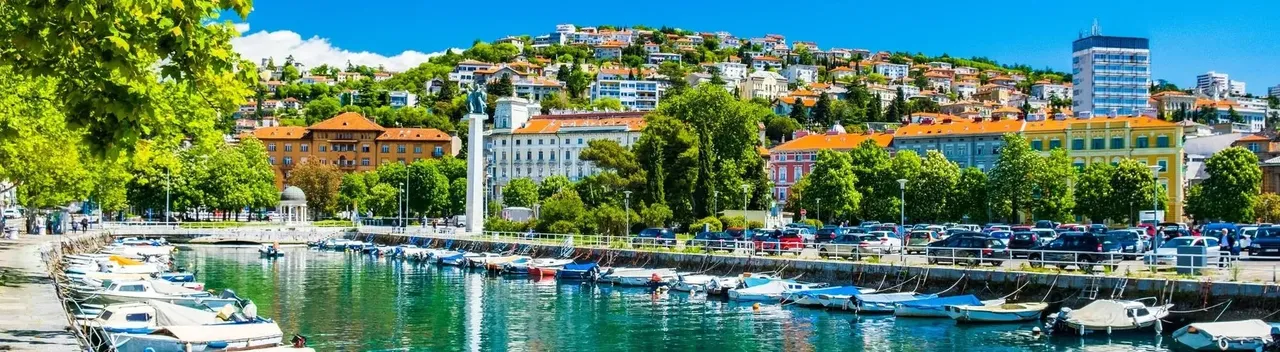
Croatia is easily the most popular country for tourists down the eastern side of the Adriatic Sea , with its long coastline, gorgeous beaches, ancient cities and great weather. In this article, you’ll find out how to make the most of a trip to Croatia, with budgets , tips and city profiles to help you plan your route.
Budget: the basics
Local currency: euro Coffee: €1.60 0.5l local beer: €2.70 Lunch: €8 Dinner in a mid-range restaurant: €16 24-hour public transport ticket: €4 Hostel for one night: €30 3-star hotel for one night: €70 with breakfast
DAILY BUDGET: €50 — €90
General tips
An obvious one first: watch out for tourist traps. Croatia has been a popular destination for years now, but with the rise of its use as a film and TV location, many filming locations are seeing a surge of visitors. You’ll generally pay more as local businesses hike prices to make the most of this newfound popularity. Almost everyone visiting the country goes to the coast (and with good reason: it’s beautiful), but don’t forget about places further into the country too. Zagreb we’ll discuss in a while, but there are other places — the baroque splendor of Varaždin; Karlovač, ‘the city of parks’ located at the meeting of four rivers; the lively city of Osijek near the Serbian border — that show another side to Croatia. Look into ways of sharing costs as well. Hostels may organize trips if enough people are interested, so club together and see what you can see. Your author met a bunch of people in a hostel in Zagreb, and by chipping in together, the hostel organized a minibus and driver to take us on a day trip encompassing the historic wooden village of Rastoke, the Plitvice Lakes, and a detour on the way back to a local swimming spot at a pleasant riverbank. There’s no way I would have organized and paid for (or even known about!) all this if it had just been me. So with all that in mind, let’s explore.
Zagreb
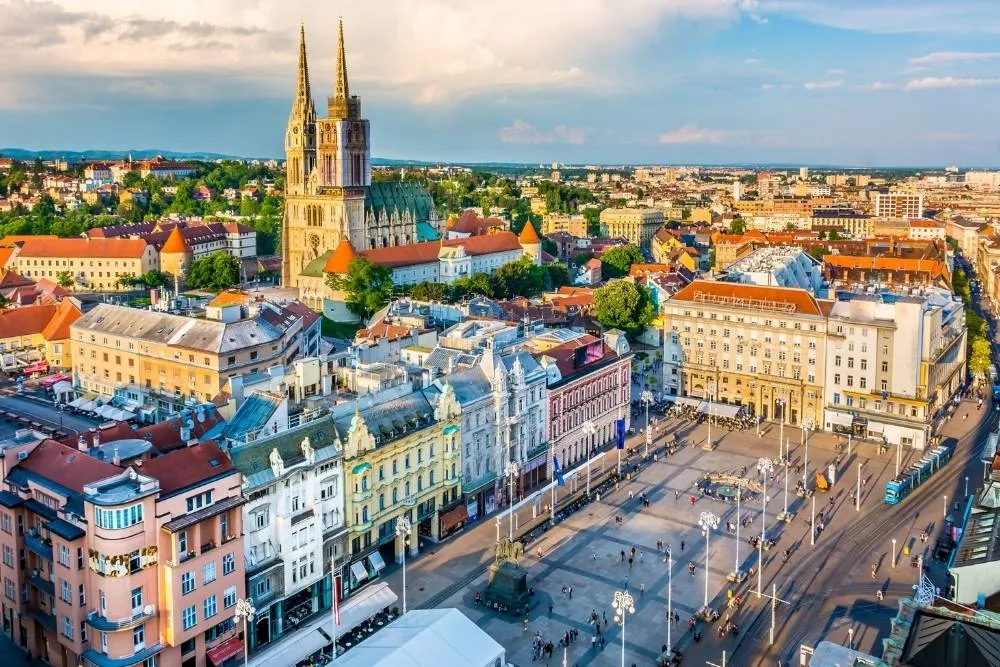 Sadly, most tourists skip Zagreb altogether, missing all that this lovely capital has to offer — Shutterstock
It seems obvious to start with the capital, though that’s not what most visitors do. As mentioned above, many people simply head to the coast, ignoring Zagreb altogether. This is a mistake, as the city is friendly, lively, easy to navigate, and not super crowded, even in summer . It’s divided into distinct parts. If you arrive at the main railway station, you’ll walk along a wide, flat boulevard flanked with 19th-century buildings and gardens. Eventually, you’ll hit Trg bana Josipa Jelačića, the square that divides the Lower Town to the south with the hills, alleys and cobbles of the Old Town and the Kaptol. In the Old Town, you’ll find the main sights of the city. Churches, walls and gates dating from medieval times, a lookout tower on a hill (a great place to relax with a beer and views over the city, just pay attention to cannon-firing times — you’ll know it when it happens), a selection of galleries and museums (including the superb Museum of Broken Relationships ), and a couple of parallel streets of bars, restaurants and pubs serving great food and local craft ales.
Split
Okay, let’s head to the coast. Split is pretty typical of many Croatian seaside towns in that it’s a) very old, b) very pretty, and c) very busy. But that shouldn’t stop you from having a great time; in fact, we’ve got an in-depth guide to exploring Split on a student budget right here . Let’s just take a quick overview though. It’s the country’s second-largest city, and it’s built around a gorgeous blue bay. The main promenade, the Riva, is on the waterfront, and is where you’ll probably find yourself first while you get your bearings. Behind the Riva is the main historic center of the city, with Roman buildings in tumbledown side streets, and huge squares surrounded by Venetian-style walkways and colonnades. It’s tempting just to lounge around the city center drinking cocktails and eating local seafood — and that’s absolutely fine! — but the real value can be found in trips out to the surrounding castles, walking along the hilltops for some greenery and shade, or getting out of the city and down the coast for less crowded beaches . Read the longer guide above, then meet me back here, okay?
Rijeka
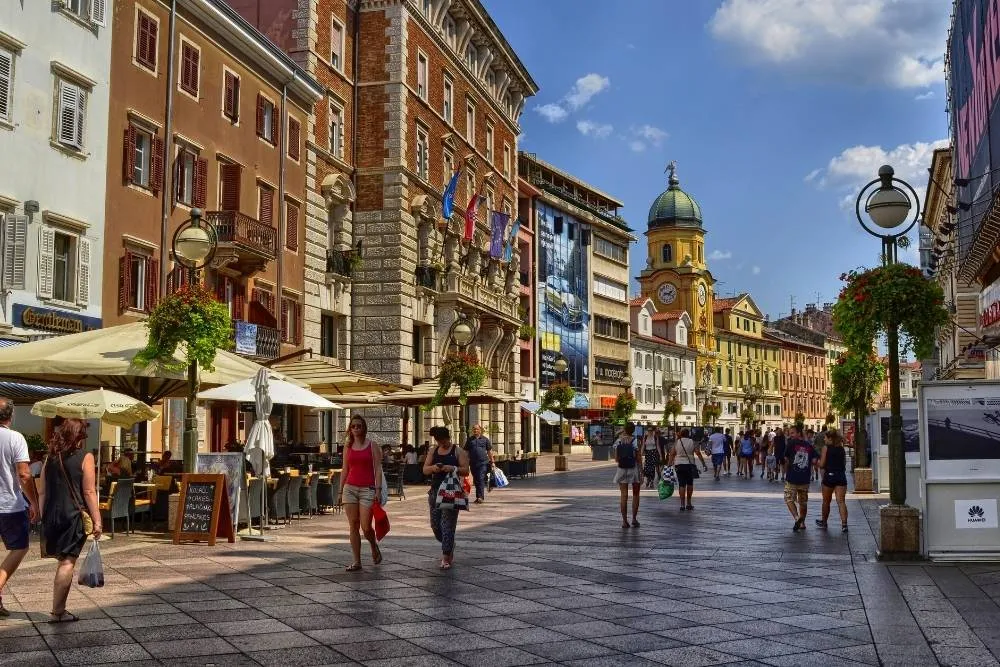 Korzo, the main street in Rijeka — Shutterstock
We’re moving from the quaint to the grandiose now, as we head up the coast to Rijeka. It’s the home of Croatia’s shipbuilding industry, meaning the Venetian fussiness is replaced by Hapsburg-era solidity. It’s also known as the “gateway to the islands”, as it’s from here you can get local ferries to the surrounding islands of the Kvarner Bay, as well as twice-weekly ferries down the coast to Split and Dubrovnik. This is how most people see Rijeka, as somewhere to pass through on their way to somewhere else . But it wasn’t named European Capital of Culture in 2020 for nothing. The relative lack of tourists has meant that rental prices have remained low, and locals have replaced the dwindling ship-building industry with art, food and culture. Formerly shabby 19th-century buildings are being renovated as cafés and restaurants. The old warehouses and factories are becoming cultural venues. In the most extreme example, the city museum is housed in a former sugar refinery. With states and empires claiming and reclaiming the port due to its strategic location, Rijeka’s history is a long and complicated one, punctuated by a devastating earthquake in 1750 that destroyed the city’s walls and much of the center. Nevertheless, what is now the main street (Korzo) was built on the former site of the walls, showing then, as now, that the people of Rijeka take what they’ve got and make the absolute best of it.
Zadar
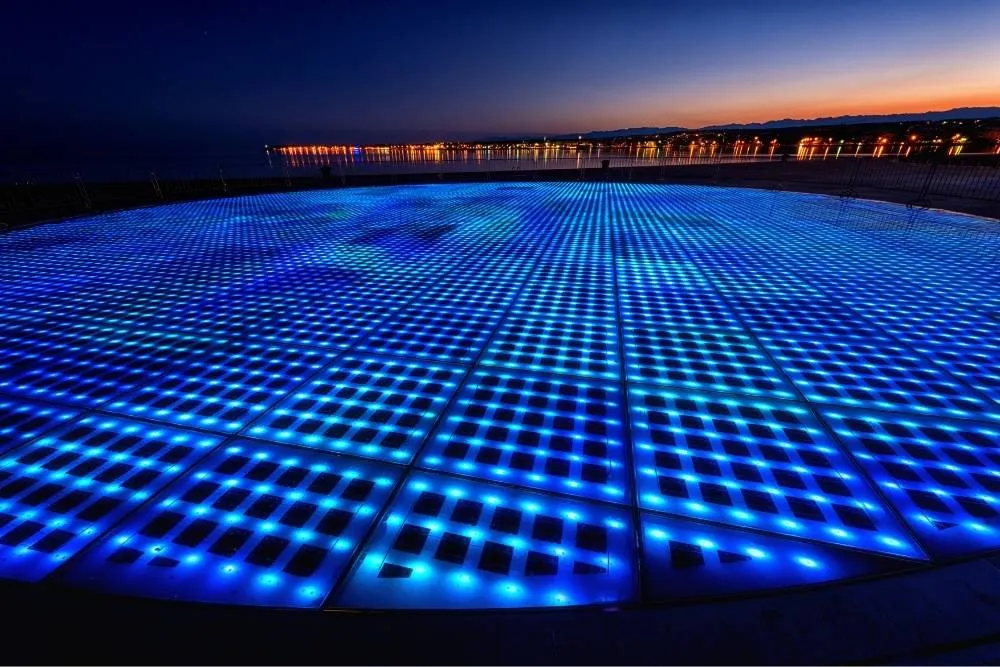 Greeting to the Sun is Zadar’s hypnotic light installation that runs entirely on solar power — Shutterstock Roughly halfway between Rijeka and Split, you’ll find Zadar. The oldest continually-inhabited city in Croatia, it’s known for the spit of land on which its Roman Forum was built thousands of years ago by… well, by the Romans. Again, like Rijeka, it has a history of being fought over and ruled by different groups for varying lengths of time (the Byzantines, the Franks, Hungary
, Venice, France, Austria
, etc.), and that rich cultural heritage is what attracts visitors today. From the year 2000, Zadar really started to flourish as a tourist destination, with an explosion of bars and clubs taking advantage of the expansion of the city’s airport. One thing fed the other, and it’s now one of the major entry points to the Adriatic. This doesn’t mean it feels hectic, however; there are many fun, friendly little quirks that you can discover. A great example of this is the Sea Organ. Opened in 2005 and designed by architect Nikola Bašić, this series of organ pipes is “played” by the waves, creating random, melodious sounds. One of Bašić’s other projects, Greeting to the Sun, is also in Zadar, and this intends to do a similar thing with light. During the day, panels collect solar energy on a giant disc which, come nightfall, is turned into a series of random, almost hypnotic, lights. Indeed, the best things in Zadar are free.
Greeting to the Sun is Zadar’s hypnotic light installation that runs entirely on solar power — Shutterstock Roughly halfway between Rijeka and Split, you’ll find Zadar. The oldest continually-inhabited city in Croatia, it’s known for the spit of land on which its Roman Forum was built thousands of years ago by… well, by the Romans. Again, like Rijeka, it has a history of being fought over and ruled by different groups for varying lengths of time (the Byzantines, the Franks, Hungary
, Venice, France, Austria
, etc.), and that rich cultural heritage is what attracts visitors today. From the year 2000, Zadar really started to flourish as a tourist destination, with an explosion of bars and clubs taking advantage of the expansion of the city’s airport. One thing fed the other, and it’s now one of the major entry points to the Adriatic. This doesn’t mean it feels hectic, however; there are many fun, friendly little quirks that you can discover. A great example of this is the Sea Organ. Opened in 2005 and designed by architect Nikola Bašić, this series of organ pipes is “played” by the waves, creating random, melodious sounds. One of Bašić’s other projects, Greeting to the Sun, is also in Zadar, and this intends to do a similar thing with light. During the day, panels collect solar energy on a giant disc which, come nightfall, is turned into a series of random, almost hypnotic, lights. Indeed, the best things in Zadar are free.
Varaždin
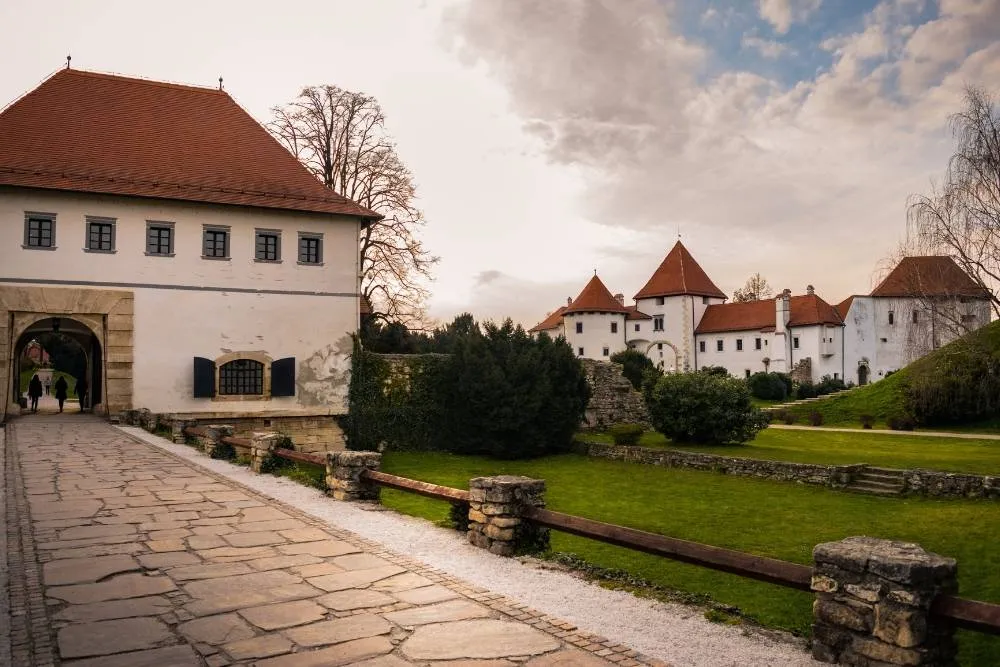 Varaždin Old Town is, in fact, a fortress — Shutterstock
Finally, time to give a bit of love to one of the inland cities mentioned earlier. I was considering staying on the coast (Šibenik, Pula, even the much-touristed Dubrovnik), but nah. Let’s see a bit more of the lesser-spotted Croatia. Varaždin isn’t a big place, with fewer than 50,000 inhabitants, but it’s an excellent place to discover what a historic, well-maintained, friendly Croatian town looks like. Smart, 19th-century buildings on dignified squares, an Old Town that’s basically a fortress within a fortress, and excellent restaurants serving Croatian specialties, local wines, and homemade ice cream. Another attraction, curiously, is the cemetery . More of a park than a final resting place, architect Hermann Haller wanted to create a “living cemetery”, where locals could stroll among nature as well as the dead. He added trees, clipped hedges, flower beds and lawns, so that it has more of the feel of a stately park than a necropolis. The other pleasing thing about Varaždin is that it’s only a couple of hours from Zagreb, so if you feel like taking a day trip, it’s a nice, easy option. As mentioned at the start of the article, ask around and see what you can get. After all, Croatia is a country rich in stories and history, and people are normally more than willing to show you what’s what in this complex, cultured country. Do you want more travel articles? Visit Kiwi.com Stories .
Popular routes on Kiwi.com
- Cheap flights from London to Turkey
- Cheap flights from London to Barcelona
- Cheap flights from London to Japan
- Cheap flights from London to New York
- Cheap flights from New York to Paris
- Cheap flights to Spain
- Cheap flights to Italy
- Cheap flights to the United States
- Cheap flights to the United Kingdom
- Last minute flights
People Also Read


How to Travel Patagonia: A First-Timer's Guide to Chile & Argentina's Wild South

Where to stay in Palma de Mallorca: best areas for beaches, culture and nightlife