







The good news is that most international airlines hover around a similar baseline: roughly 55 x 40 x 20 cm for carry-on luggage. But don’t just assume your bag fits; a quick double check before your next trip can save you from gate-side headaches and unexpected fees.
In this article
Whether you’re packing a diaper bag, laptop bags, or your trusty backpack, understanding these size and weight restrictions upfront means you can breeze through security and stash your bag in the overhead bin without a second thought. Continue reading, and I’ll unpack everything you need to know before your trip.
Quick Answer (TL;DR)
Most international airlines accept a carry-on bag sized about 55 x 40 x 20 cm (approx. 22 x 14 x 9 inches), with weight limits usually between 7 and 10 kg. But remember, each airline sets its own rules, so always double-check whether you can carry a personal item or a carry-on to avoid surprises.
Standard international carry-on size explained
When we talk about standard carry-on luggage sizes, we are usually looking at a baseline of 55 x 40 x 20 cm (roughly 22 x 15.5 x 9 inches). This size is designed to fit snugly into the overhead compartments of most narrow-body and wide-body aircraft. However, there is no legally mandated global standard; instead, there are “industry recommendations.”
Find flights for this trip

Keep in mind that in 2025 EU proposed a mandate for one free cabin bag up to 100 cm total dimensions (roughly 55 x 40 x 20 cm) and 7 kg, plus an under-seat item. However, the proposal is still pending approval from member states. Until fully enacted, check individual airline rules, as enforcement varies and budget airlines like Ryanair are strictest. Meanwhile, some international flights to North America or Asia might allow slightly more space.
Weight restrictions, however, can be a bit of a moving target. Some airlines allow a carry-on weight limit up to 10 kg, while others stick closer to 7 kg. This lack of a true global standard means you’ll find that individual airline policies vary, especially between international flights and domestic flights.
For example, low-cost carriers often enforce stricter limits to maximize limited cabin space. If you want to avoid extra fees or surprises, it pays to know the baseline and then check your airline’s specific size limits and weight restrictions.
Why airlines have different size rules
You might wonder why one carry on bag fits on one flight but is rejected on the next. It usually comes down to the plane itself. Smaller aircraft used for domestic flights have less space in the overhead compartment than massive jets flying across the Atlantic.
Also, safety regulations play a role, as cabin crews must ensure all carry-on items can be stored securely.
On another note, low-cost carriers often have the strictest restrictions because their business model relies on turning planes around quickly and selling extra baggage allowance. For these airlines, every centimeter of the cabin matters. So make sure to follow packing tips and align your shopping strategy with airlines policies.
How to measure your carry on correctly
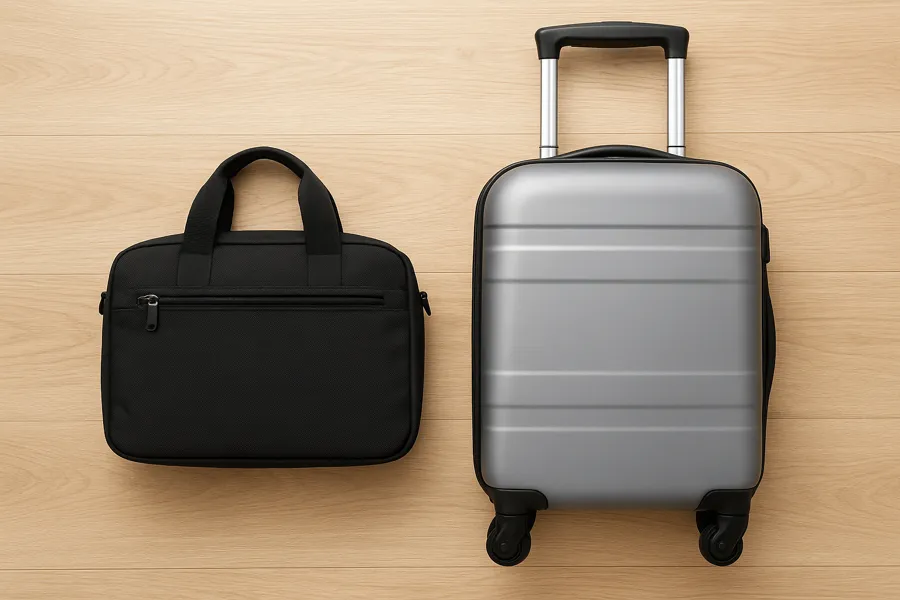
To avoid a “it looked smaller in the store” moment at the gate, you need to measure your carry on luggage like a pro. Use a hard measuring tape and follow these steps:
 Inspiration
Personal Item or Carry-On? How to Tell and Pack Right
Confused about the difference between a personal item and a carry-on? Learn how airlines define each, what sizes are allowed, and tips for packing smart so you avoid extra fees and travel stress.
Read the guide
Inspiration
Personal Item or Carry-On? How to Tell and Pack Right
Confused about the difference between a personal item and a carry-on? Learn how airlines define each, what sizes are allowed, and tips for packing smart so you avoid extra fees and travel stress.
Read the guide- Measure the Height: Start from the floor to the top of the handle (collapsed). Yes, the wheels must be included!
- Measure the Width: Measure across the widest part of the bag’s body.
- Measure the Depth: Check the side profile. If you’ve overstuffed your backpacks, this is where you’ll usually fail the “sizer” test.
- Check Linear Inches: Add height + width + depth. Many international airlines use this total sum for their size limits.
Carry on size rules for popular airlines
Before your next trip, compare these common requirements. Note that a basic economy ticket often has more restrictive rules than standard economy tickets.
| Airline | Max Dimensions (cm) | Weight Limit |
|---|---|---|
| Ryanair | 40 x 30 x 20 cm (Small bag) / 55 x 40 x 20 (Priority) | 10 kg |
| Delta Air Lines | 56 x 35 x 23 | No weight limit (mostly) |
| British Airways | 56 x 45 x 25 | 23 kg |
| Emirates | 55 x 38 x 20 | 7 kg |
| Singapore Airlines | Sum of length, width, height < 115 cm | 7 kg |
| Turkish Airlines | 55 x 40 x 23 | 8 kg |
Whether you are flying United Airlines across the US or Virgin Atlantic to London, always travel on a budget by checking if your one carry on bag is included in your fare or if you need to pay extra to board with it.
Tips to avoid size problems at the airport
We’ve all seen that one traveler desperately trying to shove a massive suitcase into the metal sizer while a line of frustrated people watches. Don’t be that person. From personal experience, the best way to travel smarter is to double check your airline’s mobile app the night before and follow these tips:
- Soft-shell vs. Hard-shell: Soft backpacks are more forgiving and can be squished under the seat if the overheads are full.
- The Weight Trap: A bag can be the perfect size but fail the weight restrictions. In South America and Europe, gate agents are increasingly likely to weigh your one personal item and carry on combined.
- Special Items: If you are traveling with musical instruments, a diaper bag for a child, or laptop bags, check if these count toward your limit. Most airlines allow a diaper bag for free, but a guitar might require you to purchase an extra seat.
Travel Light, Travel Right
Navigating international baggage rules doesn’t have to be the most stressful part of your journey. While every airline, from the budget carriers in Europe to the long-haul giants in Asia, operates with its own set of measurements, the secret to a smooth trip is simply preparation.
By measuring your bag (wheels and all!) and staying aware of the weight limits before you reach the check-in desk, you can save your money for the experiences that actually matter. Remember, the goal of traveling with just a carry-on is freedom: freedom from long lines at the luggage carousel and freedom from the anxiety of lost suitcases.
Pack smart, double-check your airline’s specific requirements on your booking confirmation, and enjoy the ease of moving through the airport with everything you need right by your side.
Carry On Baggage FAQs
What is the standard international carry on size?
While carry on size limits vary by airline, 55 × 40 × 20 cm is the most widely accepted standard internationally. To stay safe, aim for a bag around 21.5 × 15.5 × 9 inches. Always check your airline’s specific baggage allowance for your route before flying.
Do airlines include wheels and handles in the size?
Yes. When an airline lists carry on dimensions like 22 × 14 × 9 inches, they mean the total exterior size of the bag, including wheels, handles, and pockets. If these parts push your bag beyond the limit, it may be considered oversized and required to be checked.
What happens if my carry on is slightly bigger?
If a gate agent notices that your carry on exceeds size limits, you will likely be required to gate-check the bag and pay an additional fee. These fees are usually higher than checking a bag in advance, and enforcement tends to be stricter on full or crowded flights.
Can I bring a carry on and a personal item?
In most cases, yes, unless you are flying on a basic economy fare. Typically, airlines allow one carry on for the overhead bin and one personal item, such as a purse or small backpack, that fits under the seat. Always confirm the rules for your specific fare and airline.