







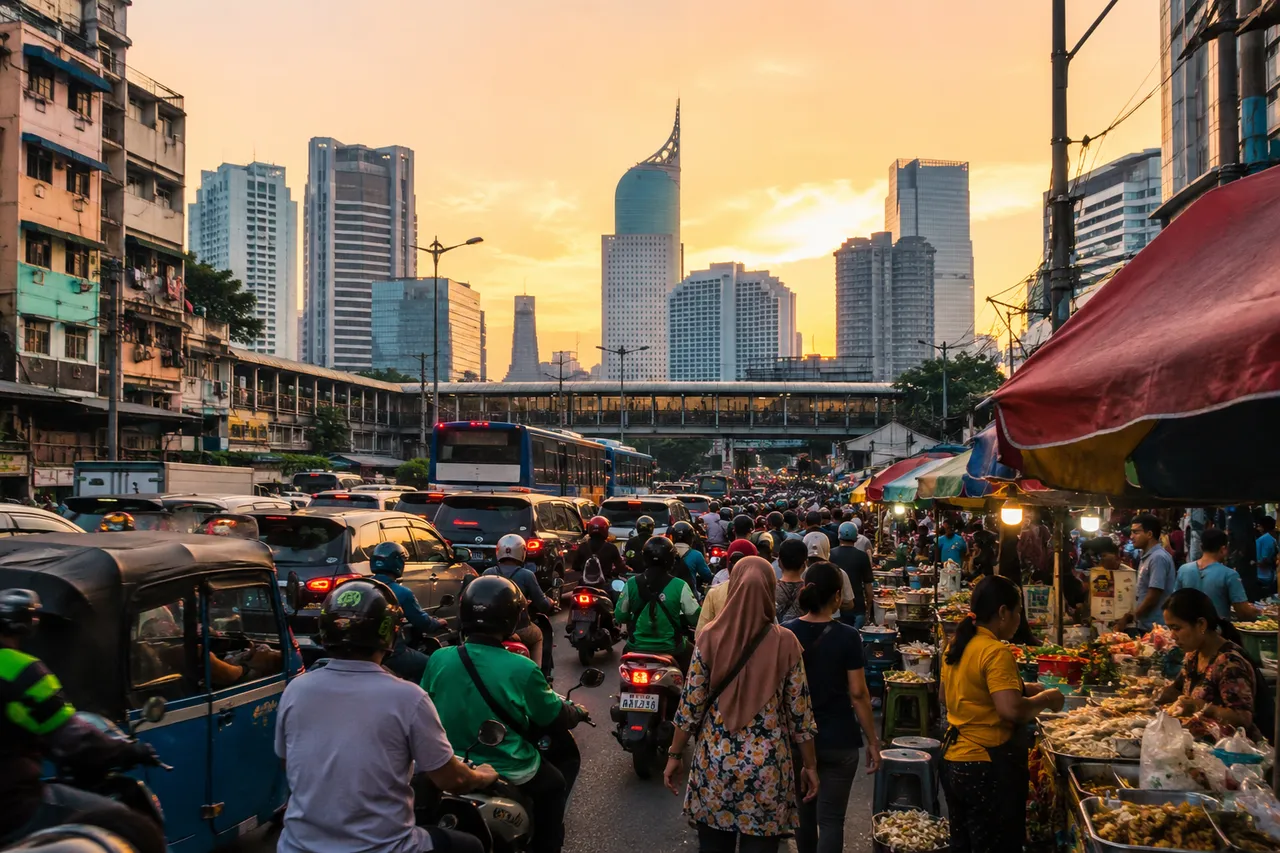
It’s loud, busy, messy, ambitious, exhausting, fascinating, and absolutely worth experiencing.
In this article
Most travellers treat Jakarta as a quick stop before heading to Bali . Which is a bit like flying to New York and immediately leaving for a beach. Because Jakarta isn’t trying to be relaxing. It’s trying to be alive.
And for budget travellers, that’s actually good news. Food is incredibly affordable, attractions are cheap, public transport is improving rapidly, and some of the city’s best experiences cost almost nothing.
From Airport To The City Without Losing Your Mind
Soekarno-Hatta International Airport is enormous. Not scary enormous. Just “maybe check your terminal before leaving home” enormous. The cheapest option into the city is the airport train, which costs around 70,000 IDR (£3–4) and avoids the one thing Jakarta is famous for besides food.
Find flights for this trip

Traffic. And by traffic, we mean traffic that occasionally feels like a long-running social experiment.
Grab and Gojek are the easiest rideshare options and generally far cheaper than many Western cities. Depending on where you’re staying, expect to pay around 100,000–250,000 IDR into central Jakarta.
Download both apps immediately. Future you will be grateful.
Getting Around Without Spending Your Entire Holiday In Traffic
Let’s address the elephant in the room. Jakarta traffic is real. The stories are true. The memes are justified. Fortunately, the city has improved dramatically thanks to new public transport systems.
The MRT is clean, modern, air-conditioned, and often faster than cars. Which sounds impossible until you experience Jakarta roads yourself.
Jakarta MRT should become part of your daily routine. The TransJakarta bus system is also surprisingly useful and ridiculously cheap. Grab and Gojek motorbike taxis deserve special mention too.
Watching your driver weave through traffic while somehow remaining completely relaxed is one of Jakarta’s defining experiences. Terrifying the first time. Incredibly efficient every time afterwards.
Skyscrapers, Street Food & History: Cheap Things To Actually Do
Kota Tua
Kota Tua is Jakarta’s historic old town. Dutch colonial buildings, museums, old cafés, street performers, cyclists riding colourful rental bikes, and enough history to remind you that Jakarta existed long before the skyscrapers arrived.
The area feels completely different from modern Jakarta. Walk around slowly. Take photos. Watch locals posing dramatically for social media content.
It costs almost nothing and offers one of the city’s most interesting contrasts.
National Monument (Monas)
If Jakarta has a main character, it’s probably National Monument. The giant tower dominates the city skyline and serves as one of Indonesia’s most recognisable landmarks.
Entry is cheap, and the observation deck gives you a surprisingly good understanding of just how huge Jakarta actually is.
Spoiler alert: Very huge.
Come early if you want shorter queues and slightly cooler temperatures.
Istiqlal Mosque
Istiqlal Mosque is the largest mosque in Southeast Asia. Even if you’re not religious, the scale alone is worth seeing. The architecture is impressive, entry is free, and guided visits help explain both the building and Indonesia’s cultural diversity.
Dress respectfully and take your time. It’s one of the most important places in the country.
Jakarta Cathedral
Directly opposite the mosque sits Jakarta Cathedral. The contrast between the two buildings tells you a lot about modern Indonesia. Beautiful architecture, interesting history, and a peaceful atmosphere right in the middle of one of the world’s busiest cities.
Sunda Kelapa Harbour
Sunda Kelapa Harbour feels like stepping into a completely different era. Traditional wooden schooners still load and unload goods here, creating scenes that look almost unchanged from decades ago.
It’s one of the most photogenic parts of Jakarta and remains surprisingly overlooked by many visitors.
Car-Free Day
If you’re visiting on a Sunday morning, Jakarta’s famous Car-Free Day transforms major roads into public spaces.
Thousands of people walk, run, cycle, exercise, and enjoy the city without traffic.
Experiencing Jakarta without cars feels slightly surreal.
Malls, Markets & Air Conditioning
Grand Indonesia
Normally a shopping centre wouldn’t make a budget guide. Jakarta is different. Grand Indonesia is less a mall and more a small city that happens to contain shops.
The food courts alone are worth visiting. You can eat incredibly well, enjoy world-class air conditioning, and people-watch for hours without spending much money.
Tanah Abang Market
Tanah Abang Market is one of Southeast Asia’s largest textile markets. It’s chaotic, enormous, loud, confusing, and fascinating. Even if you buy nothing, wandering through it feels like an experience. Just accept that you will get lost at least once.
Jalan Surabaya
Jalan Surabaya Antique Market is perfect for browsing old maps, records, antiques, books, and random objects whose purpose nobody can fully explain.
Ideal for curious travellers and people who enjoy pretending they’re going to buy vintage furniture while backpacking.
Cheap Eats That Make Jakarta Dangerous
Nasi Goreng
Indonesia’s national comfort food appears absolutely everywhere, and after a few days in Jakarta you’ll understand why. A proper nasi goreng combines fried rice, egg, vegetables, chicken or beef, crispy shallots, sambal, and often a handful of crackers on the side. It’s simple, filling, ridiculously satisfying, and somehow works equally well for breakfast, lunch, dinner, or the questionable life choices that happen after midnight. Street versions often cost 20,000–50,000 IDR, while restaurant versions rarely exceed 70,000–100,000 IDR. Every local has a favourite version and you’ll probably develop strong opinions surprisingly quickly. No judgement here.
Satay
Grilled skewers covered in rich peanut sauce might be one of humanity’s better ideas. Chicken, beef, lamb, goat, and even seafood versions appear throughout Jakarta, usually cooked over charcoal grills that can be smelled from half a block away. A portion typically comes with rice cakes, peanut sauce, sweet soy sauce, and enough flavour to justify ordering more than you originally planned. Expect to pay around 20,000–60,000 IDR depending on the type and portion size. The best strategy remains simple: follow the smoke and look for the busiest stall.
Bakso
Bakso is Indonesia’s beloved meatball soup and one of the country’s ultimate comfort foods. Bowls arrive loaded with springy beef meatballs, noodles, broth, vegetables, tofu, and various extras depending on where you order. It’s cheap, filling, and available almost everywhere from tiny street carts to shopping centre food courts. Most bowls cost 15,000–40,000 IDR, making it one of Jakarta’s best-value meals. Particularly useful when tropical rain suddenly appears and your sightseeing plans become significantly less ambitious.
Padang Food
Padang restaurants are a Jakarta essential and one of the most fun dining experiences in Southeast Asia. You sit down and suddenly your table fills with plates. Beef rendang, spicy chicken, curries, vegetables, sambal, eggs, fried fish, and dishes you’ve never seen before all arrive within seconds. The good news is you only pay for what you actually eat. The bad news is everything looks good. A simple meal might cost 30,000–60,000 IDR, while a full feast can reach 100,000 IDR or more. Either way, it’s usually excellent value and one of the best introductions to Indonesian cuisine.
Mie Ayam
If Jakarta had a candidate for the city’s most reliable cheap lunch, it might be Mie ayam. These chicken noodles are served in a savoury sauce with greens, broth on the side, and often a few meatballs if you’re feeling ambitious. They’re simple, comforting, and found absolutely everywhere. Most portions cost 15,000–35,000 IDR, making them a favourite among students, office workers, and travellers trying to stretch their budget without sacrificing flavour.
Martabak
Martabak is essentially Indonesia’s answer to late-night cravings. Sweet versions are thick stuffed pancakes filled with chocolate, peanuts, cheese, condensed milk, Nutella, Oreos, or combinations that should probably be illegal. Savoury martabak is more like a stuffed fried omelette packed with meat, onions, and spices. Portions are huge and designed for sharing, although many travellers discover this information only after ordering. Prices range from 25,000–80,000 IDR depending on size and fillings.
Soto Betawi
Since you’re in Jakarta, it’s worth trying the city’s signature soup. Soto Betawi combines beef, coconut milk, herbs, and spices into something rich enough to feel indulgent while still being sold at everyday prices. A bowl typically costs 30,000–70,000 IDR and offers a genuinely local flavour that many tourists completely miss.
Street Food Markets
Jakarta’s street food scene is genuinely world-class. You’ll find everything from tiny roadside carts to massive night markets serving dishes from across Indonesia’s 17,000-plus islands. One stall specialises in satay, another in noodles, another in fried snacks, another in desserts you’ve never heard of. The best strategy is not choosing one thing. Order small portions from several vendors and build your own feast. In many cases, 100,000 IDR is enough to leave completely full while sampling half a dozen different dishes. The biggest danger isn’t overspending. It’s running out of stomach capacity.
Coffee Culture
Indonesia grows some of the world’s best coffee.
Jakarta takes this fact very seriously.
The city is packed with excellent cafés ranging from minimalist specialty coffee shops to places that look like interior designers got carried away.
Prices remain reasonable and air conditioning remains glorious.
Off The Tourist Path: Jakarta’s Low-Key Gems
Taman Suropati
Taman Suropati is one of the city’s nicest parks. A pleasant place to escape the noise briefly and watch everyday life unfold.
M Bloc Space
M Bloc Space has become one of Jakarta’s coolest creative hubs. Food stalls, cafés, independent shops, live music, exhibitions, and young locals actually hanging out rather than performing tourism.
Always a good sign.
Chinatown
Glodok offers incredible food, temples, markets, and a completely different side of the city. One of Jakarta’s most rewarding neighbourhoods for curious travellers.
Hidden Local Food Courts
Some of Jakarta’s best meals are hidden inside office towers, malls, apartment complexes, and places you would never find accidentally. Ask locals where they eat. Then go there.
Tips For Surviving Jakarta Like A Competent Traveller
Accept that traffic exists. Fighting reality helps nobody.
Download Grab and Gojek immediately.
Carry cash alongside cards.
Stay hydrated. Jakarta’s humidity is a full-time job.
Use malls strategically for cooling down.
Eat street food from busy vendors.
Start sightseeing early before temperatures climb.
Don’t compare Jakarta to Bali. They’re completely different experiences.
When To Go
Dry Season (May–September)
Best overall weather.
Less rain, slightly easier sightseeing, and generally more comfortable conditions.
Wet Season (October–April)
Expect tropical downpours.
Usually dramatic rather than constant, but flexibility helps.
The city remains lively year-round.
How Expensive Is Jakarta?
Food: street meals 20,000–60,000 IDR, restaurant meals 60,000–200,000 IDR
Drinks: coffee 20,000–60,000 IDR, local beer 30,000–80,000 IDR
Transport: MRT rides 3,000–14,000 IDR, Grab rides 20,000–100,000 IDR
Accommodation: hostel £5–12/night, budget hotel £15–40/night
Air conditioning: priceless
Why Jakarta Deserves More Than A Stopover
Jakarta isn’t love at first sight. It’s more interesting than that.
At first, you notice the traffic. Then the food. Then the energy. Then the fact that every neighbourhood feels like a different city. Then suddenly you’re having excellent coffee, eating satay from a street cart, watching the skyline light up, and wondering why so many travellers skip this place.
Jakarta isn’t polished. It isn’t relaxing. It isn’t trying to be.
What it offers instead is something far more memorable: a chance to experience one of Asia’s biggest, busiest, most fascinating cities without spending much money.