






Osaka has a nickname: Tenka no Daidokoro. It translates as The Nation’s Kitchen.
It’s earned it. Merchants ran this city for centuries (not shoguns) and they cared about one thing above all. Getting the best deal on the best ingredients. That habit never left. Osaka still eats better and cheaper than almost anywhere else in Japan.
Tokyo gets the skyscrapers. Kyoto gets the temples. Osaka gets on with dinner.
It’s also the cheapest of Japan’s top three metropolitan cities. Hostels cost less here than in Kyoto. Street food is a legitimate meal, not a snack before the real one. And the whole city centre is compact enough to walk. Useful if you want to save money without even trying.
Osaka doesn’t require a big budget. It just requires knowing where to look.
Getting From The Airport Without Overpaying For The View
Kansai International Airport (KIX) sits on an artificial island in Osaka Bay, about 40km from the city centre. It’s a striking way to arrive. It’s also a genuine trek, so the train you pick matters.
The cheapest real option is the Nankai Airport Express , a straightforward commuter train straight to Namba, right in the heart of Dotonbori. No reserved seats, no premium surcharge. It costs 970 yen and takes 45 to 50 minutes.
Want speed instead? The Nankai Rapi:t limited express does the same route in around 35 minutes, with guaranteed seating, for 1,520 yen booked online. Comfortable, and the train itself looks like something out of a retro sci-fi film, which is reason enough for some travellers.
Heading to Umeda or Shin-Osaka instead? Hop on the JR Haruka Express . Foreign visitors get a genuine discount, around 1,800 yen to Osaka Station, and you can book the ticket easily online .
Whichever train you take, pick up an ICOCA card at the station. It’s Osaka’s tap-to-pay transit card, works on every train, subway, and bus in the city, and doubles as payment at convenience stores and most vending machines. A 2,000 yen card gets you 1,500 yen of travel credit plus a refundable deposit. You’ll use it constantly.
Walking A City That Rewards It
Central Osaka is compact and walking is often faster than the subway for short hops. Dotonbori, Namba, Shinsaibashi, and Amerikamura all sit within a 20-minute walk of each other.
When you do need the subway, a single ride typically costs 180 to 330 yen depending on distance, tapped with your ICOCA. If you’re planning a heavy sightseeing day, the Osaka Amazing Pass is worth doing the maths on. One day costs 3,500 yen and includes unlimited subway and bus travel, plus free entry to over 40 attractions, Osaka Castle’s tower included. It pays for itself after about three paid attractions plus a normal day of transport.
Tempted by a day trip? Nara is 40 minutes away by train, home to a park full of bowing deer and one of Japan’s largest bronze Buddhas. The round trip rarely costs more than 1,000 yen each way. Kobe is even closer, a straightforward 25 to 30 minute ride for 340 to 420 yen each way, and worth it for the harbourfront, Chinatown, and a genuinely different pace than Osaka’s.
A Few Things Worth Knowing
Bring cash, preferably small denominations. Japan is more card-friendly than it used to be, but plenty of the best takoyaki stalls and kushikatsu counters in this article are cash-only.
If a stall has a line, that’s the point. Don’t give up. Osaka locals will happily queue twenty minutes for lunch they could get faster elsewhere, because faster elsewhere isn’t as good.
Don’t walk and eat on the main Dotonbori strip. It’s considered poor etiquette in much of Japan, and Dotonbori specifically has signs asking visitors to stop and eat at the stall instead. Nobody will scold you, but the locals will notice.
Tipping isn’t expected. The service is already included, and leaving money on the table more often causes confusion than gratitude.
Foreign visitors can shop tax-free on any single purchase over 5,000 yen, department stores and many mid-size shops included. Bring your passport. The saving is applied at the till, not refunded afterward, so ask before you pay rather than after.
The Sights That Explain The City
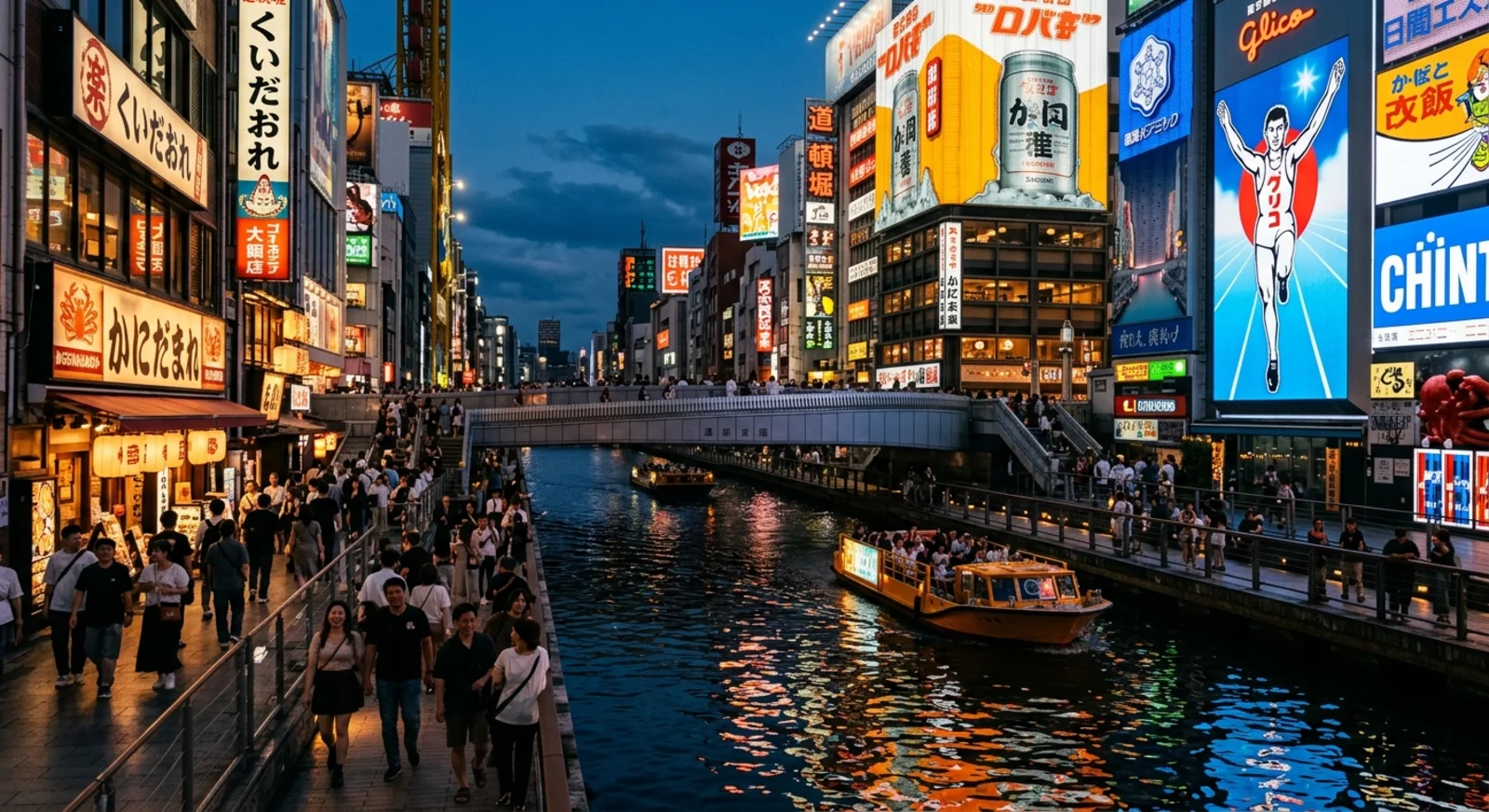
Dotonbori Canal
Osaka’s beating heart, and completely free to walk. Neon signs the size of buildings tower over the water, the giant Glico running man among them, and the canal itself reflects the whole spectacle back at you after dark. Go at dusk, when the lights switch on and the crowds thin just slightly.
Want to see it from the water instead? The Tombori River Cruise runs small boats through the heart of the canal for 1,500 yen, best after dark when the neon hits the water. Osaka Amazing Pass holders ride free, which makes the pass an easier sell if you’re already planning to use it elsewhere.
Osaka Castle
The park and moat are free, open all day, and worth an hour or two of wandering on their own. The tower itself costs 600 yen to enter. Honestly, the reconstructed interior is the least essential part. The grounds, especially under cherry blossoms in spring, are the real draw.
Kuromon Ichiba Market
A working market since the Edo period, now half local grocery run and half tourist food crawl. Both halves are worth your time. Go before 11am if you want to see it as a real market rather than a queue. Browsing costs nothing. Snacking your way through, a skewer here, a piece of fresh uni there, rarely tops 1,500 yen for a genuinely good lunch.
Shinsekai & Tsutenkaku Tower
Osaka’s most atmospheric neighbourhood, built in the early 1900s to look like a mash-up of Paris and Coney Island. Going up the tower for the panoramic view costs around 1,000 yen. The neighbourhood is also the birthplace of kushikatsu, deep-fried meat and vegetable skewers, which makes it a top spot for cheap, casual dining as much as for the view.
Namba Yasaka Shrine
A shrine built around a giant lion’s head, mouth open, stage inside. It sounds stranger than it looks, and it looks stranger than most things you’ll see all trip. One of the most photographed spots in the city, and completely free.
Shitennoji Temple
Founded in 593, one of Japan’s oldest Buddhist temples, and older than most of what Kyoto is famous for. The outer grounds and the striking stone torii gate are free to wander. The central complex, five-story pagoda included, costs 300 yen, and half an hour is enough to see it properly.
Umeda Sky Building
Two towers connected by a floating garden observatory near the top, and one of the most photographed skylines in Japan once the sun goes down. The observation deck costs 2,000 yen, but it’s one of the few paid attractions on this list actually worth the splurge. Go for sunset. The city turns gold, then a thousand shades of neon, in about twenty minutes. Amazing Pass holders get in free before 3pm and a 10 percent discount after.
Amerikamura & Shinsaibashi-suji
Osaka’s answer to a youth culture district, all second-hand clothing shops, street art, and the kind of stores that sell nothing you need and everything you’ll want anyway. Wandering it costs nothing, and it’s a useful contrast to Dotonbori’s more tourist-heavy energy. Shinsaibashi-suji, the covered shopping arcade next door, stretches for nearly 600 metres and is worth a walk-through even on a budget that doesn’t stretch to buying anything.
Eating Your Way Through Osaka
Takoyaki
Osaka invented the octopus ball, and Dotonbori is where it perfected itself. Kukuru, the shop with the giant octopus sign you can’t miss, has been doing this for decades, with chunks of octopus generous enough to actually taste. A plate of eight runs 650 to 850 yen.
Kushikatsu
Deep-fried skewers, dunked once in communal sauce, never twice. Head to Shinsekai, and specifically to Daruma, frying since 1929 under its angry-mascot sign. A five-piece set runs 800 to 1,500 yen, and a cold beer alongside it is the whole point of the evening.
Okonomiyaki
Osaka’s savoury pancake, grilled batter, cabbage, and your choice of filling, topped with sauce, mayo, and bonito flakes that dance in the steam. Mizuno in Namba is often called the best in the city, and the queue outside most evenings backs that up. A full okonomiyaki runs 900 to 1,800 yen, and it’s easily a full meal for one.
Osaka’s Own Sushi
Most of the world’s sushi traces back to Edo-era Tokyo, hand-pressed nigiri included. Osaka went a different way. In the Senba merchant district, a style called hako-zushi, or battera, developed instead: rice and fish pressed together in a wooden box mould, then sliced into neat, geometric pieces designed to survive being made ahead and eaten later. It’s less famous globally than nigiri, considerably older in origin, and still made in a handful of specialist shops around the city. Worth seeking out for a very different bite of sushi history, and usually cheaper than a nigiri counter too.
Convenience Store Culture
Don’t skip the konbini. Japan’s convenience stores, 7-Eleven, Lawson, and FamilyMart chief among them, are a legitimate part of eating in Osaka on a budget, not a fallback. Fresh onigiri rice balls run 150 to 250 yen, and the fried chicken and hot food counters are better than they have any right to be. Department store basement food halls, called depachika, are the upscale version of the same idea, and most mark down their unsold bento boxes by 30 to 50 percent in the final hour before closing.
When To Go
Spring (March to May) brings cherry blossoms to Osaka Castle Park and genuinely comfortable weather. Also the busiest, priciest season, so book ahead.
Summer (June to August) turns hot and humid fast. June and July bring Japan’s rainy season too, with rain on close to a third of the days some years, so pack for both heat and downpours. Osaka copes the way it copes with everything: it just moves the good stuff to after dark, when the arcades and riverside bars fill up and the heat finally breaks.
Autumn (September to November) rivals spring for the best weather, with the added bonus of fewer crowds and proper autumn foliage by November.
Winter (December to February) stays mild by most standards, rarely dropping below freezing, and hotel prices ease off noticeably outside the New Year period.
What Osaka Actually Costs
Approximate prices, at roughly 1 EUR ≈ 185 JPY. ICOCA cards and cash both work everywhere, though most cafés and convenience stores also take contactless cards.
- Coffee (café): 400 to 600 yen (€2.15–3.25)
- Beer (local, at a bar or izakaya): 500 to 800 yen (€2.70–4.30)
- Casual lunch (street food, market stall, teishoku set): 700 to 1,200 yen (€3.80–6.50)
- Sit-down dinner: 1,500 to 3,000 yen (€8.10–16.20)
- Hostel dorm bed: 2,800 to 4,500 yen/night (€15.15–24.30)
- Budget hotel/private room: 7,000 to 12,000 yen/night (€37.85–64.85)
- Daily budget total, spent reasonably: 6,500 to 9,500 yen, roughly €35–51
Free (or close to it): Dotonbori’s neon after dark, Osaka Castle Park, Namba Yasaka Shrine, Shitennoji’s outer grounds, and an afternoon spent simply walking Shinsekai and Amerikamura.
The Kitchen Doesn’t Need Reservations
Osaka doesn’t perform for visitors the way Kyoto sometimes seems to. It doesn’t chase the skyline the way Tokyo does. It just keeps cooking, keeps trading and keeps being unmistakably itself.
That’s good news for anyone travelling on a budget. The best food here isn’t hidden behind a hotel restaurant’s glass doors. It’s standing at a counter in Shinsekai with a beer in one hand and a skewer in the other, or in line at a takoyaki stall that hasn’t changed its recipe in decades.
The best way to understand this city is to eat your way through it. One stall at a time.
If Osaka is one stop on a wider Japan trip, both Kyoto and Tokyo are easy add-ons from here, as both have their own budget playbooks worth reading before you go.
Ready to see it for yourself? Search flights to Osaka on Kiwi.com and taste your way through the city that’s been feeding Japan for four hundred years.
Popular routes on Kiwi.com
- Cheap flights from London to Barcelona
- Cheap flights from London to New York
- Cheap flights from London to Asturias
- Cheap flights from London to Pattaya
- Cheap flights from London
- Cheap flights to Spain
- Cheap flights to Italy
- Cheap flights to Thailand
- Cheap flights to the United States
- Cheap flights to the United Kingdom
- Cheap flights from London Luton Airport
- Last minute flights
People Also Read

How to Travel Patagonia: A First-Timer's Guide to Chile & Argentina's Wild South