

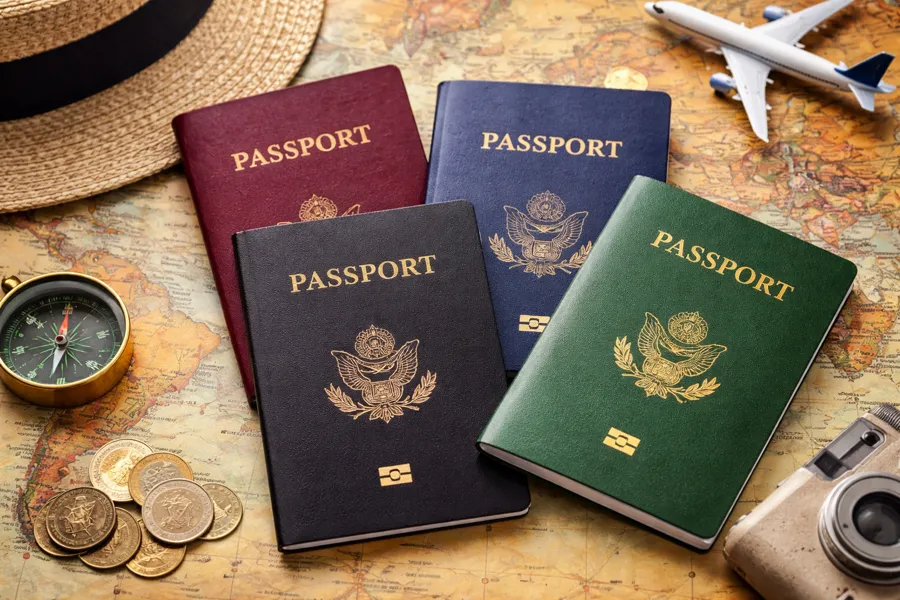
Countries choose their own preferred designs, which is why there are many different passport colors. While travelers assume the color of passports affects where or how you can travel, that’s actually a myth, as they’re mainly about appearance.
In this article
If you’re one of the many people curious about passport colors and their meanings, you’re in the right place, as we’ve created this complete worldwide guide to give you more insight.
Table of Contents
Quick Answer
From blue and green to black and red, many travelers ask ‘What are the 4 colors of passports?’ these are the standard options. Governments typically select these colors to signify membership in regional blocs, cultural heritage, religious significance, or political identity. Each nation can determine its passport color independently, without following any rules set by organizations.
What Is a Passport? (Definition & Purpose)
Anyone who wants to travel between countries needs to have a passport. By definition, a passport is an official form of ID issued by your government that proves who you are and allows you to travel abroad. They’re used to identify people and support border security.
Find flights for this trip

There are different types of passports, and what each passport type means can vary from country to country. Usually, nations will choose a color to distinguish their identity. Islamic countries are great examples of this, such as Pakistan, which uses green passports because the color green is associated with the religion.
Why Do Passports Come in Different Colors?
As long as you’re an independent country, you can choose pretty much any passport color you want. This helps explain why passports are different colors, as governments usually make that decision based on a mix of factors. For instance, many countries that are part of the European Union use burgundy to show political alignment. In contrast, New Zealand uses black for national identity, tradition, and practical design reasons, as it doesn’t wear easily.
Then there are Islamic nations, which we’ve already mentioned, that often choose green passports for religious reasons, another way to understand what passport colors mean in practice. Many countries also use blue passports, including members of CARICOM (the Caribbean Community), where the choice is said to be linked to geographical reasons, such as their close connection to the ocean.
Contrary to popular belief, countries aren’t required to use a specific passport color, which is why the meanings of their different colors vary.
The ICAO doesn’t set rules for passport colors. What they do have guidelines for is technical details, like passport sizes, which must be 125 mm by 88 mm.
The Four Primary Passport Color Categories
Passports usually come in four distinct colors: blue, red, green, and black, with some variations like maroon, dark red, and light blue. Over the years, nations have adopted different colored passports for a range of reasons. These include identifying with the ‘New World,’ reflecting religious faith, honoring historical and political traditions, or simply choosing what is practical.
Let’s take a look at each of the colors more closely.
Blue Passports
Blue passports are among the most common types you’ll see on flights to the UK and southern Europe flights . Many nations use them to identify as part of the ‘New World,’ which is one of the reasons why countries such as the United States use this color. Economic reasons have also played a big role.
The US is one of the main blue passport countries, where the color has changed multiple times over the years. The first of their passports to have a colored cover was red, which was introduced in 1926, but it changed to green during the Second World War. It wasn’t until 1976, for the US Bicentennial, that it was changed to blue. But New World countries aren’t the only ones with blue passports. Many island nations, including those part of CARICOM like Barbados , use them too to emphasize their links to the sea.
Countries with Blue Passports
Below you’ll find a list of blue passport colors by country across various continents and regions. You may already recognise the examples in North America and the Caribbean, but there are other noticeable trends elsewhere.
South America is an example where many nations that are part of the Mercosur customs union use variations of blue for their passports.
If you’re a blue passport holder and searching for flights to Central Europe or flights to Turkey , you can use Kiwi’s travel hacks, like hidden cities ticketing, to find the best deals for your upcoming trip.
North America & the Caribbean
- Antigua and Barbuda
- Bahamas
- Barbados
- Belize
- Canada
- Costa Rica
- Cuba
- Dominica
- Dominican Republic
- El Salvador
- Grenada
- Guatemala
- Haiti
- Honduras
- Nicaragua
- Panama
- Saint Kitts and Nevis
- Saint Lucia
- Saint Vincent and the Grenadines
- United States of America
South America
- Argentina
- Brazil
- Chile
- Guyana
- Paraguay
- Suriname
- Uruguay
- Venezuela
Africa
- Benin
- Botswana
- Burundi
- Cape Verde
- Democratic Republic of the Congo
- Djibouti
- Eritrea
- Eswatini
- Kenya
- Libya
- Mauritius
- Mozambique
- Rwanda
- São Tomé and Príncipe
- Somalia
- South Sudan
- Sudan
- Tanzania
- Uganda
Europe
- Belarus
- Bosnia and Herzegovina
- Croatia
- Iceland
- Liechtenstein
- San Marino
- Ukraine
- United Kingdom
Oceania
- Australia
- Fiji
- Kiribati
- Marshall Islands
- Micronesia
- Nauru
- Palau
- Papua New Guinea
- Samoa
- Tuvalu
Asia
- Afghanistan
- Armenia
- Bhutan
- India
- Iraq
- Israel
- Jordan
- Kazakhstan
- Kuwait
- Kyrgyzstan
- Laos
- Lebanon
- North Korea
- South Korea
- United Arab Emirates
- Viet Nam
- Yemen
H3: The US Passport
The American passport has been blue only since 1976, with a short break from 1993 to 1994, when it was green to mark 200 years of the US Consular Service. However, it’s important to mention that not all US passports are the same color.
There are different US passport color variations for diplomatic purposes, and other cases when citizens need to take flights across the USA and abroad.
- Normal citizens: Dark blue
- Diplomats: Black
- Other government representatives and those serving in the military: Maroon.
- Private contractors working for the US government: Gray
Blue Passport Examples
Canada
Canada’s passport color is navy blue with gold lettering. It underwent an upgrade in 2013, when the government added extra security measures, such as a polycarbonate data page. The newly revamped navy passport also received a cover update featuring a maple leaf design that wasn’t there before.
Those on the hunt for Canada flights should use Kiwi to secure amazing bargains that are hard to find anywhere else.
Australia
Another nation with a blue passport is Australia, which has used the color for a long time, with different variations over the years. The older version was called the ‘P Series,’ while the newer version is listed as the ‘R Series,’ released in September 2022. It includes a range of updated design elements, including well-known Australian landscapes.
Never miss out on low-cost flights to Australia with our wonderful features, like price alerts, which help you stay on top of airfares and notify you about every drop or increase.
The Philippines
While everyday citizens of the Philippines are not issued blue passports, diplomats are. All Filipino passports include the country’s coat of arms on the front, but the colors vary depending on their purpose.
Red & Maroon Passports
The next color we’re going to discuss is red passports, which are commonly found across Europe, especially in EU member states such as Ireland and in post-Soviet countries like Latvia.
Because red is such a popular passport color, it’s often misunderstood as having a universal or global meaning. However, this isn’t true at all; many nations have their own reasons for using it, whether that be for political alliances or cultural relevance.
Compare options and book your flights to Western Europe using a platform like Kiwi today!
Countries with Red Passports
Here’s the complete list of red passport countries from around the world, including EU member states, former Soviet nations, members of the Andean Community, and more!
European Union
- Austria
- Belgium
- Bulgaria
- Cyprus
- Czech Republic
- Denmark
- Estonia
- Finland
- France
- Germany
- Greece
- Hungary
- Ireland
- Italy
- Latvia
- Lithuania
- Luxembourg
- Malta
- Netherlands
- Poland
- Portugal
- Romania
- Slovakia
- Slovenia
- Spain
Former Soviet States
- Georgia
- Moldova
- Russia
Andean Community Nations
- Bolivia
- Colombia
- Ecuador
- Peru
Asia
- Bahrain
- Cambodia
- China
- Iran
- Japan
- Malaysia
- Maldives
- Mongolia
- Myanmar
- Nepal
- Philippines
- Qatar
- Singapore
- Thailand
- Timor-Leste
- Türkiye
- Uzbekistan
Africa
- Equatorial Guinea
- Ethiopia
- Senegal
- Seychelles
Non-EU countries in Europe
- Albania
- Andorra
- Monaco
- Montenegro
- North Macedonia
- Norway
Whether you’re a red passport holder searching for flights to Germany or direct routes to popular regional hubs like Colombia, the options are endless when booking with us.
Red Passport Meaning in the Philippines
Today, the Philippines has maroon (dark red) passports for regular citizens, but this wasn’t always the case. Originally, they issued both green machine-readable passports and maroon versions. However, these were phased out in 2015 following the full rollout of e-passports, which are dark maroon in color. The government introduced them to comply with International Civil Aviation Organization requirements.
You might be asking yourself, ‘What’s the red passport meaning in the Philippines?’ The red passport is reserved solely for Filipino government officials traveling on official business, while the maroon (dark red) passport is issued to general citizens.
Flying from the Philippines and not sure where to go next? Discover new destinations across the Asia-Pacific region with flights to Japan or South Korea .
Dark Red & Maroon Passports
‘Red’ is often used as a broad label for passport covers, though there are many different shades of red, such as burgundy and maroon.
Red passports tend to have a brighter, stronger tone. They’re not that common, as the color can feel quite bold or ‘in your face,’ but countries like Switzerland have managed to make it work with their clean design.
Burgundy passports have a deeper, wine-like color with a more refined appearance. Several EU countries issue passports in this color, making it a frequent sight on Northern Europe flights . Plus, it was also the color of the British passport before the UK left the European Union. However, since Brexit, they have started to use a blue passport.
Maroon passports lean more toward a reddish-brown tone and have been adopted by countries such as Turkey as their standard color.
Green Passports
Green passports have long been used by countries where Islam is the predominant religion, due to the color’s deep significance in Muslim traditions. That’s why you’ll see nations like Indonesia and Morocco using them. Plus, if you end up booking flights to Saudi Arabia , you’ll likely notice plenty of green passports, since many people are traveling to Mecca.
However, religion is only one reason for adopting green passports. A significant number of countries within economic unions, such as the Economic Community of West African States (ECOWAS), have also selected green as a shared regional colour. Côte d’Ivoire and the Gambia are two prime examples.
Countries with Green Passports
Wondering which countries have green passports? The following list includes every nation that issues them, from Asian states like Bangladesh to African islands like the Comoros .
Middle East
- Saudi Arabia
- Turkmenistan
Africa
- Algeria
- Burkina Faso
- Cameroon
- Central African Republic
- Chad
- Comoros
- Côte d’Ivoire (Ivory Coast)
- Egypt
- Gabon
- Gambia
- Ghana
- Guinea
- Guinea-Bissau
- Lesotho
- Liberia
- Mali
- Mauritania
- Niger
- Nigeria
- Sierra Leone
- Togo
- Zambia
- Zimbabwe
Psst…get your hands on some affordable Eastern African flights today!
Asia (Non-Middle East)
- Azerbaijan
- Bangladesh
- Indonesia
- Pakistan
North America
- Mexico
Oceania
- Solomon Islands
- Tonga
- Vanuatu
Europe
- The Vatican City
Light Green & Special-Issue Passports
Many people who are wondering which country has green passports are surprised to learn that there are two main types, including light green and special-issue versions. These passports are a unique style used by governments for civil servants and other government employees. For example, Canada issues special passports to those in public office and to non-diplomats employed by the government to work overseas. However, the country’s diplomats receive red passports instead, that’s the distinction. Turkey also follows a similar policy for special passports.
Black Passports
Although quite rare, black passports do exist, with a select few nations, such as New Zealand, using them to reinforce their identity and heritage. They also offer a strong, formal appearance and a sense of powerful branding that other colors often fail to match.
Are you traveling on a black passport and searching for flights to Eastern Europe ? We offer flexible ticket options, including Saver, Standard, and Flexi fares, allowing you to travel on your terms.
Countries with Black Passports
If you’re researching country passport colors, you’ll quickly realize that black is rarely used, except in a handful of African nations and a few others.
- Angola
- Congo
- Malawi
- New Zealand
- Tajikistan
- Trinadad and Tobago
Save big on your Southern Africa flights when you choose Kiwi. Enjoy great-value fares to your dream destinations throughout the year.
Black Passports in India & the US
You’d be surprised at the number of people who think there are black passports in India, but there’s no such thing. People get confused because India’s dark navy passport looks black under certain lighting and in photographs. However, the official color is dark navy.
One country that does use black passports for diplomats is the United States. Citizens serving as diplomats receive these special types of passports, but they are not issued to the general public.
Rare Passport Colors (Purple, Brown, Light Blue, White & More)
While the vast majority of countries stick to the four standard colors we’ve discussed, a few rare passport colors, such as brown, light blue, white, and purple passports, are issued in specific cases. These colors are sometimes used for unique travel documents or temporary passports, depending on the circumstances.
Purple Passports
Purple passport colors are very uncommon, with few nations issuing them, but the US is a notable exception. The United States provides purple passports for emergency situations, such as the loss of an original passport or other extreme circumstances. These passports have limited validity and are typically issued at a US embassy or consulate.
Brown & Dark Brown Passports
Very few countries have brown or dark brown passports, except in the case of service passports. Morocco, for example, issues these to individuals employed in government services.
Light Blue Passports
Many nations tend to use dark blue or navy, but it’s not that common to see light blue passports. A notable rare case is with special-issue documents, such as the UN Laissez-Passer for officials, which may be issued in light blue, depending on the holder’s rank.
White & Gray Passports
White and gray passports are issued only in special situations by select countries. The meaning of the white passport changes depending on the country. In Canada, white passports are reserved for emergencies and are given as temporary travel documents in cases such as lost passports or urgent travel needs. Gray passports are also rare and are typically issued only to government contractors in the United States.
Passport Covers vs. Passport Colors
It’s common to see people using personalized passport covers with unique designs or quotes. However, these covers are never issued by governments and are only added by individuals who think they look nice. They have no connection to a country’s official passport cover color or its meaning. In most cases, when a person presents their passport that has a personalized cover to an immigration officer, they will be asked to remove it.
Passport Colors by Region
Europe
Many countries in Europe, including most EU member states, have a burgundy or red design for their passports. This reflects their identity as part of the bloc. Countries that align with the EU’s values, but are not part of the organization, have also decided to adopt similar colors, like Albania.
Africa
On a continent as large as Africa, it’s understandable that country passport colors vary, but there is a noticeable trend of green passports being widely used. Given that Africa is home to many nations, including Burkina Faso, where a large portion of the population adheres to the Muslim faith, this choice is not surprising.
Asia
Across Asia, we see a mix of blue and green passports, with some red passports used as well. Nations like India and Jordan use blue, while Islamic nations such as Pakistan follow the green route. Then there are countries like Bahrain, which have stuck to red as it is the color of their national flag.
Oceania
Blue is the predominant color in Oceania, with major nations such as Australia using it to symbolize their connection to the New World. Smaller islands like Fiji and Kiribati follow suit due to their association with the sea.
Americas
Another region where blue is widely used for passports is the Americas, with the US and Canada being the prominent examples. Other countries, such as Argentina and Brazil, also use blue, highlighting their strong economic ties with Mercosur.
Passport Color Myths vs. Real Meanings
Many myths surround passport color meanings, but most of them are based on speculation rather than fact.
The first major myth is that certain passport colors give their holders more power than others. This isn’t true. For example, an EU citizen with a burgundy passport and a US citizen with a dark blue passport have no inherent advantage over one another. Entry rules are determined by the country being visited and its visa policies for particular nationalities, not by the color of the passport.
Another common misconception is that passport colors indicate a country’s political alignment. This is also false. For instance, many Islamic countries issue green passports, but so does Vatican City, a Christian nation.
How Passport Colors Are Chosen Today
There isn’t a single regulatory body that sets passport color codes, so nations usually choose colors for historical, cultural, political, or economic reasons. However, the ICAO outlines specific standards that passport designs must follow, and the vast majority of countries adhere to them. Some of the standards include requirements such as photo sizes being 2 × 2 inches and the face occupying 70 to 80 percent of the image.
To prevent valid passports from being forged, modern versions now include enhanced security features, such as placing serial numbers on every page and including page numbers in the design. Nowadays, e-passports and biometric covers are becoming increasingly common. These types of passports provide extra protection for the holder because they store the individual’s biometric data in a single chip inside the passport.
How Passport Color Can Affect Travelers
As travelers, we want to feel confident on the road, and passport colors can play a subtle role in that. Having a commonly used passport color can put us at ease, especially when booking last-minute flights to a region where many people carry similarly colored passports. It makes it easier to recognize and reduces the likelihood of being asked too many questions.
The color of your passport can also contribute to the speed at which your documents are processed. For instance, if you’re traveling around the EU and have a burgundy EU passport, you can usually use the e-gates instead of waiting for an immigration officer, which typically takes longer.
Being a holder of a passport in one of the four main colors we’ve discussed can make the identification process more straightforward. Border officials see these different color passports daily, so they are accustomed to them and prepared for any potential issues that may arise.
Passport Colors and Global Mobility
Just because you have a certain passport color doesn’t mean you have strong visa power. A person’s ability to travel to certain countries is usually determined by economic and diplomatic relationships between governments, not by the color of their passport. While many people are interested about the meaning of passport colors, there is no connection between color and visa power, even though the two have often been associated.
Indices like the Henley Passport Index rank the world’s passports based on visa-free travel access. For 2026, Singapore has the strongest passport in the world, granting visa-free access to 192 countries. Singapore’s passport may be red, but the color itself does not grant any special access. For example, Singaporeans still need a visa to enter countries like Equatorial Guinea, which also issues red passports.
Ready to Explore the World With Your Passport?
Passport colors undoubtedly spark curiosity among travelers. While some people might say they define us, they are largely symbolic. No matter what color your passport is, red, blue, green, black, or something more unique, you can use Kiwi.com to find cheap flights to wherever you want.
Passport Color FAQs You Need to Know Before You Travel
Why do some countries use red passports while others use blue?
There are no rules requiring countries to choose a particular color for passports, but red and blue are two of the most commonly selected options. Red has often been chosen by nations that are part of blocs such as the EU to represent their alliance, while the US and some of its partners, like Canada, use blue as part of a broader “New World” identity.
What do the different colors US passports mean?
US passport colors are blue for regular citizens going abroad, gray for government-employed contractors, black for diplomats, and maroon for those traveling on official government business. If someone holds a passport other than the blue one, they will still have a blue passport for personal use.
Which countries have green passports and why?
Many countries with significant Muslim populations issue green passports because of the color’s strong association with the faith. Some of these include Egypt, Mauritania, and Mali. Although lots of Islamic nations use green passports, other countries have adopted the color for their own cultural branding, even where the Muslim population is not particularly large, such as Mexico.
What is the rarest color passport?
Out of the four main colors, black is considered the rarest since only six UN-recognized countries issue passports in this color. That said, shades like brown and white, used by countries such as Morocco and Canada for special purposes, are additional examples.
Does passport color affect visa-free travel or mobility?
No, passport colors have nothing to do with visa-free travel or mobility. Each country simply chooses its own color. Visa rules, on the other hand, are typically determined through diplomatic agreements between governments.
Which passport color is the most common worldwide?
Blue is widely considered the most commonly used passport color worldwide, with many variations, including navy. Many countries also use red and green, but their numbers do not match blue, which is used by more than 80 countries.
Why are EU passports mostly burgundy or maroon?
Many EU nations’ passports are burgundy or maroon to reflect the shared values and the economic and political cooperation within the bloc. Croatia is one of the only EU members that has not adopted a burgundy or maroon passport, as it still uses a blue cover.
Can two passports from the same country be different colors?
Yes, it’s common for a country to issue passports in different colors, as governments use this strategy to distinguish regular citizens from those serving in official roles, such as diplomats. The Philippines is a good example of this, as ordinary citizens receive maroon passports, while diplomats are issued blue ones.
Are passport colors regulated by ICAO?
No, the International Civil Aviation Organization only sets standards for machine-readable travel documents, such as passports, covering elements like format and size. However, it’s ultimately up to individual governments to regulate their passports and follow the recommendations set out by the ICAO.
Why do some people have light blue or white temporary passports?
Light blue passports are primarily issued as United Nations Laissez-Passer for staff members, depending on their position level within the organization. White passports are issued to Canadian citizens who require emergency travel documents. Both are extremely rare and are not issued to the vast majority of people.