






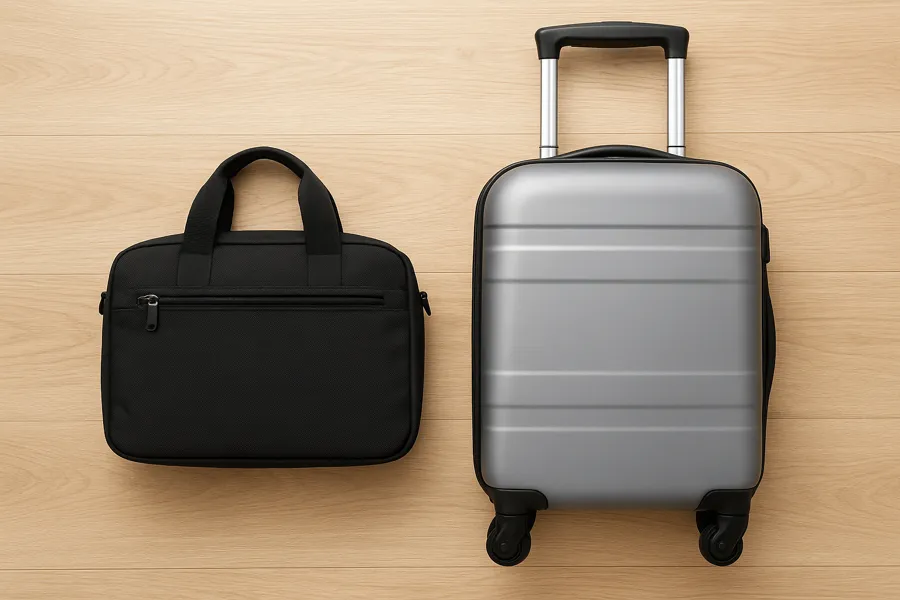
Personal items are smaller bags designed to fit under the seat in front of you, while cabin baggage (often called carry-on luggage) refers to larger bags stored in the overhead compartment. Both are subject to airline-specific size and weight limits that can differ significantly. For example, Korean Air allows personal items up to 40 × 30 × 15 cm, Turkish Airlines limits personal items to 4 kg, and Aer Lingus permits cabin baggage up to 55 × 40 × 24 cm with a maximum weight of 10 kg. Travelers should always review their airline’s policy before flying.
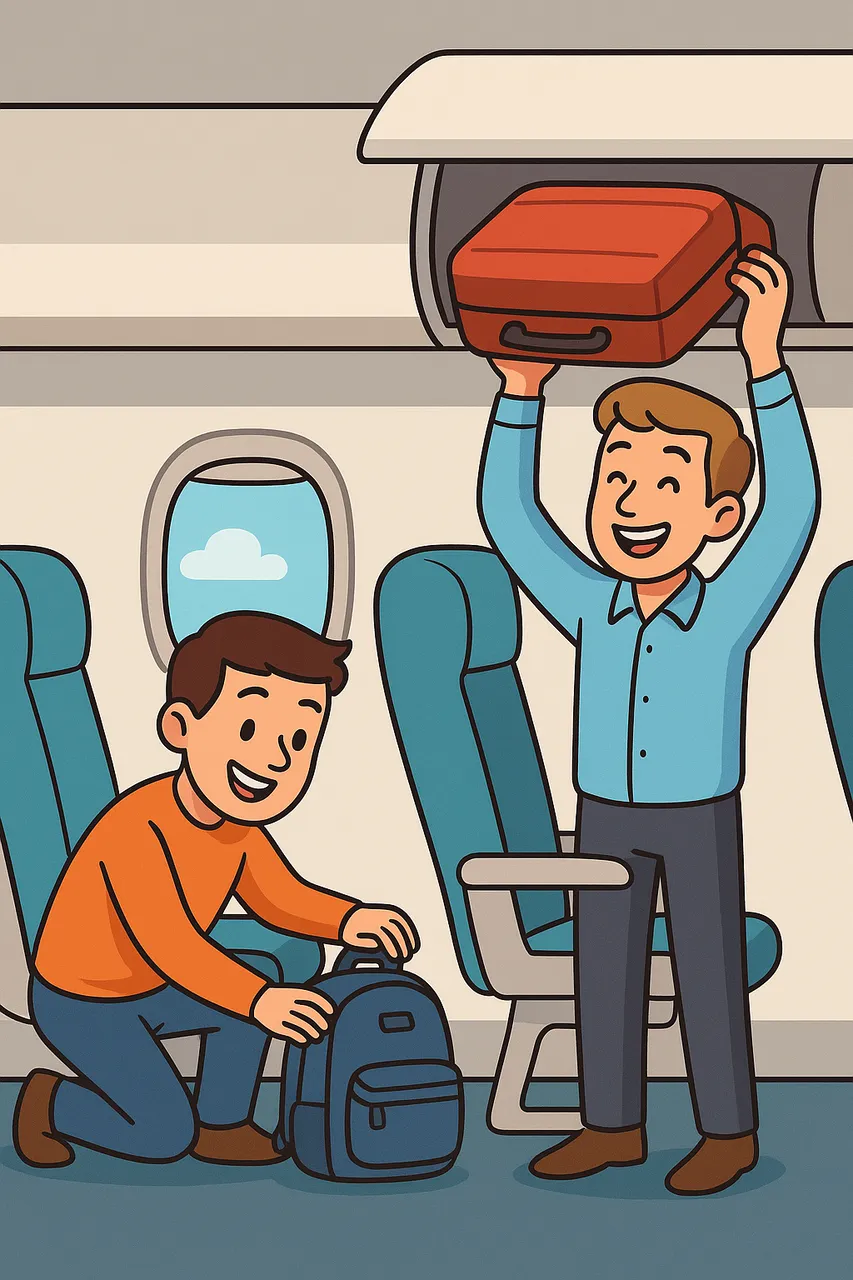
Personal items fit under the seat, while cabin baggage goes in the overhead—highlighting the key difference between the two types of bags. © Kiwi.com
What Is a Personal Item?
Almost everyone brings a personal item on board with them unless they’re traveling on a short domestic route. This is one small piece of luggage that should fit under your seat, typically a handbag, backpack, or something similar. Permitted sizes vary from carrier to carrier. For example, on Korean Air , passengers’ personal items should be no larger than a piece 40cm x 30cm x 15cm. In contrast, Air New Zealand doesn’t have any rules listed on its website, but it gives examples of items it deems acceptable.
Types of Personal Items
A personal item is a piece you keep with you in the cabin, rather than something you put in the overhead bin. Below is what airlines generally permit.
- Backpacks
- Laptop/laptop cases
- Jackets
- Briefcases
- Musical instruments (depending on size)
- Purses
- Duty-free items
- Blankets
- Cameras
What You Need to Know About Personal Items
There’s a tendency for passengers to believe they can take any personal item with them and should get through without any issues. But it doesn’t always work like that. A handful of airlines also have weight limits on personal items, in addition to the dimensional restrictions. One carrier that does this is Turkish Airlines , which has a weight limit of 4kg, along with a dimension limit of 40x30x15 cm.
You’ll want to make sure that only one personal item is brought on the plane, or else the airline might slap you with an extra charge for going over the allowance. Most full-service carriers aren’t picky with the size of the vast majority of personal items, unless someone tries to sneak something overly large with them. However, budget airlines like Ryanair are notorious for doing random spot checks, and they will fine you, so don’t even think about trying to outsmart them. Keep in mind that if you are on a short trip or are taking a same day return flight , you are likley not going to need more than just a backpack.bout trying to outsmart them.
What Is Cabin Baggage?
Cabin baggage refers to the luggage you bring onboard, besides your personal items, that you plan to store in the overhead compartment in the cabin. Some airlines include this in your airfare, such as Emirates , while others, like Spirit , charge an additional fee. Many airlines have varying cabin baggage regulations concerning size and weight. For example, American Airlines only allows carry-on bags of up to 56x36x23 cm in size, but doesn’t specify a weight limit. In contrast, Aer Lingus’s dimension limit is 55x40x24 with a weight limit of 10kg.
Types of Cabin Baggage
- Backpacks
- Duffer bags
- Trolley bags
- Suitcases
- Weekender bags
What You Need to Know About Cabin Baggage
Cabin baggage doesn’t always come included with your ticket, so it’s important to check with your booking before assuming you can bring something on board. If it doesn’t come with it, that means you’ll have to pay for every bag. Oftentimes, even if you are allowed, only one free piece is permitted per ticket unless you fly business class with an airline like Qatar Airways that grants these ticket holders two pieces.
Always double-check before your flight that the size of your cabin baggage is in line with the airline’s limit. I say this because if you board the plane, and the bag is too big to be stored in the overhead compartment, they’re going to end up charging you to store it under instead.
How Do Personal Items and Cabin Baggage Differ?
Now that you’ve had a brief breakdown on both personal items and cabin baggage, you’re probably wondering what the difference is between the two.
Storage
Personal items are small enough to be able to slot in under your seat, whereas cabin baggage must be suitable for storage in the overhead compartment.
Use
Passengers tend to use their personal items to hold the things they’ll need on the flight, while cabin baggage is better suited for storing larger belongings, such as toiletries and clothing.
Price
The vast majority of airlines let passengers bring a personal item on the plane for free. However, only certain carriers permit passengers to carry a complimentary piece of cabin baggage onto the plane with them, and these tickets are often more expensive. Airlines that don’t give passengers free cabin baggage frequently charge passengers for it.
Size and Weight
Even though most airlines require personal items and cabin baggage to fit under a seat or in the overhead compartment, both still have size and weight restrictions, with personal items having smaller dimensions and weight than carry-on bags.
| Feature | Personal Item (Under Seat) | Cabin Baggage (Overhead) |
|---|---|---|
| Storage | Under the seat | Overhead bin |
| Typical Size | Smaller (purse, laptop) | Larger (suitcase, duffel) |
| Weight Rules | Sometimes (4–7 kg) | Often (7–10+ kg) |
| Cost | Free on most airlines | Sometimes extra fee |
| Best Use | Essentials for flight | Clothes & bigger items |
Tips for Using Personal Items and Cabin Baggage
- Read the baggage policy: After you’ve found the right flight, don’t just click ‘yes’ to everything. Go through the airline’s baggage policy to understand the rules and restrictions.
- Watch out for flight packages: During the flight booking process, airlines sometimes automatically activate a package that includes meals and baggage. However, you can unselect this option and add the baggage separately, which is usually cheaper.
- Know the rules for your entire route: If you’re switching planes on a stopover and using a combination of two airlines, ensure that both luggage policies align. Otherwise, you could encounter issues.
- Keep your personal items for essentials: Since you can put your personal items under the seat, store all the things you’ll need in there during the flight, like books, laptops, etc. Or else you’ll be that annoying person sitting at the window seat, asking everyone in your row to move as you try to get up and take something out of your bag.
- Evaluate the length of your trip: If you are going on a short business trip, or are taking a quick memorial day weekend flight , don’t over pack. You might be able to get away with carrying on a simple backpack with the essentials, without having to pay for extra luggage.
Personal Item or Cabin Baggage: What Option Are You Choosing?
Personal items and cabin baggage both have their place. What will suit you really depends on the purpose of your trip. If it’s a quick weekend getaway and the airline has no size restrictions, you could easily stick to a personal item without forking out the extra few quid for a cabin bag. But if you have an extended trip, it’s wise to add a cabin bag, even if it costs extra, as you’ll still be allowed a personal item as well.
Smart Carry-On Questions Answered
Am I allowed to bring a personal item on a flight operated by a budget airline?
Most budget airlines allow one personal item on board without an extra charge. If you bring an additional bag alongside your personal item, it will likely be classed as cabin luggage and incur fees on many budget carriers (for example, Ryanair and Spirit). Policies vary, so contact the airline directly if you’re unsure about a specific budget carrier’s rules.
What happens if my cabin bag is too big?
If airline staff determine your cabin bag is too large, they may require it to be placed in the hold and charge an extra fee. An exception can occur with some full-service airlines (e.g., Qatar Airways) that may stow an oversized cabin bag in the hold for free if you haven’t checked luggage. To avoid surprises, measure and check your bag size before you travel.
Can I carry liquids in my personal item and carry-on baggage?
You can carry liquids in both personal items and carry-on bags, but liquids are often subject to the 100 ml rule (or local equivalent), depending on your destination. For fewer restrictions and larger quantities, pack liquids in checked baggage whenever possible.
Do airlines weigh personal items at the gate?
Some airlines do weigh personal items at the gate or during carry-on bag checks, especially if they suspect items exceed limits. If a bag check is performed, your personal item may be weighed or measured and could result in additional charges if it exceeds policy limits. Stick to the published size/weight limits to avoid fees.
Popular routes on Kiwi.com
- Cheap flights from London to Barcelona
- Cheap flights from London to New York
- Cheap flights from London to Asturias
- Cheap flights from London to Pattaya
- Cheap flights from London
- Cheap flights to Spain
- Cheap flights to Italy
- Cheap flights to Thailand
- Cheap flights to the United States
- Cheap flights to the United Kingdom
- Cheap flights from London Luton Airport
- Last minute flights
People Also Read




How to Travel Patagonia: A First-Timer's Guide to Chile & Argentina's Wild South