



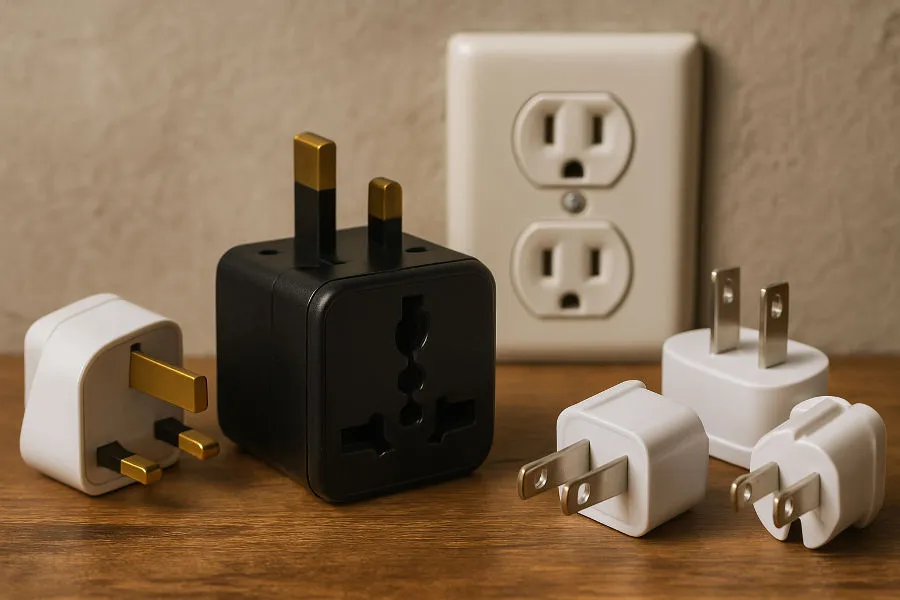
Travelers visiting multiple countries often need different plug adapters, sometimes more than one per destination, due to regional variations in outlet types and voltage. For example, Brazil uses two plug types and operates on both 127V and 220V, so travelers may need two adapters and a voltage converter for safe use. Most modern electronics are dual-voltage (100–240V), but high-power devices may require a step-down transformer. Always check device voltage and research plug types before departure.
The Basics: Adapters and Converters
An adapter is just another word for plug and is used when traveling to a country with a different outlet type, but your devices are compatible with the voltage used in that country. It physically modifies the plug so it can fit into a different type of outlet. It does not change the electrical current. For example, a US adapter plug allows a two-pronged US plug to fit into, for example, a French wall socket.
However, if your device is not dual-voltage (meaning it can handle both 120V and 230V), you may also need a voltage converter, especially for high-power appliances. Here’s more detail:
- Dual-Voltage Devices : Most modern electronics, like phones, laptops and cameras, are designed to work with dual voltages (100-240V) and only need an adapter. But if your device is not dual-voltage, you will also need a voltage converter, especially for high-power appliances.
- If you have a device designed for 110V and you are traveling to a country with 220V outlets, you will need a voltage converter to step down the voltage to 110V for your device(s).
- If you are traveling to a country with 220V outlets and your device is designed for 220V (or dual voltage 110/220V), you only need an adapter to fit your plug into the local outlet.
- To repeat: most modern electronics are dual voltage. This means they can safely operate on both 110-120V and 220-240V, which are the standard voltages used in different parts of the world. Devices like phones, laptops, cameras, and their chargers are typically dual voltage. You’ll often see this indicated on the device’s label or in its manual with a voltage range such as “100-240V.”
So always check the label on your devices. If they list a range of voltages, like 100-240V, it’s dual voltage and can be used with just an adapter plug in different countries. If it lists a single voltage (e.g., 120V only), you’ll need a voltage converter to use it safely in countries with a different voltage standard.
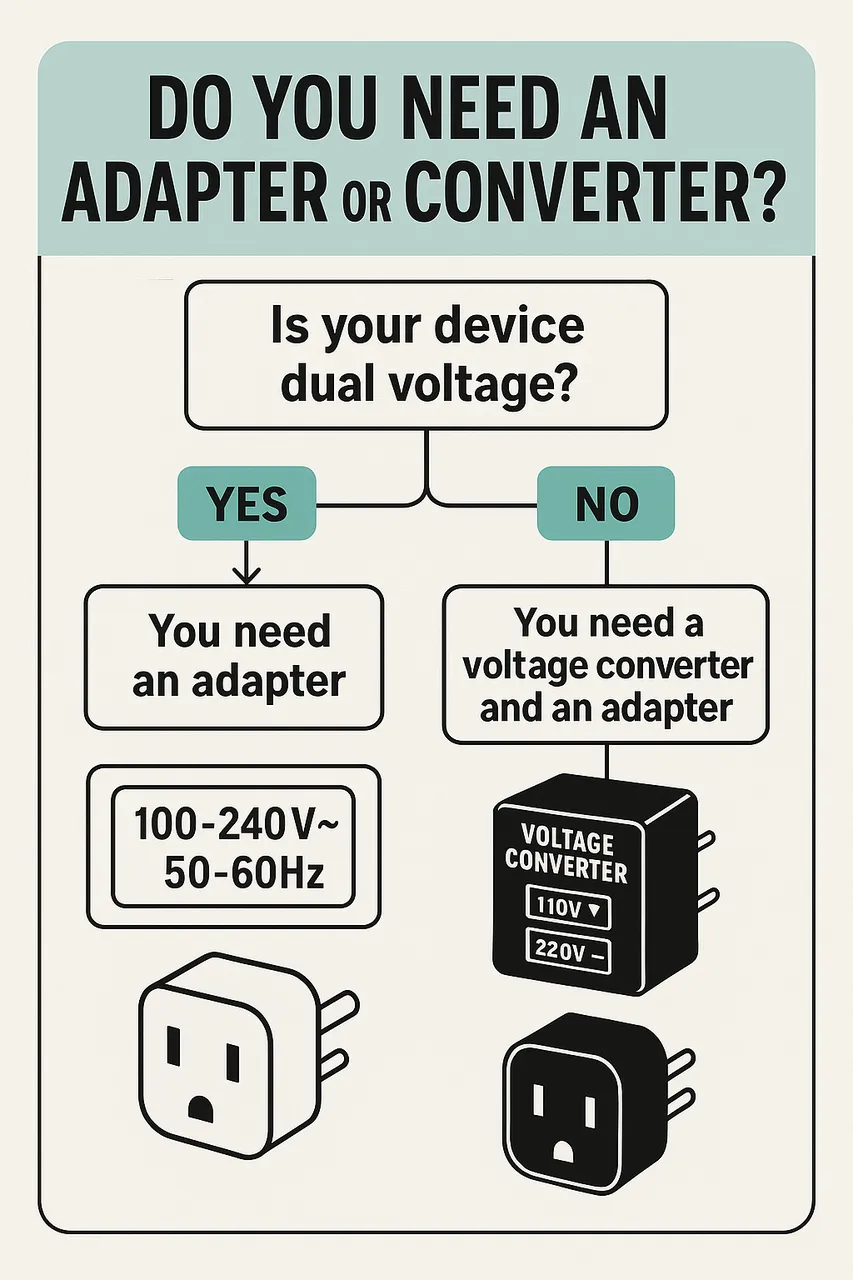
Do you need a plug or an adapter? Find out! © Kiwi.com
The Nuts and Volts of It
What’s a Volt?
Electrical systems differ between countries primarily in voltage and frequency. Voltage is a measure of electrical potential difference and represents the “thrust” or “pressure” that drives the electric current through a circuit, a little like how water pressure pushes water through pipes. By potential difference, we mean the difference in electrical potential energy between two points in a circuit.
A higher voltage means a greater potential for current to flow. Most of Europe, Asia, Africa and Australia uses 220-240 volts, while North and Central America and parts of South America use 100-127 volts.
What’s Frequency?
The term current frequency refers to the number of times the alternating current (AC) changes direction every second. In AC circuits, the current flows in one direction and then reverses, constantly oscillating back and forth. This change in direction is what we refer to as frequency. It’s measured in Hertz (Hz), where 1 Hz equals one cycle per second.
A 50 Hz frequency means the current changes direction 50 times per second, while a 60 Hz frequency means it changes direction 60 times per second. In most of the world, including Europe, Asia, and Australia, the standard frequency is 50 Hz, while North America commonly uses 60 Hz.
What Does All That Have to do With Plugs?
Plugs are adapted to voltage and frequency through a combination of physical design and internal circuitry. Different countries use various plug types and voltage/frequency standards, necessitating adapters and converters for travelers to be able to use their devices wherever they are. But not all plus are equal. In fact, adapter plugs come in a great variety, with different looks, number of prongs and geographic functionality.
How many different plugs are there?
There are 15 different main types of plugs, which are characterized as Type A, Type B, Type C all the way to Type O. But there are variations of some of these plugs. For example, there are two kinds of the Brazilian Type N plug, one with two prongs and one with three prongs (the word pin is often used instead of prong).
The extra prong on the three-prong plug grounds the plug to earth and is therefore safer than the two-prong variant. In a standard three-prong plug, the live prong (typically brown) carries the electrical current from the power source to the appliance. The neutral pin (typically blue) provides a return path for the current back to the power source to complete the circuit.
Or, for another example, there is a Type I plug that is used in Argentina and a different Type I that is the standard in Australia and New Zealand. But they are not equal because the wiring configurations are different. Australian and New Zealand plugs have the live and neutral pins arranged in a specific “V” shape, while Argentine plugs have them reversed. That is why the Australian Type I adapter plug is not compatible with the Argentine wall socket. Remember, it’s not supposed to make sense; it’s just supposed to work.
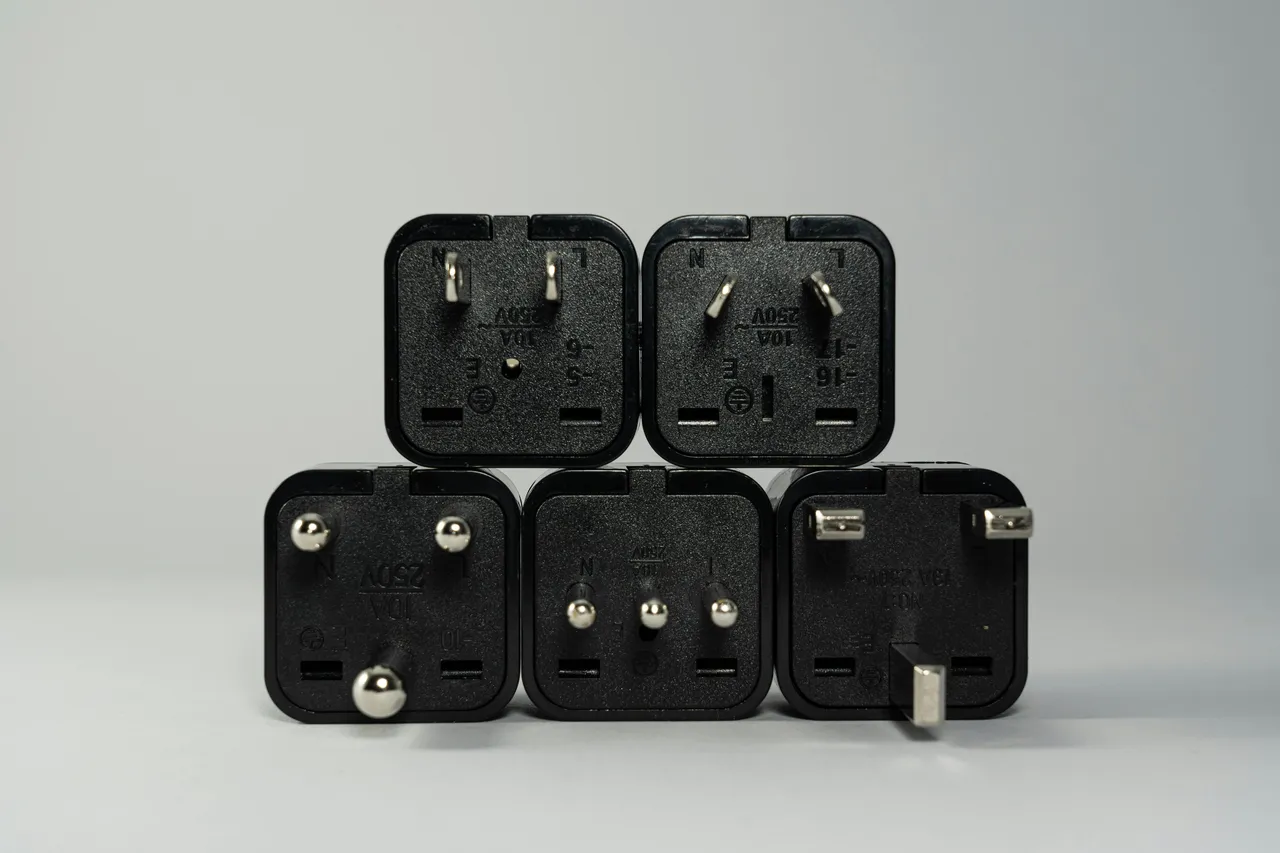
There are 15 main plug types worldwide, each with unique variations and wiring designed for safety and regional standards © Pexels
So What?
So it’s crucial to ensure that the plug and adapter being used are rated for the voltage and current requirements of the device to prevent damage and possible hazards. Always use the correct adapter and converter for the specific voltage and plug type, and avoid plugging a device into an incompatible outlet. Duh!
Why Are There So Many Different Types of Plugs?
That’s a good question. The answer involves history, culture and technological development in a non-globalized world that led to the parallel development of different plug standards:
- History and independent development : Electrical systems developed independently in different countries because they did not look beyond their borders but simply based their systems on their local electrical infrastructure and technical preferences.
- Voltage and frequency differences: Electrical systems vary in voltage and frequency around the world. Some countries use 110-120V, while others use 220-240V. This directly affects plug and socket designs, as they must be optimized for local electrical capacity and safety needs. And in Brazil, the power supply is 127V. However some of the newer hotels operate at 220V. So come prepared.
- Safety considerations: Different countries have different priorities regarding safety. As a result, electrical safety standards differ from region to region. The different existing safety regulations lead to different plug designs.
- Why it won’t change anytime soon: In a word, cost. Changing plug systems internationally to adopt a single system is extremely costly and would require substantial changes to existing electrical infrastructures as well as electronic devices. And, frankly, the irritation caused by having so many different plug and socket types isn’t bad enough to warrant such a great expense.
- So embrace the plug-and-socket chaos. A little understanding of the incredible variety of plugs and sockets in the world will, hopefully, reduce the inconvenience of adapting to all the different sockets and even make you see the humor in the world’s plug-and-socket hodgepodge.
Universal Sockets and Plugs
That’s not to say that there aren’t any “universal” sockets or plugs. But, of course, they’re not really universal, one-plug-fits-all-sockets solutions. In fact, you should be wary of “hybrid,” “multi-standard” and “universal” sockets. They are intended to accommodate plugs of two or more types, but they’re usually in violation of local safety standards in many jurisdictions.
Safety experts and some manufacturers have cited numerous safety issues with universal sockets and adapters, including voltage mismatch, lack of proper earth-grounding connections and a lack of protection from overloads or short circuits – to name just a few potential hazards.
Universal sockets may also not meet the necessary technical standards for durability and other performance requirements because they are outside the scope of national and international technical standards. So don’t use them.
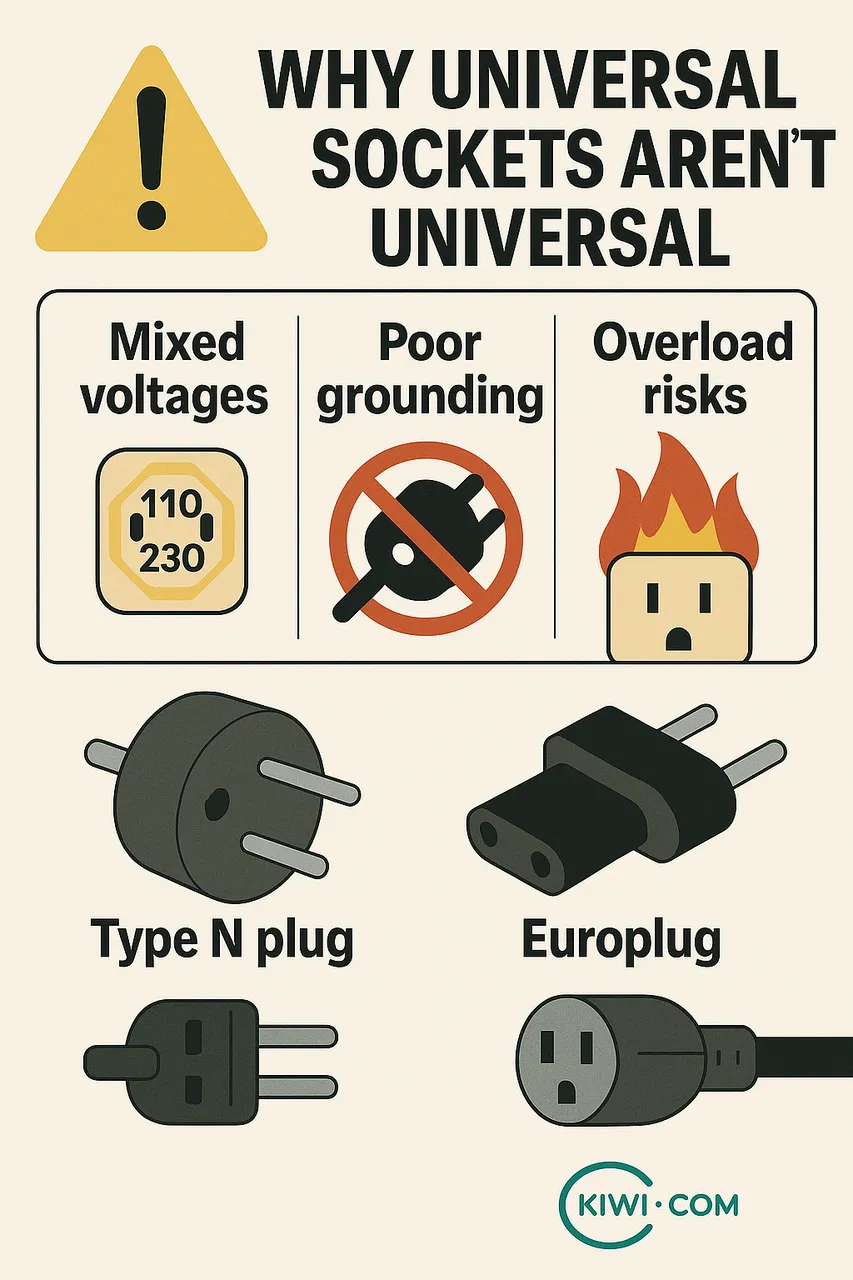
Think universal sockets work everywhere? Think again! Plug types and voltages vary more than you think © Kiwi.com
Regarding universal plugs, the International Electrotechnical Commission (IEC) has chosen a standard universal plug, type N, but it is used only in Brazil (where it is not even ‘universal’) and in South Africa . It comes in a two-pin, or ungrounded, version and with three pins, or grounded. So much for the global solution.
Then there’s the Europlug, which is as universal a solution as you can have currently. It is a Type C plug and features two parallel round prongs. Because of its simple design, this plug is compatible with other standards, such as the E, F, and K plugs with two prongs and even the J, K or N plugs with three holes in the socket. However, it won’t work in the U.K. or Ireland.
Country-by-Country List of Plugs, Sockets, and Voltages
| Country | Plug Type(s) | Voltage (V) | Frequency (Hz) |
|---|---|---|---|
| Afghanistan | C, F | 220 | 50 |
| Albania | C, F | 230 | 50 |
| Algeria | C, F | 230 | 50 |
| Andorra | C, F | 230 | 50 |
| Angola | C | 220 | 50 |
| Antigua and Barbuda | A, B, D, G, J, K, L | 230 | 60 |
| Argentina | C, I | 220 | 50 |
| Armenia | C, F< | ||
| Bosnia and Herzegovina | C, F | 230 | 50 |
| Botswana | M | 230 | 50 |
| Brazil | C, N | 127/220 | 60 |
| Brunei | G | 240 | 50 |
| Bulgaria | C, F | 230 | 50 |
| Burkina Faso | C, E | 220 | 50 |
| Burundi | C, E | 220 | 50 |
| Cabo Verde | C, F | 230 | 50 |
| Cambodia | A, C, G | 230 | 50 |
| Cameroon | C, E | 220 | 50 |
| Canada | A, B | 120 | 60 |
| Central African Republic | C, E | 230 | 50 |
| Chad | C, E | 220 | 50 |
| Chile | C, L | 220 | 50 |
| China | A, C, I | 220 | 50 |
| Colombia | A, B | 110 | 60 |
| Comoros | C, E | 220 | 50 |
| Congo, Democratic Republic of the | C, E | 220 | 50 |
| Congo, Republic of the | C, E | 220 | 50 |
| Costa Rica | A, B | 120 | 60 |
| Côte d’Ivoire (Ivory Coast) | C, E | 220 | 50 |
| Croatia | C, F | 230 | 50 |
| Cuba | A, B, C, L | 110 | 60 |
| Cyprus | G | 240 | 50 |
| Czech Republic | C, E | 230 | 50 |
| Denmark | C, E, F, K | 230 | 50 |
| Djibouti | C, E, F, J | 220 | 50 |
| Dominica | A, B, G | 230 | 50 |
| Dominican Republic | A, B | 110 | 60 |
| Ecuador | A, B | 120 | 60 |
| Egypt | C, F | 220 | 50 |
| El Salvador | A, B | 120 | 60 |
| Equatorial Guinea | C, E | 220 | 50 |
| Eritrea | C, L | 230 | 50 |
| Estonia | C, F | 230 | 50 |
| Eswatini | M | 230 | 50 |
| Ethiopia | C, F, L | 220 | 50 |
| European Union (various countries) | C, E, F | 230 | 50 |
| Fiji | I, G | 240 | 50 |
| Finland | C, F | 230 | 50 |
| France | C, E | 230 | 50 |
| Gabon | C, E | 220 | 50 |
| Gambia | G | 230 | 50 |
| Georgia | C, F, L | 220 | 50 |
| Germany | C, F | 230 | 50 |
| Ghana | D, G | 230 | 50 |
| Greece | C, F | 230 | 50 |
| Grenada | A, B, G | 230 | 50 |
| Guatemala | A, B | 120 | 60 |
| Guinea | C, F | 220 | 50 |
| Guinea-Bissau | C, F | 220 | 50 |
| Guyana | A, B, D, G, I | 240 | 60 |
| Haiti | A, B | 110 | 60 |
| Honduras | A, B | 120 | 60 |
| Hong Kong | G | 220 | 50 |
| Hungary | C, F | 230 | 50 |
| Iceland | C, F | 230 | 50 |
| India | C, D, M | 230 | 50 |
| Indonesia | C, F, G | 230 | 50 |
| Iran | C, F | 230 | 50 |
| Iraq | C, D, G | 230 | 50 |
| Ireland | G | 230 | 50 |
| Israel | C, H | 230 | 50 |
| Italy | C, F, L | 230 | 50 |
| Jamaica | A, B, G | 110 | 50 |
| Japan | A, B | 100 | 50/60 |
| Jordan | C, D, F, G | 230 | 50 |
| Kazakhstan | C, F | 220 | 50 |
| Kenya | G | 240 | 50 |
| Kiribati | I, G | 240 | 50 |
| North Korea | C, F | 220 | 60 |
| South Korea | C, F | 220 | 60 |
| Kuwait | G | 240 | 50 |
| Kyrgyzstan | C, F | 220 | 50 |
| Laos | A, B, C, E, F | 230 | 50 |
| Latvia | C, F | 230 | 50 |
| Lebanon | C, D, G | 230 | 50 |
| Lesotho | M, D, G | 220 | 50 |
| Liberia | A, B, C, D, E, F, G, I, K, L, N | 120/240 | 60 |
| Libya | C, D, F, L | 230 | 50 |
| Liechtenstein | C, J | 230 | 50 |
| Lithuania | C, F | 230 | 50 |
| Luxembourg | C, F | 230 | 50 |
| Madagascar | C, E, J | 220 | 50 |
| Malawi | G | 230 | 50 |
| Malaysia | G | 240 | 50 |
| Maldives | G, D, M | 230 | 50 |
| Mali | C, E | 220 | 50 |
| Malta | G | 230 | 50 |
| Marshall Islands | A, B | 120 | 60 |
| Mauritania | C, E | 220 | 50 |
| Mauritius | C, G | 230 | 50 |
| Mexico | A, B | 127 | 60 |
| Micronesia | A, B | 120 | 60 |
| Moldova | C, F | 230 | 50 |
| Monaco | C, E | 230 | 50 |
| Mongolia | C, E, I | 230 | 50 |
| Montenegro | C, F | 230 | 50 |
| Morocco | C, E | 220 | 50 |
| Mozambique | C, F | 220 | 50 |
| Myanmar (Burma) | C, D | 230 | 50 |
| Namibia | M, D, F, G | 220 | 50 |
| Nauru | I | 240 | 50 |
| Nepal | C, D, M | 230 | 50 |
| Netherlands | C, F | 230 | 50 |
| New Zealand | I | 230 | 50 |
| Nicaragua | A, B, C | 120 | 60 |
| Niger | C, D, E, F | 220 | 50 |
| Nigeria | D, G | 230 | 50 |
| North Macedonia | C, F | 230 | 50 |
| Norway | C, F | 230 | 50 |
| Oman | G | 240 | 50 |
| Pakistan | C, D, G | 230 | 50 |
| Palau | A, B | 120 | 60 |
| Panama | A, B | 120 | 60 |
| Papua New Guinea | I, M | 240 | 50 |
| Paraguay | C, F | 220 | 50 |
| Peru | A, B, C | 220 | 60 |
| Philippines | A, B, C | 220 | 60 |
| Poland | C, E | 230 | 50 |
| Portugal | C, F | 230 | 50 |
| Qatar | G | 240 | 50 |
| Republic of the Congo | C, E | 220 | 50 |
| Romania | C, F | 230 | 50 |
| Russia | C, F | 220 | 50 |
| Rwanda | C, J, L | 230 | 50 |
| Saint Kitts and Nevis | A, B | 120 | 60 |
| Saint Lucia | A, B, G | 230 | 50 |
| Saint Vincent and the Grenadines | A, B, G | 230 | 50 |
| Samoa | I | 230 | 50 |
| San Marino | C, F | 230 | 50 |
| Sao Tome and Principe | C, F | 220 | 50 |
| Saudi Arabia | G | 230 | 60 |
| Senegal | C, D, E, K | 230 | 50 |
| Serbia | C, F | 230 | 50 |
| Seychelles | G | 240 | 50 |
| Sierra Leone | D, G, I | 230 | 50 |
| Singapore | G | 230 | 50 |
| Slovakia | C, E | 230 | 50 |
| Slovenia | C, F | 230 | 50 |
| Solomon Islands | I, G | 230 | 50 |
| Somalia | C, D, E, F, G, I, K, L | 220 | 50 |
| South Africa | M, N | 230 | 50 |
| South Korea | C, F | 220 | 60 |
| South Sudan | D, G, M | 230 | 50 |
| Spain | C, F | 230 | 50 |
| Sri Lanka | D, G, M | 230 | 50 |
| Sudan | C, D, M, F | 230 | 50 |
| Suriname | A, B, C, F | 127 | 60 |
| Sweden | C, F | 230 | 50 |
| Switzerland | C, J | 230 | 50 |
| Syria | C, E, L | 220 | 50 |
| Taiwan | A, B | 110 | 60 |
| Tajikistan | C, F | 220 | 50 |
| Tanzania | D, G, M | 230 | 50 |
| Thailand | A, B, C, O | 220 | 50 |
| Togo | C, E | 220 | 50 |
| Tonga | I | 240 | 50 |
| Trinidad and Tobago | A, B, D, G | 115 | 60 |
| Tunisia | C, E | 230 | 50 |
| Turkey | C, F | 230 | 50 |
| Turkmenistan | C, F | 220 | 50 |
| Tuvalu | I | 240 | 50 |
| Uganda | D, G, M | 240 | 50 |
| Ukraine | C, F | 230 | 50 |
| United Arab Emirates | G | 230 | 50 |
| United Kingdom | G | 230 | 50 |
| United States | A, B | 120 | 60 |
| Uruguay | C, F | 230 | 50 |
| Uzbekistan | C, F | 220 | 50 |
| Vanuatu | I, G | 230 | 50 |
| Vatican City | C, F | 230 | 50 |
| Venezuela | A, B | 120 | 60 |
| Vietnam | A, C | 220 | 50 |
| Yemen | A, B, C, D, G, H | 230 | 50 |
| Zambia | C, D, G, J, K, M | 230 | 50 |
| Zimbabwe | D, G, M | 230 | 50 |
Final Words
As I hope you’ve gathered by now, the world of plugs is wild and wacky and even illogical and therefore requires your utmost attention, especially if you’re traveling well off the beaten tourist path. Fortunately for you, you now have this handy guide to that offbeat world and all sorts of even more detailed information online should you require it. Take advantage of that information, especially if you’re traveling to plug salads like South America or other, similar destinations.
Your Complete Guide to Travel Plug Adapters
What is a plug adapter, and do I need one when traveling?
A plug adapter allows your device’s plug to fit into foreign outlets with different shapes. You need an adapter whenever the plug type in your destination differs from your device’s plug. Adapters only change the plug shape; they do not convert voltage. Most modern electronics are dual voltage (100–240V) and only require an adapter. Check your device label to confirm if a voltage converter is also needed.
What’s the difference between a plug adapter and a voltage converter?
A plug adapter changes the plug’s physical shape to fit different outlets. A voltage converter changes electrical voltage to protect devices that aren’t dual voltage. If your device is not dual voltage and the local voltage differs (e.g., 110V device in a 220V country), you need a voltage converter, especially for high-power appliances like hairdryers.
How do I find out which plug types I need for my trip?
Identify the plug types used in your destination country by consulting a country-specific plug guide or chart. Some countries use multiple plug types (e.g., Peru uses Types A, B, and C), so pack accordingly. Always verify before traveling to avoid surprises.
Are universal plug adapters safe to use?
Universal adapters are designed to fit multiple plug types but often lack proper grounding and protection, potentially creating safety hazards. They may also violate local regulations and technical standards. Using dedicated adapters and converters for each country is safer.
Why do different countries have so many plug and socket types?
Plug standards developed independently worldwide due to history, culture, and differing electrical systems. Variations in voltage, frequency, and safety requirements also influenced designs. Global standardization is expensive and disruptive, so multiple plug types remain in use, requiring travelers to carry various adapters.
Popular routes on Kiwi.com
- Cheap flights from London to Barcelona
- Cheap flights from London to New York
- Cheap flights from London to Asturias
- Cheap flights from London to Pattaya
- Cheap flights from London
- Cheap flights to Spain
- Cheap flights to Italy
- Cheap flights to Thailand
- Cheap flights to the United States
- Cheap flights to the United Kingdom
- Cheap flights from London Luton Airport
- Last minute flights
People Also Read