





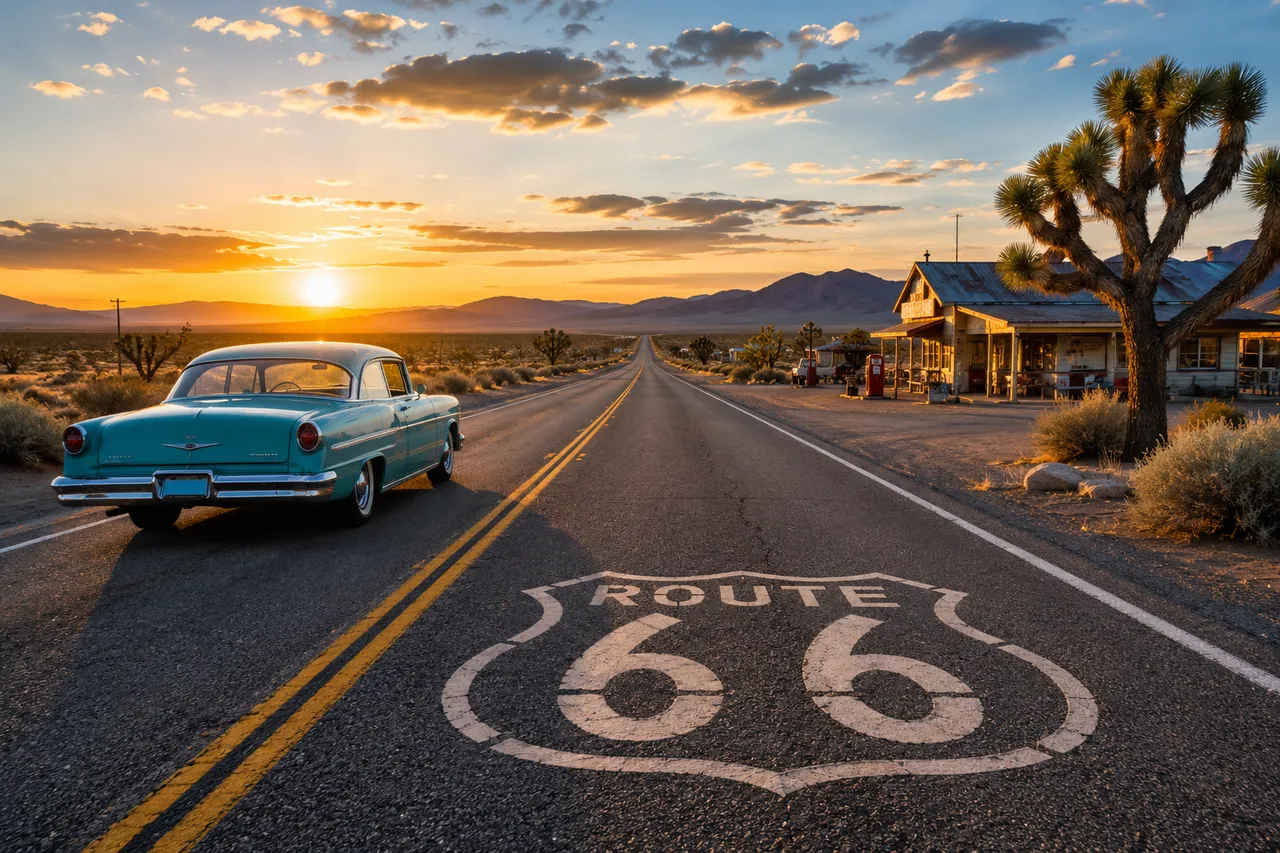
Stretching 2,448 miles (3,940 km) from Chicago to Santa Monica, Route 66 earned nicknames like the “Mother Road” and “Main Street of America.” It was a catalyst for economic development, fostering the rise of “mom-and-pop” businesses and early fast-food concepts. Because it is no longer a continuous highway, driving Route 66 requires navigating a patchwork of turn-offs, detours, and stretches on the interstate. The Historic Route 66 Association of America and the National Scenic Byways Route 66 page are useful resources.
Route 66 in American Culture
Route 66 isn’t just a stretch of asphalt; it is a primary character in the American narrative. It has evolved from a practical migration path into a global symbol of freedom, rebellion, and the bittersweet “golden age” of the mid-20th century.
Literature: The “Mother Road”
The most profound cultural stamp on the route came from the writer John Steinbeck. In his 1939 masterpiece The Grapes of Wrath, he dubbed it the “Mother Road.”
The Symbolism
To the Joad family of The Grapes of Wrath and thousands of real-life “Okies,” Route 66 was a “road of flight”—a path of desperate hope leading away from the Dust Bowl toward the perceived Eden of California.
The Legacy
Steinbeck’s gritty portrayal ensured that the road would always be associated with the resilience of the American spirit.
Music: “Get Your Kicks”
In 1946, songwriter Bobby Troup hopped in his car and headed west. By the time he reached Los Angeles , he had written the lyrics to “(Get Your Kicks on) Route 66.” Recorded by Nat King Cole, and later covered by everyone from Chuck Berry to The Rolling Stones and Depeche Mode, the song turned a dusty highway into a trendy destination for the post-war generation, making names like Winona, Kingman, and Barstow famous worldwide.
Television & Film: The Road as Escape
The road has been a backdrop for the American dream—and its darker underbelly—for more than a half-century.
The Route 66 TV Series (1960-64)
Featuring two young men in a Chevrolet Corvette, this show cemented the idea that the road was where you went to “find yourself.” Many episodes weren’t even filmed on the actual route, but the idea of it was what mattered.
Pixar’s Cars (2006)
This film is arguably responsible for the modern revival of Route 66. The fictional town of Radiator Springs is a composite of real stops (like Seligman and Peach Springs, both in Arizona). It poignantly captured the tragedy of towns bypassed by the Interstate.
Easy Rider (1969)
While the film wanders, it utilizes the Southwestern stretches of the route to highlight the clash between the 1960s counterculture and the traditional “Main Street” values the road originally represented.
The Aesthetic: Neon and “Googie”
Route 66 created a unique architectural language known as Googie architecture. It was designed to catch the eye of a driver moving at 50 mph.
Neon Signage
At night, the route was a glowing ribbon of light. To this day, the “neon glow” is the visual shorthand for Route 66 nostalgia.
Roadside Giants
The “Muffler Men” and giant fiberglass animals (like the Blue Whale) were the 1950s version of clickbait—physical structures designed to force a “scroll-stopping” pause in your journey.
Cultural Symbolism: Freedom vs. Homogenization
Culturally, the road represents a tension between two Americas:
- The Individualist: Every diner had a different pie; every motel had a different theme. It represents an era of local flavor and “mom-and-pop” entrepreneurship.
- The Modern: The Interstate (I-40) represents efficiency and corporate uniformity. The “death” of Route 66 in 1985 is often cited in cultural studies as the moment America traded its soul for speed.
Interesting Fact
Because of its massive cultural footprint, Route 66 is more popular with international tourists (particularly from Germany, Japan, and the UK) than it is with many Americans. To the rest of the world, it is the ultimate American experience.
Iconic Sites to Visit: The Eastern Half
While the eastern half (Illinois to Texas) of a full cross-country trip along Route 66 is rich with midwestern charm and quirky roadside art, the western half (New Mexico to California) offers some of the most dramatic landscapes and iconic neon-lit stops on the Mother Road. A full trip typically takes 2 to 3 weeks to experience comfortably.
“Route 66 Begin” Sign
The “Route 66 Begin” sign is located on East Adams Street, just west of South Michigan Avenue, in downtown Chicago, Illinois, and marks the official starting point of the historic U.S. Route 66. Because Adams Street is a one-way street heading west, it serves as the practical launch point for travelers.
The corresponding “End Route 66” sign, for those who travel the route from west to east, can be found a few blocks away on Jackson Boulevard.
Lou Mitchell’s
Lou Mitchell’s is often called the “first stop” on the Mother Road. This historic Chicago diner has been serving hearty breakfasts to travelers since before Route 66 was even officially named.
- Famous for its classic diner atmosphere and legendary omelets.
- Listed on the National Register of Historic Places.
The Gemini Giant
The Gemini Giant is a 30-foot-tall spaceman in Wilmington, Illinois, holding a silver rocket. It is a prime example of the “Muffler Men” fiberglass statues that once dotted the American roadside.
Cozy Dog Drive In
The Cozy Dog Drive in Springfield, Illinois, claims a special place in culinary history as the birthplace of the corn dog on a stick. The diner is packed with Route 66 memorabilia and neon signs. Signature “Cozy Dogs” are still made with the original secret batter recipe.
Meramec Caverns
The Meramec Caverns became a staple of Route 66 tourism thanks to an aggressive barn-painting advertising campaign that stretched across several states. These colorful Missouri caves were also a rumored hideout for the outlaw Jesse James.
- Offers guided tours of massive mineral formations.
- Known for its historic “Greatest Show Under the Earth” light display.
Historic Rainbow Bridge
The Historic Rainbow Bridge is located just outside of Baxter Springs, Kansas. It is a beautifully preserved example of early-20th-century concrete bridge design and is the last remaining Marsh arch bridge on the entire route.
Blue Whale of Catoosa
The Blue Whale of Catoosa is perhaps the most beloved “weird” attraction in Oklahoma. Originally built as an anniversary gift in the 1970s, the massive iron-and-cement whale became a popular swimming hole and rest stop.
Cadillac Ranch
The Cadillac Ranch is a public art installation in Amarillo , Texas, featuring ten vintage Cadillacs buried nose-first in the ground. It was designed to represent the “Golden Age” of the American automobile. Visitors are encouraged to bring spray paint and leave their own mark on the cars.
New Mexico: Neon and Natural Wonders
Blue Swallow Motel
The Blue Swallow Motel in Tucumcari is arguably the most famous motel on the entire route. Its stunning neon sign and restored vintage rooms make it a must-visit for anyone seeking the authentic 1940s road trip experience.
Blue Hole
The Blue Hole Santa Rosa is a natural phenomenon, a sapphire-blue, bell-shaped pool in the middle of the desert. The water remains a constant 62 degrees year-round, making it a popular spot for scuba diving and a refreshing break for travelers.
66 Diner
Housed in a converted 1940s Phillips 66 service station, the 66 Diner in Albuquerque is a quintessential 1950s-style diner located on a historic stretch of Central Avenue. It is famous for its milkshakes and a “wall of signs” that serves as a perfect photography backdrop.
Arizona: The Heart of the Mother Road
Petrified Forest National Park
The Petrified Forest National Park is the only national park that contains a segment of Route 66. The park features ancient fossilized logs, the vibrant colors of the Painted Desert and offers stunning overlooks of badlands and archaeological sites.
Wigwam Motel
Built in 1950 and meticulously restored, the Wigwam Motel in Holbrook is one of only two remaining “Wigwam Villages” on Route 66. Each room is a freestanding concrete teepee, providing a truly unique overnight stay.
Meteor Crater Natural Landmark
Nearly one mile across and over 500 feet deep, the Meteor Crater Natural Landmark is a massive impact site just off the highway. It is the best-preserved meteorite crater on Earth and was used as a training ground for Apollo astronauts.
Hackberry General Store
Hackberry General Store is a living museum of Route 66 history. This former gas station is packed with vintage memorabilia, old fuel pumps, and weathered road signs.
Mr D’z Route 66 Diner & Gift Shop
Mr D’z Route 66 Diner & Gift Shop in Kingman is a bright pink-and-turquoise diner that perfectly captures the mid-century aesthetic. Customers rave about its homemade root beer and burgers and its classic soda fountain experience
Oatman
Famous for daily Wild West gunfights, Oatman is a former gold-mining town in the Black Mountains in which friendly wild burros, the descendants of miners’ pack animals, roam the streets. The drive to Oatman via Sitgreaves Pass is one of the most scenic and challenging segments of the entire route.
California: The Final Stretch
Roy’s Motel & Cafe
Roy’s Motel & Cafe in Amboy is a solitary mid-century landmark in the heart of the Mojave Desert. Known for its Googie architecture and stark, desert beauty, its massive neon “Roy’s” sign is one of the most photographed sights on Route 66. It currently operates primarily as a gas station and photo op.
Elmer’s Bottle Tree Ranch
Elmer’s Bottle Tree Ranch in Oro Grande is an eccentric folk art installation consisting of hundreds of “trees” made from glass bottles and scrap metal.
Santa Monica Pier
The Santa Monica Pier marks the official western end of Route 66. A “Route 66 - End of the Trail” sign stands near the end of the pier, overlooking the Pacific Ocean. It features a historic wooden carousel and the Pacific Park amusement park.
The Best Time to Drive Route 66
The Ideal Windows
Spring (May–early June)
This is widely considered the best time. The weather is mild across the entire route, the desert flowers are in bloom, and most seasonal attractions have just opened for the year. You avoid the extreme desert heat of the summer and the late-season snow in the mountains.
Fall (September–October)
This is the second-best window. The summer crowds have thinned and the scorching temperatures in Texas, Arizona, and the California desert begin to drop. The crisp autumn air in the Ozarks (Missouri) and the changing leaves in the Illinois plains make for a scenic drive.
Seasonal Pros and Cons
| Season | Pros | Cons |
|---|---|---|
| Summer (July–Aug.) | Long daylight hours; peak “road trip” energy; all businesses and museums are open. | Oppressive heat (100°F+) in the Southwest; high humidity in the Midwest; peak crowds and higher hotel prices. |
| Winter (Dec. –Feb.) | No crowds; lower hotel rates; a unique look at the route with occasional snow. | Many iconic mom-and-pop stops close for the season; potential for dangerous snow/ice in Illinois, Arizona, and New Mexico. |
| Spring/Fall | Temperate weather; fewer crowds; lower humidity; ideal for classic car photography. | Weather can be unpredictable; potential for “Tornado Alley” storms in the Midwest during late spring. |
The 2026 Centennial Factor
If you are planning your trip for 2026, it is the 100th Anniversary of Route 66 as well as the 250th anniversary of the founding of the US. This will be a massive year for the road.
Pro
There will be unprecedented festivals, car shows, and special events in nearly every major town along the route (like the “Centennial Great Race” in June).
Con
It will be the busiest year in the road’s history. If you plan to go in 2026, you should have booked your historic motels (like the Blue Swallow or Wigwam) at least a year in advance.
Pacing
For a full cross-country trip, 3 weeks is the “Goldilocks” duration. This allows you to drive roughly 120–150 miles a day, leaving plenty of time to pull over for every giant statue, neon sign, and local diner you encounter.
Bon Voyage!
The “Mother Road” has undergone a significant high-tech and eco-friendly transformation leading up to its 2026 Centennial. Modernization along the route focuses on making the journey accessible for electric vehicles, integrating digital storytelling, and revitalizing historic spaces for a new generation.
Tip
For planning maps and preservation information, the Historic Route 66 Association of America and the National Scenic Byways Route 66 page are useful resources.
Need to Know Before Driving Route 66? Start With These Essential FAQs
What’s so special about US Route 66?
US Route 66 is one of the most iconic highways in American history. Originally opened in 1926, it became a symbol of freedom, adventure, rebellion, and opportunity throughout the 20th century. It played a major role during the Great Depression and later became closely tied to America’s booming car culture in the 1950s and 1960s.
Route 66 has inspired countless books, movies, songs, and road trip stories, including John Steinbeck’s The Grapes of Wrath and the famous song “(Get Your Kicks on) Route 66.” Today, it remains one of the world’s most legendary road trips.
Why is Route 66 worth visiting?
Route 66 delivers the classic American road trip experience with quirky roadside attractions, retro diners, neon signs, vintage motels, and unforgettable scenery. International travelers especially love it because it captures the nostalgic spirit of old America.
The eastern section features charming Midwestern towns and unique roadside art, while the western portion offers stunning desert landscapes and famous stops like Cadillac Ranch, the Blue Whale of Catoosa, and Petrified Forest National Park.
How long is Route 66 and how much time is needed for the drive?
The complete Route 66 journey stretches approximately 2,448 miles (3,940 km) from Chicago, Illinois, to Santa Monica, California.
Most travelers need around 2 to 3 weeks to properly experience the route without rushing. This allows enough time to explore attractions, small towns, historic landmarks, and scenic viewpoints along the way.
When is the best time to drive Route 66?
Late spring, especially from May to early June, is widely considered the best time to travel Route 66. Temperatures are comfortable across most states, desert flowers are blooming, and seasonal attractions are reopening after winter.
Early fall, from September to October, is another excellent option because crowds are smaller and the intense summer heat in states like Arizona, Texas, and California begins to cool down.
Is Route 66 still the same road that opened in 1926?
No. Route 66 was gradually replaced by the Interstate Highway System and officially removed from the U.S. Highway System in 1985. However, about 85% of the original route can still be driven today as Historic Route 66.
Travelers should expect occasional detours, disconnected sections, and short interstate stretches while following the historic route. Planning ahead with updated Route 66 maps and preservation resources is highly recommended.
Popular routes on Kiwi.com
- Cheap flights from London to Turkey
- Cheap flights from London to Barcelona
- Cheap flights from London to Japan
- Cheap flights from London to New York
- Cheap flights from New York to Paris
- Cheap flights to Spain
- Cheap flights to Italy
- Cheap flights to the United States
- Cheap flights to the United Kingdom
- Last minute flights
People Also Read

How to Travel Patagonia: A First-Timer's Guide to Chile & Argentina's Wild South
Where to stay in Palma de Mallorca: best areas for beaches, culture and nightlife