






When flights are on different tickets, the second airline usually has no obligation to rebook you if you miss it. So allow yourself 1–3 hours to make your connecting flight when traveling domestically and 2–6 hours on international flights. Airlines have different policies toward self-connecting flights. A budget airline such as Ryanair will offer you no protection if you miss your second flight. If saving money matters, choose self-connection when you travel carry-on or you know the airports well and have ample buffer time between flights.
Why Fly on Separate Tickets
How It Works
You book each flight as an independent ticket, even if they are for the same overall journey. You are responsible for making the connection between flights. This means that you must collect your checked luggage after your first flight and then re-check it for your next flight. On international flights, you will also need to go through security and immigration or customs at the connecting airport.
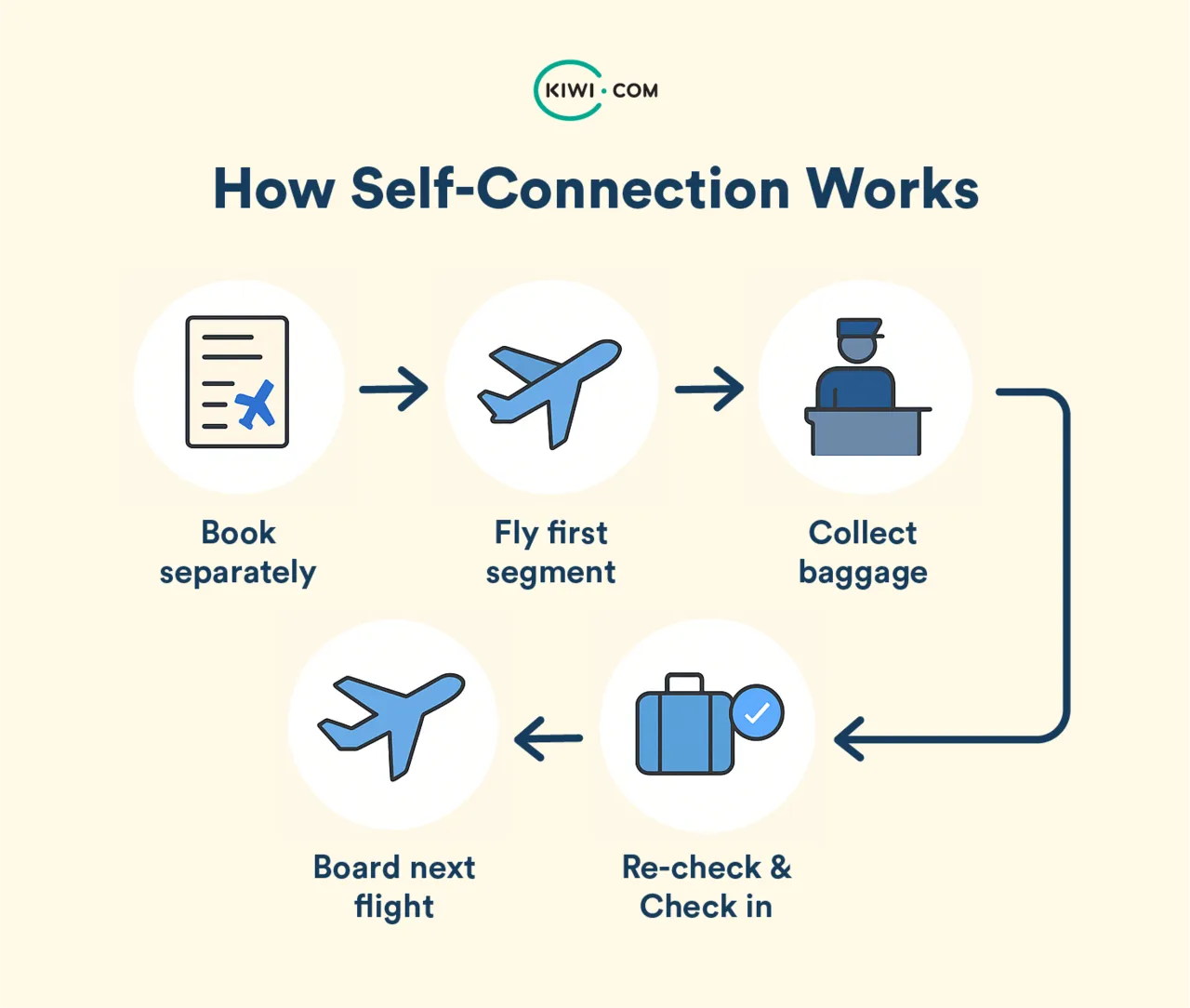
How self-connecting flights work, from booking to boarding your next plane © Kiwi.com
Cost savings
Lower fares
Different carriers or booking markets often show much cheaper prices on individual legs than for a single through fare. In addition, combining a major carrier for a long-haul leg with a budget airline for the short connection can cut the overall price.
Award and loyalty strategy
You can book an award for the long-haul portion and buy a separate positioning flight to reach the award’s origin airport. And you can book a premium carrier for the segment where lounge access or baggage benefits matter while buying a cheaper linking flight.
Routing and Schedule Flexibility
You can add a multi-hour or multi-day stopover to visit a city without paying for a complicated multi-segment ticket. In cases when cities have multiple airports and single-ticket options don’t align, you can arrive at one airport and depart from another.
Access or Connectivity Reasons
When two airlines don’t interline, you must buy two tickets to combine their schedules. Also, small regional airports may be served only by local carriers, which would require a separate connecting ticket.
Special Needs and Preferences
You can book separate segments to get a preferred cabin, aircraft, or seat on the most important leg.
Timing and Contingency Planning
If you want to take advantage of a one-way or sale fare that only originates from another city, you will need a separate ticket. A separate ticket also allows you to break a trip into independently changeable parts without disrupting the whole itinerary.
Key Tradeoffs and How to Reduce Risk
Tradeoffs
Separate tickets place the risk of a missed connection and baggage collection on you; airlines are not obliged to rebook you if an earlier carrier delays you.
How to reduce risk
- Allow for generous connection time between tickets.
- Avoid checking baggage on the first ticket or, if you accept the risk, leave ample time to re-check.
- Buy flexible fares or a refundable/partially refundable ticket on at least one leg.
- Consider travel insurance that covers missed connections and onward rebooking costs.
- If possible, use the same alliance or carriers that may voluntarily assist when delays or cancelations occur.
- Keep alternative flight options and contact information ready for quick rebooking.
What to consider before deciding
If the cost savings are significant and/or the routing is significantly better, separate tickets may be worth the risk. If you cannot accept the hassle and extra costs of rebooking for missing a connection, go for a single through ticket. Remember that you can reduce the risk by traveling carry-on and making sure to have a long-enough time between connections.
The Risks of Self-Connecting Flights
In general, avoid self-connecting flights when you lack a sufficiently long layover, especially if you have checked baggage, are traveling with children, are hunting for cheap flights for seniors who need more time between gates, have limited funds to buy a new last-minute ticket, are unfamiliar with the airport, don’t have the necessary visa or entry permits for the transfer country, or if either flight is on an airline without a “transfer protection” guarantee.
Missed Connections
Delays to your first flight can lead to a missed connection, and you’ll be responsible for rebooking and any associated costs.
No Airline Assistance
Unlike flights booked on a single ticket, the airlines are not obliged to rebook you on the next available flight for free, as you’ve booked separate tickets.
Baggage Issues
You’ll likely have to collect your checked luggage on the first flight and then re-check it for the second, which takes significant time and adds to your risk of missing the connection.
Financial Costs
If you miss your connecting flight, you may have to buy a completely new last-minute ticket, which can be very expensive.
Entry Requirements
On international flights, you must ensure that you are eligible to enter the country of your transfer, even for domestic-to-international or international-to-domestic self-transfers, as you will likely pass through immigration.
When to Be Extra Cautious
Short Layovers
A layover of less than 3-4 hours could be too short for a self-connecting flight unless you are traveling carry-on only or know the airport well.
During Peak Travel
Connecting through major airports known for congestion or at busy times increases the risk of delays.
Elderly or Young Travelers
Traveling with children or elderly individuals adds complexity, as delays can be more problematic and require more time.
Lack of Transfer Protection:
If the booking platform doesn’t offer a transfer protection guarantee, you’ll be fully exposed to the risks of missed connections.
Unfamiliar Airports:
Avoid self-connecting at airports known for being difficult or time-consuming to navigate, especially with multiple terminals requiring additional transport.
Recommended Minimum Connection Time for Self-connecting Flights
Domestic (same airport)
- Carry-on only: allow 1-2 hours.
- With checked baggage: allow 2-3 hours to collect bags, re-check them, pass security, and move between terminals.
- If terminals are far or you must change terminals by bus/train: 3+ hours.
International (any segment requires immigration/customs)
- Carry-on only: allow 2-4 hours because you may need to clear immigration or visit a transfer desk.
- With checked baggage: allow 4-6 hours to collect bags, clear immigration/customs, re-check, and pass security.
- Allow extra time if visa or transit permission is required to leave the sterile area
Changing airports for your connection
- Minimum practical window: 5-8 hours as a baseline in medium-size cities.
- Busy/large cities or peak traffic times: plan 8-12 hours to cover surface transfer time, check-in recommended opening times, and unexpected delays.
- If flights are early morning or late night with limited public transport: allow longer or simply avoid transfer involving different airports.
| Scenario | Baggage Situation | Recommended Time |
|---|---|---|
| Domestic – Same Airport | Carry-on only | 1–2 hours |
| Checked bags | 2–3 hours | |
| Changing terminals | 3+ hours | |
| International – Any Segment with Immigration/Customs | Carry-on only | 2–4 hours |
| Checked bags | 4–6 hours | |
| Visa or transit permit required | Add extra buffer | |
| Changing Airports | Medium-size city | 5–8 hours |
| Large/busy city or peak traffic | 8–12 hours | |
| Early morning/late-night with limited transport | Allow longer or avoid altogether |
What to do to reduce risk
- Travel carry-on only when possible.
- Check airport transfer times (shuttle, train, taxi) and typical traffic at your travel hour.
- Confirm check-in and bag-drop opening times for the second airline.
- Buy flexible or refundable tickets and trip insurance that covers missed connections on separate tickets.
- Build at least one extra hour of buffer for international connections and city transfers during peak seasons or poor weather.
Airline Policies for Self-Connecting Flights
Airlines differ widely: some offer limited help for self-connections, most do not accept responsibility, and a few partner carriers may cooperate. Always assume no protection unless your itinerary is on one ticket or the airline explicitly confirms otherwise.
Common Policy Differences
Baggage handling
Some airlines will not accept through-checking of bags onto a separately ticketed carrier. Most expect you to collect and re-check bags yourself. A few carriers or alliances may allow through-checking between partner airlines even on separate tickets, but this is the exception.
Missed connection liability
When flights are on separate tickets, the second airline usually has no obligation to rebook you if you miss your connecting flight because of a delay on the first flight. If both legs are on one ticket, the operating airline must accommodate you under its contract of carriage.
Re-accommodation and compensation
Compensation rules and rebooking protections apply only when the same airline (or the operating carrier) is responsible for the whole itinerary. On separate tickets you typically must buy a new ticket or use travel insurance.
Check-in and transfer procedures
Separate tickets often require you to exit the sterile area, pass immigration or customs, collect and recheck bags, and possibly change terminals or airports. Some airports and airlines offer a formal self-transfer desk or service that assists with this, but it is not universal. Ask the airline either before you fly or when checking in.
Visa and entry requirements
Airlines expect you to have the right to enter or transit the country where you self-connect. If you need a transit visa or must clear immigration to collect bags, the airline will still check you in only if you meet those requirements.
Fees and taxes
You may pay airport fees, baggage fees, and check-in fees twice. Some airlines add fees for manual reissue or for checking in late when arriving from another carrier.
Partner and alliance exceptions
Airlines in alliances or with interline agreements are more likely to cooperate with baggage transfer and rebooking even with separate ticketing. But cooperation varies and is not guaranteed. Be sure to check your airline’s policy.
Practical actions to take
- Check each airline’s contract of carriage and baggage policy before booking.
- Allow generous connection time: several hours for same-airport transfers, much more if changing terminals or airports.
- Travel with carry-on only when possible to avoid rechecking bags.
- Buy trip insurance that covers missed connections on separate tickets or choose refundable/flexible fares.
- Consider booking protected self-transfer services: some airports/agents offer this service where carriers coordinate transfers for a fee.
- Prefer alliance or interline partners when you must self-connect; chances of assistance are higher.
How Airlines Commonly Treat Self-connecting Flights
| Airline / group | Through-check baggage on separate tickets | Missed-connection protection | Typical notes |
|---|---|---|---|
| Ryanair | Unlikely | None | Low-cost, point-to-point carrier; you must collect and recheck bags and rebook if you miss the second flight. |
| EasyJet | Unlikely | None | No interline agreements with most carriers; treat each ticket independently. |
| Wizz Air | Unlikely | None | Low-cost; no protection or through-check on separate tickets. |
| Lufthansa Group (Lufthansa , Swiss, Austrian) | Possible if an interline agreement exists; not guaranteed on separate tickets | Rare on separate tickets; only when on one ticket or explicit agreement | Legacy carrier; more partner cooperation when flights are on a single PNR or when formal interline is in place. |
| IAG carriers (British Airways , Iberia ) | Possible with partners under interline agreements; usually not for independent tickets | Only when itinerary is ticketed together | Legacy/full-service carriers that can protect connections when ticketed as one itinerary. |
| Air France , KLM | Possible with partners when interline/Alliance arrangements exist | Only when the whole itinerary is on one ticket | Legacy group; better partner handling if booked through one reservation. |
| Turkish Airlines | Possible with partners; varies by route and ticketing | Only when ticketed together or formal protection purchased | Often cooperative with alliance/partner carriers but separate tickets remain risky. |
| Emirates | Possible with partner airlines via interline; varies | Protection only on single-ticket journeys or when partner explicitly accepts responsibility | Strong global partnerships but separate-ticket protection is not automatic. |
| Scoot / other long-haul LCC subsidiaries | Unlikely | None | Low-cost or hybrid LCC subsidiaries typically do not provide through-check or rebook protection on separate tickets. |
Key takeaways
- Low-cost carriers (Ryanair, easyJet, Wizz Air, many LCC subsidiaries) almost always treat self-connects as unprotected and will not through-check bags.
- Legacy/full-service carriers (Lufthansa Group, Air France–KLM, IAG, Emirates, Turkish) have more interline and alliance options and may cooperate with partners. But cooperation usually requires either a single ticket or a formal interline agreement; separate tickets remain risky.
- Always assume no protection on separate tickets unless the airline explicitly confirms through-check and missed-connection coverage.
Practical steps
- Check the airline’s baggage and contract of carriage pages for interline/through-check policies.
- Ask the airline in writing whether they will through-check bags and accept responsibility for missed connections when flights are on separate tickets.
- If uncertain, allow plenty of transfer time or rebook both legs on a single ticket with a carrier or partner that will protect the connection.
- For financial protection, purchase travel insurance that covers missed connections on separate tickets.
Self-Connecting Flights: Urgent, Practical FAQs
What is a self-connecting flight and what are the benefits?
A self-connecting flight is when you book two or more separate tickets to reach your destination instead of one protected itinerary. Benefits include lower prices and greater flexibility in routes and schedules.
What are the risks of a self-connecting flight?
You must collect and recheck your bags, clear customs and immigration where required, and check in again for the next flight. If you miss the connection, rebooking costs are on you.
When should I not travel on separate tickets?
Avoid self-connecting when layovers are short, you are traveling with children or elderly passengers, funds are tight, you are unfamiliar with the airport, you lack required visas or entry permits for the transfer country, or either flight is on an airline with no transfer protection.
How can I minimize the risks of self-connection?
Travel with carry-on only, buy insurance that covers missed connections on separate tickets, fly carriers that cooperate with partners (for example, Lufthansa or Air France-KLM) rather than budget carriers that do not protect self-connects, allow generous time for rechecking bags and border control, and review baggage and contract of carriage pages for interline or through-check policies.
How much time is “ample” between flights?
Domestic: 1–2 hours with carry-on, 2–3 hours with checked bags, 3+ hours if changing terminals. International: 2–4 hours with carry-on, 4–6 hours with checked bags, and extra time if a visa is needed to exit the sterile area. Changing airports: budget 5–12 hours depending on city size and transit time.
Popular routes on Kiwi.com
- Cheap flights from London to Barcelona
- Cheap flights from London to New York
- Cheap flights from London to Asturias
- Cheap flights from London to Pattaya
- Cheap flights from London
- Cheap flights to Spain
- Cheap flights to Italy
- Cheap flights to Thailand
- Cheap flights to the United States
- Cheap flights to the United Kingdom
- Cheap flights from London Luton Airport
- Last minute flights
People Also Read



How to Travel Patagonia: A First-Timer's Guide to Chile & Argentina's Wild South