






Using incognito mode will not prevent prices from rising. Airlines use a sophisticated mix of strategies and data analytics to set ticket prices, aiming to maximize revenue while staying competitive, including, time of booking, route popularity and algorithms that adjust fares constantly. Southwest Airlines uses time-of-purchase as its main pricing lever, with fares climbing steadily as departure approaches. To find the cheapest flights , compare several search engines and online travel agencies, then click through to the airline’s site before buying.
What Is Incognito and What Does It Do?
Incognito mode is a private browsing feature built into web browsers that limits what the browser saves locally during a browsing session.
How It Works
It does not save browsing history, which means that pages you visit aren’t added to the browser history on that device. At session end it deletes cookies and local storage, while temporary files created during the session are removed when you close the incognito window. It does not keep form data. Search entries, autofill, and passwords entered in the session are not saved to the browser. And it separates sessions. Websites opened in normal windows and incognito windows have separate cookie stores while the session is open.
What It Does Not Do
It does not make you anonymous on the internet. Which means that websites, your internet service provider, employer, and any network-level observers can still see your traffic.. Your public IP address remains visible unless you use a VPN or proxy. It does not bypass tracking by third parties. Trackers that fingerprint your browser or use server-side identifiers can still link activity across sessions. And, most important, it does not change pricing or availability as it does not alter airline inventory, prices, or how sites present offers.
For stronger privacy or anonymity online
Use a reputable VPN, browser privacy extensions, or privacy-focused browsers and combine them with good habits such as clearing cookies and disabling unnecessary tracking.
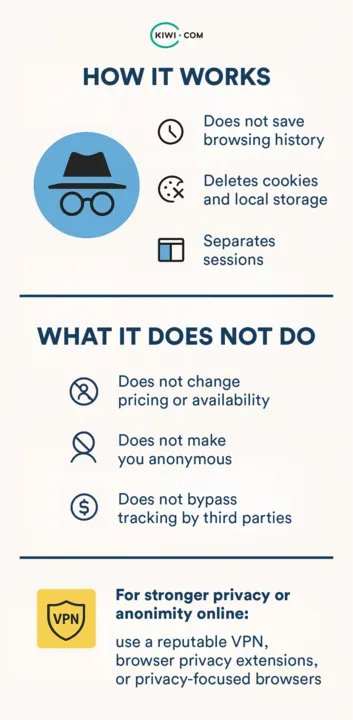
Understanding the real purpose of incognito mode © Kiwi.com
How Airlines Set Prices
Airlines use a sophisticated mix of strategies and data analytics to set ticket prices, aiming to maximize revenue while staying competitive. Here’s how it works:
Core Pricing Strategies
Dynamic Pricing
Prices fluctuate based on real-time demand, booking patterns, and market conditions. Algorithms adjust fares constantly, sometimes many times a day.
Yield Management
Airlines focus on selling the right seat to the right customer at the right time for the right price. To that end, seats are divided into fare classes (e.g., economy, premium economy, business), each with limited availability. Then airlines forecast demand and adjust seat availability across fare classes accordingly.
Price Discrimination
Different customers pay different prices for the same seat based on booking time, travel flexibility, loyalty status and whether they purchase their tickets via the airline website or a travel agency.
Key Influencing Factors
Demand & Seasonality
High demand periods, such as holidays, summer and major events like a Taylor Swift concert drive prices up. Off-peak seasons often feature discounts and promotions.
Time of Booking
Early bookings may be cheaper, but last-minute deals often appear if seats remain unsold. So be sure to set low-fare alerts.
Route Popularity & Competition
More competition on a route usually means lower prices, while so-called monopoly routes (e.g., remote destinations) tend to be more expensive.
Fuel Prices, Regulations & Taxes
The price of fuel can be a major cost driver because when fuel prices rise, airlines often pass costs to consumers. Airport fees, government taxes, and environmental levies vary by country and also affect final ticket prices.
Budget Airlines vs. Full-Service Airlines
| Feature | Budget Airlines | Full-Service Airlines |
|---|---|---|
| Base Fare | Very low | Higher |
| Add-ons (bags, meals) | Charged separately | Often included |
| Pricing Flexibility | Highly dynamic | Dynamic but more structured |
| Loyalty Programs | Minimal or none | Extensive (e.g., miles, upgrades) |
| Booking Channels | Mostly online | Online + travel agents |
| Seat Classes | Usually one | Multiple (economy, business, etc.) |
Budget Carriers Pricing Strategies
Budget airlines – or low-cost carriers (LCCs) – have transformed the global airline landscape with their focus on cost reduction, unbundled services, and dynamic pricing methods. Typically, they offer very low base fares, often as loss-leaders or at breakeven, and generate profitability from maximizing load factors and charging for ancillary services.
Their pricing model consists of stimulating demand with low fares, then nudging travelers to add services such as baggage, seat selection, priority boarding, and onboard snacks, each of which carries an additional fee. The trick is that only a small percentage of seats are available at the lowest advertised price, with the remainder subject to increasing fare increments as seats are booked and the departure date approaches. So if you’re traveling with an LCC, definitely reserve early.
LCCs leverage high aircraft utilization, fast turnarounds, point-to-point routing, and aggressively negotiating low airport fees, often using secondary or regional airports to minimize costs. They favor direct sales channels, in order to avoid paying travel agent commissions, and invest heavily in user-friendly online platforms.
Dynamic pricing is aggressive. Fares can change many times daily, with the best deals reserved for those who book early, travel off-peak, or are highly flexible. The margin for LCCs is in volume and ancillary revenue. In 2024, leading LCCs like Frontier and Spirit earned over 50% of revenue from non-ticket services, compared to 15-25% for full-service carriers.
In addition, LCCs make real-time adjustments in response to competitor moves, booking velocity, and external market shifts. Penetration pricing and frequent flash sales keep planes full and drive demand.
Dynamic pricing
Dynamic pricing in airlines is a strategy where ticket prices fluctuate based on real-time factors: prices rise when demand is high and drop during off-peak times; prices increase as seats fill up – early bookers usually get cheaper fares; last-minute bookings tend to be more expensive, while early bookings may offer discounts.
Penetration pricing
Penetration pricing is a strategy of setting a low initial price for a new product or service to rapidly gain market share and attract a large number of customers. The goal is to encourage quick adoption by luring price-sensitive customers and building brand awareness, with the expectation that prices can be gradually increased once the product has a firm foothold and customer loyalty is secured.
Ancillary revenue
Ancillary revenue is any income earned from services and products beyond the base ticket price, such as baggage fees, seat selection, in-flight meals and Wi-Fi.
Full-Service Carrier Pricing Strategies
Full-service carriers (FSCs), or legacy airlines, operate multi-class cabins, feature-heavy service offers, and maintain broad, global networks. Their pricing is built on yield management principles: time of purchase, fare class, flexibility, and bundled amenities.
Base airfares are higher, as they typically include checked bags, meals, seat selection, and customer support. Advanced fare rules, loyalty programs, and bundled products (i.e., air, hotel, car rental) further differentiate the customer base and attract differentiated payment segments.
FSCs use profits from one customer group – for example, business travelers – to fund another activity, product, or customer group that is losing money or operating at a lower price, such as economy travelers. Their pricing structures are less transparent and more complex and often have more conservative and rules-bound pricing than LCCs.
But the gap is narrowing. Today, FSCs use more and more dynamic pricing methods and digital retailing, and they have launched “basic economy” fares that resemble the unbundled, barebones offerings of LCCs. Frequent flyer and loyalty integration allows for more precise customer targeting and retention, and can include bundled services and personalized offers.
Comparative Analysis: Budget vs Full-Service Pricing Approaches
Key Differences: Budget (LCC) vs Full-Service (FSC) Airlines, 2025
| Feature | Budget Airlines (LCC) | Full-Service Airlines (FSC/Legacy) |
|---|---|---|
| Base Fare | Very low, excludes extras | Higher, includes amenities |
| Fare Structure | Dynamic, simple, few classes | Tiered, complex, many classes |
| Ancillary Fees | High, unbundled | Lower, most services included |
| Dynamic Pricing | Very aggressive, real-time | Moderate, managed by yield systems |
| Service Bundling | Minimal, add-on charging | Bundled, with selective unbundling |
| Airport Strategy | Secondary airports, low fees | Main hubs, higher fees |
| Booking Channel | Direct/online | Mix of direct, GDS, agent, corp. sales |
| Fleet Strategy | Single-type, standardized | Multi-type, flexible |
| Network Model | Point-to-point | Hub-and-spoke |
| Loyalty Programs | Limited/none | Extensive, integrated partnerships |
| Booking Timing Sensitivity | High—early booking is key | Moderate—advance yields some savings |
| Flexibility/Refunds | Limited, often non-refundable | Greater, especially in premium cabins |
| Technology Use | Advanced, automated pricing | Sophisticated, integrates legacy/AI |
| Price Volatility | High | Moderate |
Summary
The budget carrier model is optimized for high booking volumes, efficiencies of scale, and maximum ancillary exploitation. In exchange for lower base fares, travelers must navigate à la carte pricing, less convenient airports, and fewer flexibility options. Full-service airlines retain an edge in comfort, flexibility, and bundled value, but at a price that often places them beyond the reach of travelers. The use of unbundled services and competitive basic fare offerings is increasingly blurring these distinctions. Which means that budget travelers have a larger choice and may not have to sacrifice much comfort for low prices.
Airlines: Case Studies
Ryanair
Europe’s largest low-cost carrier (LCC) leverages relentless cost-cutting, standardized fleet operations, secondary airports, and aggressive ancillary fee proposals. Its dynamic pricing strategy stimulates demand with ultra-low advertised fares but maximizes revenue by raising fares as seats sell and the departure date approaches. This can result in price increases of 200-300% from early to late booking.
Ryanair’s revenue from ancillary services exceeded 50% of total revenue in 2024, with high dynamic pricing intensity on most routes, especially where competition is fierce or when seats are filling quickly.
Delta
Delta employs sophisticated yield management , AI-driven dynamic pricing, and personalization tools. It adjusts flight frequency and pricing by season and demand, integrates premium cabins and multiple fare classes, and leverages its loyalty program to extract maximal customer value. The introduction of “basic economy” fares enables it to compete with LCCs on price-sensitive routes.
Smart Flight-Booking FAQs
Does incognito browsing help reduce flight ticket prices?
No. Browsing in incognito mode does not ensure privacy and has no effect on ticket prices. Airlines are not lowering or raising fares based on your cookies or prior searches.
So how do airlines set prices?
Airlines use dynamic pricing that reacts to real-time demand, booking patterns, market conditions, and revenue-management algorithms. Budget carriers (like Ryanair) advertise low base fares, then charge for extras such as checked bags and seat selection, and raise prices as seats sell and departure approaches. If you see a good fare, reserve early.
Is it possible to fly budget with full-service carriers?
Yes—just don’t expect full service. Many legacy airlines now sell Basic Economy–style fares: limited or no seat selection, later boarding, and fees for checked bags. On many domestic routes you’ll get only snacks and non-alcoholic drinks, while long-haul flights still include full meals. Some carriers, like United, may limit you to one small personal item on their most restrictive fares.
How important is it to book early?
Very. For budget airlines such as Ryanair, early booking is essential because the cheapest seats sell first and prices spike quickly. Southwest is also heavily time-of-purchase driven, with fares climbing as departure nears. Aim for 2–3 months ahead for domestic and 4–6 months for international on budget carriers. For full-service airlines, booking early helps you snag limited cheap fare buckets (e.g., Basic Economy): target 1–3 months ahead for domestic and 3–5 months for international.
What else can I do to get the cheapest flight?
Compare multiple search engines and OTAs, then click through to the airline’s site. Track fares for a few days, set price alerts, and use airline tools like Lufthansa’s “best-price search.” Be flexible with dates, times, and nearby airports; buy when a cheap fare class is available. Minimize add-ons, skip optional extras, and bring your own food.
Popular routes on Kiwi.com
- Cheap flights from London to Turkey
- Cheap flights from London to Barcelona
- Cheap flights from London to Japan
- Cheap flights from London to New York
- Cheap flights from New York to Paris
- Cheap flights to Spain
- Cheap flights to Italy
- Cheap flights to the United States
- Cheap flights to the United Kingdom
- Last minute flights
People Also Read

How to Travel Patagonia: A First-Timer's Guide to Chile & Argentina's Wild South

Where to stay in Palma de Mallorca: best areas for beaches, culture and nightlife