
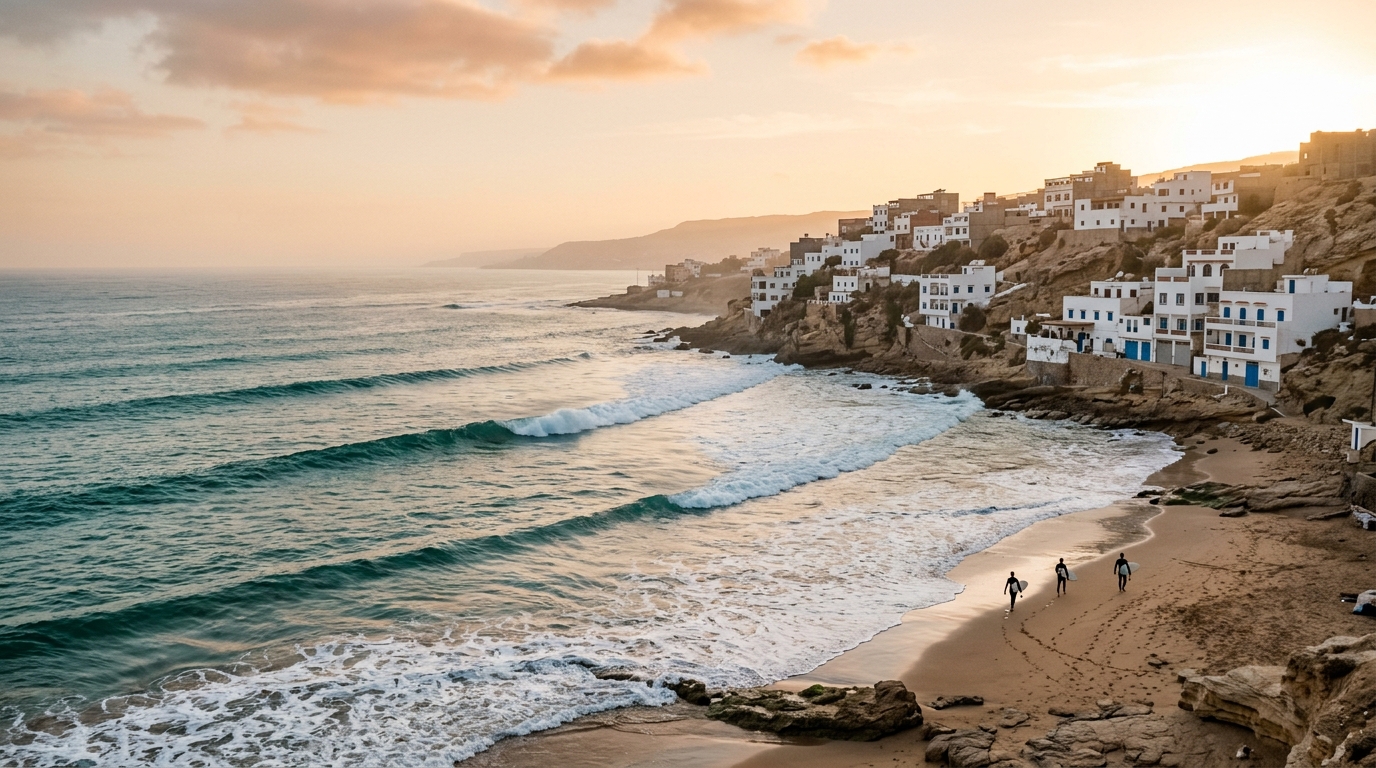
If you’re someone who likes to stay on top of current travel trends, you’ve likely already come across Morocco’s thriving surf towns: Taghazout and Tamraght. Just a 15-minute drive from one another along the Atlantic coast, these two places may be close, but they couldn’t be more different. And travelers, including wave catchers, summer holidaymakers and long-term nomads, are flocking here in droves to get a slice of the action.
In this article
This guide breaks down Taghazout and Tamraght, covering why now is the time to visit and the logistical realities of traveling to both. Let’s help you decide which surf town in Morocco to visit next.
Key takeaways
Distance The two villages are a 15-minute drive or a one-hour coastal walk apart, so you can sample both on one trip.
Vibe Taghazout is livelier and more social; Tamraght is sleepier, cheaper and better for long stays.
Budget Dorm beds start at MAD 99 (€9) per night, a local dish at MAD 50 (€4.54), and a surf lesson at MAD 242 (€22) for two hours.
Timing Many nationalities get 90 visa-free days, and Morocco now runs on GMT, aligned with the European working day.
Taghazout vs. Tamraght: A quick comparison
Taghazout
Taghazout was once a tiny blip on a map, where Berber fishing communities spent their days on the Atlantic looking for their next catch. Over time, though, it started to attract a very different type of crowd.
Word spread through the surfing community about an incredible spot north of Agadir with seriously epic waves. Soon, surfers from all backgrounds were turning up to tackle the impressive breaks at Taghazout Beach, with surf schools springing up to meet the growing demand. Then more and more health-conscious cafés began appearing along the oceanfront, and so did unique attractions like Taghazout Skatepark. Before long, it became one of Morocco’s hippest and most happening surf towns.
Tamraght
South of Taghazout, a stone’s throw away, sits the dusty hillside settlement of Tamraght. Unapologetically sleepy and a little rough around the edges, less flashy than its Instagram-polished neighbor, Tamraght invites you to slow down.
Days here are for wellness, indulging in nourishing hammam treatments, knocking back nicely chilled Arabica in stylish cafés, and racing up to viewpoints for sunset. It’s special in its own way and offers an experience Taghazout could never quite replicate.
Why now is a good time for Taghazout and Tamraght
Fast internet and better connectivity
A good chunk of the people visiting Taghazout and Tamraght come for longer stays. I mean the nomad types. Contrary to popular belief, these people actually do work, so they need decent Wi-Fi if places want them to stick around for more than a few days. The good news is that both Taghazout and Tamraght are stepping up their game in this department.
Fiber internet is becoming more readily available, as is 5G. Work-friendly cafés like The Laundry in Tamraght have introduced laptop tables, while Taghazout is even starting to get coworking spaces, with SunDesk leading the charge.
European time zone alignment
Being so close to Europe means remote workers can stay on roughly the same time schedule as clients and employers back home. Following a recent change to the nation’s time zone in September 2026, Morocco now observes GMT (UTC+0), keeping it closely aligned with the working day across much of Europe’s big cities like London, Dublin and Paris.
This allows remote workers to stay employed while living out their coastal dreams without making too many sacrifices. Morning yoga before a 9 am start, followed by an evening surf session as soon as the clock strikes five. Not a bad way to live. Plus, the cost of living can be lower than in many parts of Europe, so you won’t have to watch your pennies quite as closely.
90-day visa-free stays
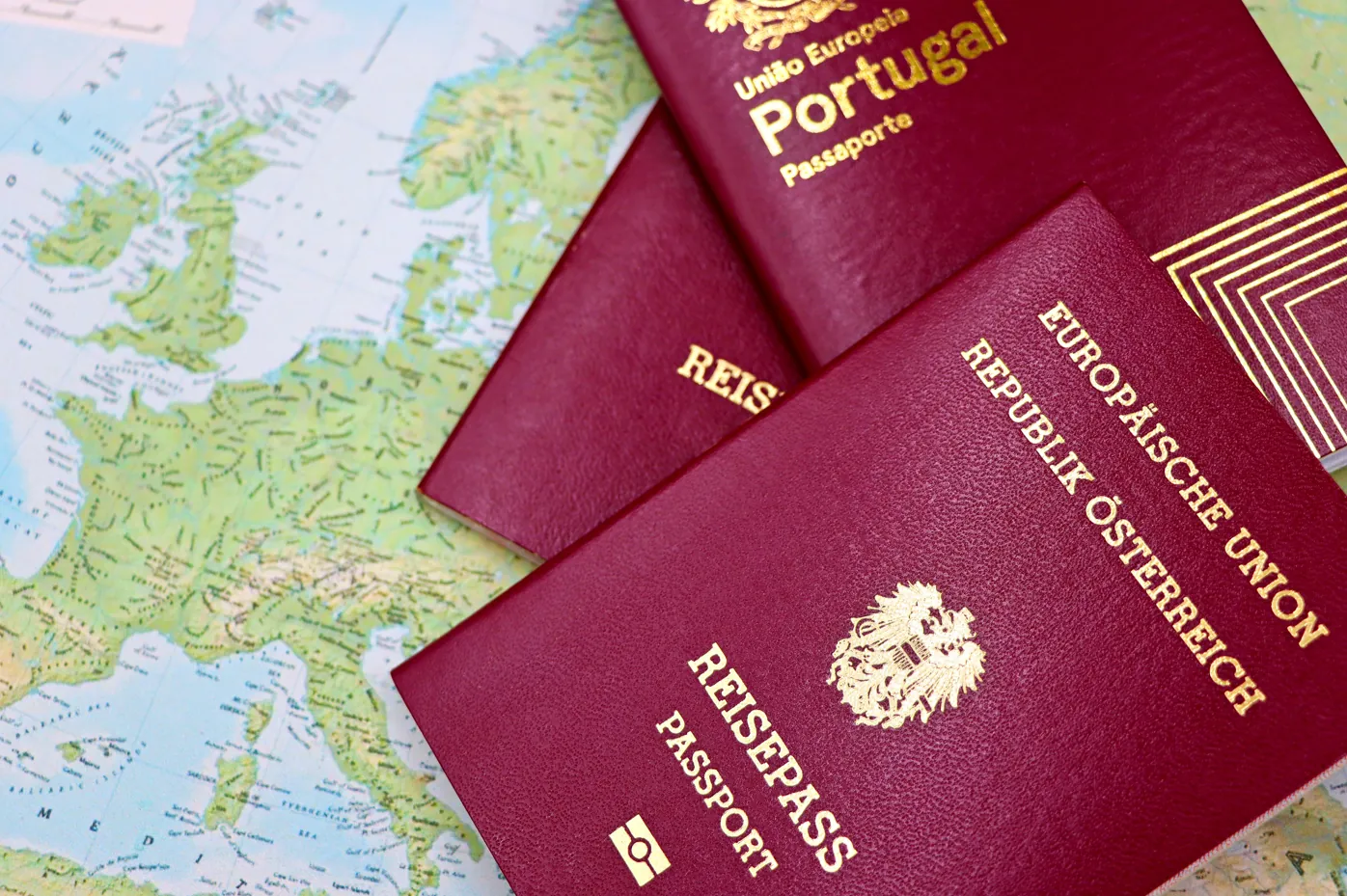
Passport holders from many countries can visit Morocco visa-free for up to 90 days. This gives travelers from countries including the US and Australia and several European nations the option to spend a decent chunk of time in Taghazout or Tamraght, or split their stay between the two.
For those who want to spend part of the year in Morocco, the 90-day visa-free option is an absolute game changer. You can take things at your own pace, choose the village that suits you best, and then hunker down for a while to surf, learn yoga, or simply enjoy a slower way of life.
Just be aware that visa requirements and permitted stays vary by nationality. One passport holder might be able to enter visa-free for 90 days, while another may need to apply for a visa through a Moroccan embassy or consulate before traveling. Do your own research through official sources before booking to make sure you understand the rules for your nationality.
Best neighborhoods to stay in Taghazout and Tamraght
Taghazout
Taghazout Village: If local vibes are what you’re after, Taghazout Village is it. This is the more residential part of the village; prices are considerably lower for accommodation, and you’re well placed to explore pretty much everywhere. Most of the properties in the village are hostels and guesthouses, so it’s definitely less upmarket than other parts of Taghazout.
Taghazout Beach: Across the street from the village area is Taghazout Beach. Popular with those who want to be right by the water, there are a few nice places to stay along the shoreline, plus a handful of cafés and restaurants, so you won’t feel completely cut off. The big draw for many is being right on the beach, without having to navigate Taghazout’s tiny alleys every time you go looking for your hotel. Trust me. It happens.
Taghazout Bay: Finally, there’s Taghazout Bay, where you’ll find the fancier hotels and resorts and where many holidaymakers choose to stay. You’ll pay the highest prices here, but you’ll get more modern, spacious surroundings and greater privacy. It’s quite popular with families, as you can imagine, and the swimming is also nice.
Tamraght
Tamraght Village: Up in the hills with clear views of the Atlantic, Tamraght Village’s network of meandering streets, dotted with guesthouses, hostels and boutique properties, makes it particularly attractive for anyone planning to stay long-term. On one street, you’ll find trendy coffeehouses, while the next is lined with small family-run eateries serving hearty tagines. It’s a place of contrasts with plenty of variety, and prices are generally better than down by the beach.
Tamraght Beach/Imourane Beach area: The Tamraght and Imourane Beach area is particularly attractive for anyone who wants to surf and wake up next to the action. However, there isn’t much accommodation here besides a few hotels and a campsite, so most people end up basing themselves in the village instead.
Which area is better for you?
| Area | Best for | Accommodation |
|---|---|---|
| Taghazout Village | Local atmosphere and budget travelers | Hostels and guesthouses |
| Taghazout Beach | Beach lovers and surfers | Smaller hotels and guesthouses |
| Taghazout Bay | Families, resort stays and privacy | Upscale hotels and resorts |
| Tamraght Village | Long-term travelers, digital nomads, budget travelers | Guesthouses, hostels and boutique properties |
| Tamraght Beach/Imourane Beach area | Surfers | Hotels and campsites |
Taghazout and Tamraght travel costs
Note: prices are approximate and can change depending on where you stay and what you do.
Accommodation
| Type | Price |
|---|---|
| Hotels | From MAD 297 (€27) |
| Apartments | Full private apartment from MAD 242 (€22) |
| Hostels/surf houses | From MAD 99 (€9) for a bed in a dorm per night, or MAD 220 (€20) for a private room |
Food and drink
| Item | Price |
|---|---|
| A dish at local restaurants | From MAD 50 (€4.54) |
| International-style dishes | From MAD 65 (€5.91) |
| Beer | From MAD 40 (€3.64) |
| Glass of wine | From MAD 50 (€4.54) |
| Coffee | From MAD 20 (€1.82) |
Activities
| Activity | Price |
|---|---|
| Surfboard rental | From MAD 100 (€9.09) per day |
| Surf lessons | From MAD 242 (€22) for two hours |
| Yoga class | From MAD 155 (€14.09) |
Transport
| Type | Price |
|---|---|
| Airport taxis | Agadir Airport to Taghazout: MAD 308 (€28); Agadir Airport to Tamraght: MAD 250 (€22.72) |
| Standard taxis | From MAD 15 to 25 (€1.36 to €2.27) for short trips |
| Grand taxis | From MAD 10 (€0.91) per seat |
| Buses | From MAD 5.50 (€0.50) |
Getting around Taghazout and Tamraght
Grand taxis
The main type of transport around Taghazout and Tamraght is the grand taxi. These are essentially shared taxis where drivers sell each seat on a point-to-point route and drop passengers off along the way. They run between neighborhoods and other key destinations, including Taghazout and Tamraght. Expect to pay around MAD 10 (€0.91) for a seat between the two.
Buses
Buses are another way to get around Taghazout and Tamraght. The main routes are L32 and L33. The L32 starts in Agadir at Place Salam and goes as far as Taghazout. The L33 also departs from Agadir but stops in both Taghazout and Tamraght, giving you a little more flexibility. Tickets are priced at roughly MAD 5.50 (€0.50).
Walking
Given how small Taghazout and Tamraght are, you can also get around on foot if you don’t mind the heat. Heck, you can even walk between the two along the coast. It’s only around 5 km and takes about an hour each way. I’d suggest doing this while you’re here, even if you’re set on sticking to one spot, as it’s a nice way to get a feel for the other.
And if you’re combining surf-town downtime with a city leg, flights from London to Agadir run direct and land you an hour from both villages.
Find flights for this trip

Cash, cards and paying for things
In Taghazout and Tamraght, cash still rules. Most establishments prefer you to pay in the local currency, Moroccan dirhams, so try to get some when you arrive. ATMs are available in the villages, but they can run out of cash and often charge fees. Bringing a stronger currency covers you if that happens. Then all you need to do is change some money at a local exchange bureau, and you’ll be ready to go.
Some places may accept cards, such as fancy hotels or surf shops, but it’s not guaranteed. If you want to pay by card, I’d recommend contacting the place first and asking if they accept them. At least then, you’ll have a better idea of what to expect rather than being stuck with no other option.
Local culture norms to be aware of
Dress code
Morocco is still a very conservative country, and people dress that way, but in Taghazout and Tamraght, things are slightly different. Maybe it’s because you’re by the sea, or locals are generally just more tolerant here. Women often go around in bikinis and men in swimwear with their tops off, and nobody really bats an eyelid. If you do, though, I would save it for the beach rather than walking around the villages where residents live, as it could be viewed as disrespectful.
Religious awareness
Islam is the predominant religion in Morocco, with over 98% of the population being Muslim, and this is evident everywhere you go. You will encounter locals worshipping five times a day, with mosques playing the call to prayer; this is simply part of everyday life here. Fridays are an important day in Islam, so expect things to be quieter than usual, with some establishments closing.
One other thing to factor in is that, unlike in some other countries, most mosques in Morocco do not allow foreigners to enter. I encountered this many times during my visit when I tried to go inside and was refused entry. While disappointing, these are the rules and they must be followed.
Ramadan
Being in Taghazout and Tamraght during Ramadan is a totally different experience. People fast from early morning until sunset; many restaurants are shut, and you may notice that people have lower energy levels than usual because they’re fasting, which often means they stay indoors until dark.
If you’ve never traveled during Ramadan, it can take some time to get used to. Before booking, consider whether your plans could be disrupted, especially for a short trip, since closures and limited access to certain experiences can happen.
A day in the life: Taghazout vs. Tamraght
| Time | Taghazout | Tamraght |
|---|---|---|
| Morning | Wake up for a morning surf session at Taghazout Beach, then tuck into an oceanfront breakfast. | Get your surf on at Tamraght Beach or do some yoga on the sand. |
| Late morning | Grab a coffee at a local café and get some work done. | Fuel up with breakfast in Tamraght Village. |
| Afternoon | Head back down to the beach, catch some rays, and get stuck into a good book as the day goes by. | Spend the afternoon at a hammam enjoying a nourishing treatment. |
| Evening | Pop up to Taghazout Skatepark to take in the ocean views. After that, head out for dinner along the main beachfront strip and socialize with other travelers in bars and cafés. | Hike into the surrounding hills to watch the sunset, then indulge in an evening tagine. |
Pair the coast with a few days in Marrakesh and you get Morocco’s two best faces in one trip: surf mornings and medina evenings.
So, where wins it for you: Taghazout or Tamraght?
Taghazout and Tamraght are popular destinations for good reason. Both sit right on the Atlantic and are cool places, but they have very different vibes. One is more laid-back, while the other is livelier and more social. Rather than choosing one as the ‘best’ option, I think each suits a different type of traveler. The nice thing is that you can easily visit both on the same trip and see which one is more your vibe.
This article will only settle half the debate, though, as the discussion is still going strong in the comments of our Taghazout and Tamraght Reel on Instagram. Head over there to see what others are saying and weigh in yourself if you have something to add.
Find flights for this trip
Frequently asked questions
Is Taghazout or Tamraght better for beginners?
Tamraght’s beaches and surf schools are generally better for beginners, with gentler breaks and a slower pace. Taghazout’s main breaks draw a more experienced crowd, though its surf schools also teach first-timers.
Which is cheaper, Taghazout or Tamraght?
Tamraght is usually cheaper. Guesthouse and hostel prices in Tamraght Village are generally lower than comparable stays in Taghazout, and its village eateries serve hearty tagines at local prices.
Can you walk between Taghazout and Tamraght?
Yes. The coastal walk between the two is around 5 km and takes about an hour each way, making it easy to sample both villages even if you base yourself in one.
Do I need a visa for Morocco?
It depends on your nationality. Passport holders from many countries, including the US, Australia, China, and several European nations, can stay visa-free for up to 90 days. Others need a visa from a Moroccan embassy or consulate. Check official sources before booking.
Is there good internet for remote work?
Yes, and improving. Fiber and 5G are becoming more available, work-friendly cafés like The Laundry in Tamraght have laptop tables, and Taghazout has coworking spaces such as SunDesk.