






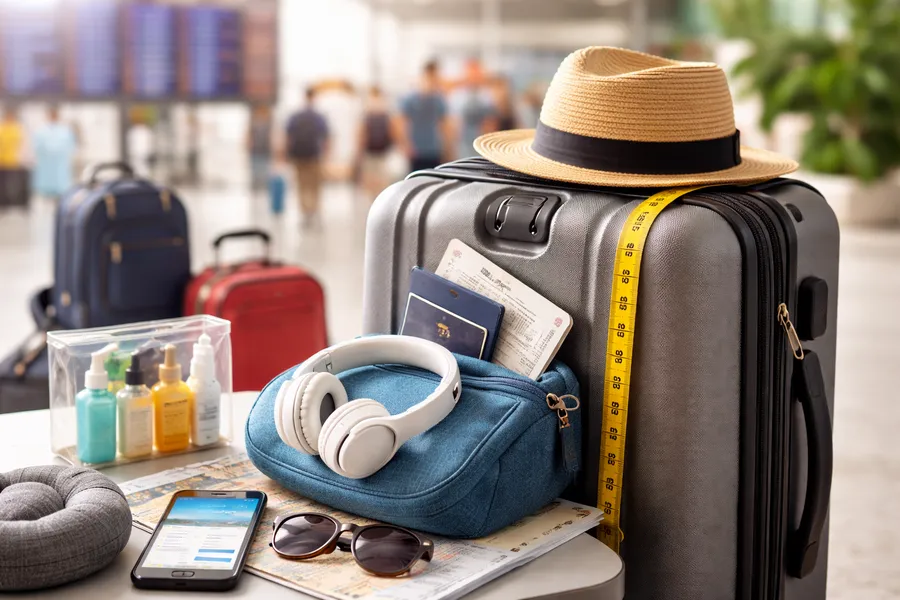
In the US, there is a standard maximum size for carry-on bags of 22 x 14 x 9 inches. While most major U.S. airlines adhere to it, budget airlines generally are stricter. For example, Frontier and Allegiant restrict free carry-ons to 18 x 14 x 8 in. International airlines generally also have stricter size limits and they often impose carry-on weight limits as well. When measuring, always include wheels and handles as they must fit into the “sizer” units at the airport.
Airline-by-Airline Carry-On Rules for 2025
Almost all major legacy U.S. airlines adhere to a standard maximum size of 22 x 14 x 9 inches (56 x 36 x 23 cm) for free carry-ons. International and budget airlines often have stricter or varied limits, and weight restrictions are common outside the U.S. Most major U.S. carriers do not impose a weight limit, provided you can lift the bag into the overhead bin unassisted. Below are the 2025 carry-on size and weight rules.
U.S. Major Airlines
| Airline | Carry-On Bag Size (Max) | Personal Item Size (Max) | Weight Limit |
|---|---|---|---|
| American Airlines | 22 x 14 x 9 in (56 x 36 x 23 cm) | 18 x 14 x 8 in (45 x 35 x 20 cm) | No limit (Domestic) |
| Delta Air Lines | 22 x 14 x 9 in (56 x 35 x 23 cm) | 17 x 13 x 9 in (43 x 33 x 23 cm) | No limit (Domestic) |
| United Airlines | 22 x 14 x 9 in (56 x 35 x 23 cm) | 17 x 10 x 9 in (43 x 25 x 22 cm) | No limit (Domestic) |
| Alaska Airlines | 22 x 14 x 9 in (56 x 36 x 23 cm) | Must fit under seat | No limit (Domestic) |
Important to Note
- United Airlines (Basic Economy): Lowest fares sometimes restrict you to a free personal item, with carry-ons costing extra or requiring a higher fare. If you bring a carry-on to the gate with United, a $35+ gate-check fee usually applies.
- American Airlines Update: American Airlines now allows one free carry-on for all destinations, including Basic Economy fares.
- Regional Flights: On “Express” or “Connection” flights using smaller aircraft, even standard-sized bags may be gate-checked for free due to limited overhead space
How to Avoid Paying Fees:
- Pack Light: Master packing everything into your personal item.
- Buy Priority Boarding : This usually includes a small cabin bag (overhead) plus your personal item.
- Check Dimensions: Know your airline’s specific size limits for personal items (e.g., under seat) versus carry-ons (overhead bin). Always include wheels and handles in your measurements.
International Airlines
In 2025, major international airlines typically follow a standard carry-on size of roughly 22 x 16 x 8 inches (55 x 40 x 20 cm). However, weight limits are much stricter than on US domestic flights, often capped between 15–22 lbs (7–10 kg**)** for Economy class.
| Airline | Carry-On Bag Size (Max) | Weight Limit (Economy) | Personal Item Size (Max) |
|---|---|---|---|
| British Airways | 22 x 18 x 10 in (56 x 45 x 25 cm) | 51 lbs (23 kg) | 16 x 12 x 6 in (40 x 30 x 15 cm) |
| Lufthansa | 21.6 x 15.7 x 9 in (55 x 40 x 23 cm) | 17.6 lbs (8 kg) | 15.7 x 11.8 x 4 in (40 x 30 x 10 cm) |
| Air France / KLM | 21.7 x 13.8 x 9.9 in (55 x 35 x 25 cm) | 26.4 lbs (12 kg) total of carry-on and personal | 16 x 12 x 6 in (40 x 30 x 15 cm) |
| Emirates | 22 x 15 x 8 in (55 x 38 x 20 cm) | 15.4 lbs (7 kg) | 18 x 14 x 8 in (approx.) |
| Qatar Airways | 20 x 15 x 10 in (50 x 37 x 25 cm) | 15.4 lbs (7 kg) | Varies by class |
| Singapore Airlines | 45 linear inches (115 cm total) | 15.4 lbs (7 kg) | 15.7 x 11.8 x 3.9 in (40 x 30 x 10 cm) |
| Air Canada | 21.5 x 15.5 x 9 in (55 x 40 x 23 cm) | Must be able to lift bag into overhead bin | 17 x 13 x 6 in (43 x 33 x 16 cm) |
Important to Note
As of late 2025, there are no fully enforced, universal EU-wide rules for carry-on luggage dimensions and fees. New rules have been proposed and voted on by the European Parliament but are awaiting final approval by the EU member states (European Council). Until the new rules are officially enacted, you must follow your specific airline’s baggage policy.
Low-Cost Carriers
Most low-cost carriers have more restricted carry-on limits than full-service airlines. Weight limits vary, and most budget airlines charge extra if you want a larger cabin bag in the overhead bin.
North American Budget Airlines
| Airline | Personal Item Size (free) | Carry-On Bag Size (paid) | Weight Limit |
|---|---|---|---|
| Spirit Airlines | 18 x 14 x 8 in (45.7 x 35.5 x 20.3 cm) | 22 x 18 x 10 in (56 x 46 x 25 cm) | 40 lbs (18 kg) for carry-on |
| Frontier Airlines | 18 x 14 x 8 in (45.7 x 35.5 x 20.3 cm) | 24 x 16 x 10 in (61 x 40.6 x 25.4 cm) | 35 lbs (15.8 kg) |
| JetBlue (Blue Basic) | 17 x 13 x 9 in (43.2 x 33 x 22.8 cm) | 22 x 14 x 9 in (55.8 x 35.5 x 22.8 cm) | None listed |
| Allegiant Air | 18 x 14 x 8 in (45.7 x 35.5 x 20.3 mm) | 22 x 16 x 9 in (55.8 x 40.6 x 22.8 mm) | Not specified |
| Southwest Airlines | 18.5 x 13.5 x 8.5 in (approx. 47 x 34.3 x 21.6 cm) | 24 x 16 x 10 in (61 x 40.6 x 25.4 mm) | None listed |
European Budget Airlines (2025)
| Airline | Personal Item (Free) | Priority Carry-On (Paid) | Weight Limit |
|---|---|---|---|
| Ryanair | 15.7 x 11.8 x 7.8 in (40 x 30 x 20 cm) | 21.6 x 15.7 x 7.8 in (55 x 40 x 20 cm) | 22 lbs (10 kg) |
| EasyJet | 17.7 x 14.1 x 7.8 in (45 x 36 x 20 cm) | 22 x 17.7 x 9.8 in (56 x 45 x 25 cm) | 33 lbs (15 kg) |
| Wizz Air | 15.7 x 11.8 x 7.8 in (40 x 30 x 20 cm) | 21.6 x 15.7 x 9 in (550 x 400 x 230 cm) | 22 lbs (10 kg) |
Key Policy Reminders for 2025
Measurement Inclusion: Dimensions must include wheels, handles, and side pockets. If a bag does not fit completely into the airline’s “sizer bin” at the gate, you may be charged gate-check fees ranging from $60 to $100 or more.
Surprise fees: Budget airlines make much of their profit from baggage charges. If your bag is oversized, expect steep gate fees.
Check ticket type: “Basic” fares usually restrict you to just the under-seat bag. Upgrades (Priority, Plus, Extra) unlock overhead cabin bags.
Measure before you go: Even a few centimeters over can lead to penalties. Use a luggage sizer at home.
Always Verify: Rules can change based on fare class, route, or aircraft type. Always check the official airline website for the most accurate and current rules just before your trip.
LCCs versus Major Airlines: The Trade-Off
Low-cost carriers (LCCs) generally impose stricter, smaller size and weight limits than traditional flag carriers to generate ancillary revenue from baggage fees, while flag carriers typically adhere to a more generous, unofficial industry standard.
Size Differences
- Flag Carriers/Major Airlines: Most major U.S. and international full-service carriers align their maximum carry-on dimensions around a common standard of 22 x 14 x 9 inches (56 x 36 x 23 cm). This size is designed to fit comfortably in the overhead bins of most commercial aircraft.
- Low-Cost Carriers (LCCs): LCCs often require smaller bags. They usually mandate a free carry-on that is significantly smaller and fits only under the seat in front of you (e.g., Ryanair’s non-priority allowance of 40 x 30 x 20 cm), while a standard “carry-on” size bag requires an extra fee.
The Trade-off
The primary trade-off is the initial ticket price versus flexibility.
LCCs
Budget airlines offer a lower base fare but unbundle services like baggage, seat selection, and meals, charging extra for everything beyond a very basic allowance. This means if you need a standard-sized carry-on, the actual cost of an LCC ticket may end up being similar to a flag carrier ticket.
Flag Carriers
Major airlines usually offer a more substantial carry-on allowance (and often a personal item) in the base price, providing more predictable and usually less restrictive baggage rules, which can make travel easier for those who pack a standard amount. However, some do not offer free carry-ons beyond a personal item for the lowest fares.
Key Takeaway
If you are traveling with a standard 22 x 14 x 9-inch rolling suitcase, you are generally safe with flag carriers. When flying with an LCC, you must adhere strictly to their often smaller, specified dimensions and weight limits or be prepared to pay hefty gate fees.
How Carry-On Gate Checking Works
Gate checking is when your carry-on bag is taken by airline staff at the boarding gate and stowed in the cargo hold of the plane. The process is typically free for standard carry-on sized bags, provided you are not on a Basic Economy ticket that prohibits a full-sized carry-on, or if the bag is not oversized. The process usually happens for one of two main reasons: the airplane is a smaller regional jet with limited overhead space, or the flight is full and the overhead bins are completely occupied.
The Process
At the Gate:
A gate agent or flight attendant will tag your carry-on bag with a baggage claim ticket and give you the stub to keep.
Before Boarding:
You hand the bag to airline staff either at the gate desk or at the end of the jet bridge before you step onto the plane.
After Landing:
- Baggage Claim: In most cases, the bag will be sent to the general baggage claim area at your final destination, where you collect it like any other checked luggage.
- Jet Bridge (Valet Check): On smaller or regional aircraft, you may be able to pick up your bag on the jet bridge immediately after deplaning. The airline staff will inform you where to retrieve it.
When Gate Checking is Free
Gate checking is free in situations where the airline initiates the check for operational reasons:
Full Flights/Limited Overhead Space:
If the overhead bins are full, airlines will ask for volunteers or require passengers to gate-check their compliant carry-on bags at no extra cost.
Smaller Aircraft
When flying on smaller regional jets where standard carry-ons do not fit in the overhead bins, you will be required to “valet check” the bag at the jet bridge for free.
Voluntary Check-in
Some airlines may offer a free gate check if you voluntarily check your carry-on at the gate to speed up the boarding process. You can even ask at the check-in counter before security if your flight is full, and they might check it for free to your final destination.
When You Might Be Charged
Basic Economy Fares
Some major and most budget airlines’ basic economy tickets only permit a small personal item (which fits under the seat) for free. If you bring a standard full-size carry-on to the gate with this fare type, you will be forced to check it and pay a fee, which is often higher than the standard checked bag fee.
Oversized or Overweight Bags
If your bag exceeds the airline’s maximum allowed dimensions or weight for a carry-on or a checked bag, you may be subject to additional fees regardless of the fare type or overhead space availability.
Smart Luggage and Expandable Bags
Smart Luggage
Smart luggage integrates technology to provide convenience, security, and connectivity for travelers.
- Built-in Chargers and USB Ports: Many models include integrated USB-A and USB-C ports, allowing travelers to charge devices on the go using an internal, often removable, power bank.
- GPS Tracking and Proximity Alarms: Some smart bags can be tracked via an app on your smartphone, and a proximity alarm can alert you if you become separated from your luggage.
- Smart Locks: Features like Bluetooth-enabled, TSA-approved locks can be remotely locked or unlocked using a smartphone app or even a fingerprint, enhancing security.
- Built-in Scales: Certain pieces of luggage have integrated scales in the handle to help prevent overweight bag fees.
- Other Features: Some advanced models can be ridden like a scooter, have cup holders, or feature modular organizers that sync with apps.
Airline Regulations
A key consideration for smart luggage is airline approval. Due to fire risks associated with lithium-ion batteries, airlines typically require the battery to be removable. If you plan to check your smart bag, the battery must be removed and carried with you in the cabin.
Expandable Bags
Expandable bags feature a design that allows the storage capacity to be increased (often by 25-30%) when needed, usually via a hidden zipper. They have the following advantages:
- Flexible Packing: This feature is useful for travelers who anticipate buying souvenirs or need extra space for longer trips.
- Avoid Overweight Fees: The extra capacity helps distribute items efficiently, potentially preventing issues with hitting the weight limit on non-expandable luggage.
- Versatility: Expandable bags provide the flexibility to use one piece of luggage for both light and heavier packing scenarios.
Brands like SwissGear and Briggs & Riley offer popular expandable options in both hardside and softside designs.
Integrated Options
Many modern suitcases combine these technologies, offering expandable hardshell luggage with a cup holder and USB charging port. Some popular brands are Béis, Solgaard, Travelpro, and Briggs & Riley.
Some Interesting Features
Béis offers the Carry-On Roller, which expands by 2 inches and features a built-in weight indicator in the side handle to prevent overweight fees.
The Solgaard Carry-On Closet is engineered with a built-in, removable shelving system for organization and often includes a USB charging point.
Briggs & Riley is known for its innovative CX expansion-compression system, which increases packing capacity and then compresses the bag back to its original size.
Tumi’s premium luggage, such as the 19 Degree collection, often includes a built-in locator ID tag and pre-wired USB ports, alongside expandable options for extra capacity.
Know the Carry-On Rules Before You Get to the Airport
What are the rules for carry-on size limits on US airlines?
Almost all major legacy U.S. airlines adhere to a standard maximum size of 22 x 14 x 9 inches (56 x 36 x 23 cm) for free carry-ons. However, United restricts its Basic Economy fares to a personal item that must fit under the seat in front of you. Most major U.S. carriers do not impose a weight limit, as long as you can lift the bag into the overhead bin without assistance.
What are the carry-on rules for budget airlines?
Low-cost carriers generally require smaller bags and usually allow only a free personal item that fits under the seat in front of you. For example, Ryanair’s non-priority allowance is 15.7 x 11.8 x 7.8 inches (40 x 30 x 20 cm). Standard carry-ons typically require an added fee, and some budget airlines such as Frontier and Spirit also enforce weight restrictions.
What are the carry-on restrictions for international airlines?
International airlines, both major and budget, tend to have stricter carry-on size rules than U.S. carriers and often include weight limits. British Airways, for example, allows carry-on bags up to 22 x 18 x 10 inches (56 x 45 x 25 cm) but enforces a maximum weight of 51 pounds (23 kg).
How can I avoid paying a fee for my carry-on?
Pack as light as possible and try to fit everything into your personal item. Purchasing priority boarding can help, as it usually includes an overhead cabin bag plus a personal item. Always confirm your airline’s exact size limits for both personal items and carry-ons, and measure wheels, handles, and side pockets to avoid surprises.
When can I be charged a fee for my bag?
You may be charged a fee if you are traveling on a basic economy fare that allows only a personal item and you bring a full-size carry-on to the gate. Fees can also apply if your bag exceeds the airline’s size or weight limits for either carry-on or checked luggage, regardless of your fare type.