




As I said: simplistic. Which doesn’t mean, however, that it isn’t true. Anyway, the Estonian capital of Tallinn is primarily (though not exclusively) for holidays of the second type. It has a beautiful and beautifully preserved medieval Old Town, its Hanseatic architecture is sheer eye candy, there’s a castle, lots of museums, some lovely churches, good food, it’s a great walking city, most of the things to do and see are free and those that aren’t free are very affordable. Need I say more?

Tallinn: A timeless escape wrapped in medieval charm and modern affordability © Pexels
Yes, I do: There’s also a lovely port, which means the sea, in this case the Gulf of Finland and the Baltic Sea. On the other side of the water lies the Finnish capital Helsinki. On the east, Estonia borders Russia, under whose political yoke it suffered for nearly a half-century.
But the country’s history is more complex than that. While the Estonian language is about 2,000 years old, the country was not an independent nation until 1918, after the end of the Russian Empire. If you’re interested in learning more, read up before you visit. It’s fascinating.
Courtesy Nations Online Project
That history and the influences of its two larger neighbors – Finland to the north and Russia to the east – make Estonia and its capital city different , so that you’ll want to pay attention to what you are looking at and learning.
But there’s stuff for the body in Tallinn too: the food, of course, but also the country’s sauna culture, which consists of more than simply sweating in a hot box. And there are beaches galore on the sea, if you’re planning to go in the summer.
So, if you have no idea what you want to do for the next long weekend, visiting Tallinn should be high on your list of possibilities.
How to Get There & When to Go
No problem. Direct and inexpensive return flights are available from any airport in Europe. That should be a reason to go whenever the spirit moves you.
Spring comes late to Tallinn , but it comes with a bang. There’s the Jazzkaar Festival in April, which this year featured the great American saxophonist James Carter. In May there are the Kalamaja Days, with outdoor concerts and markets featuring spring produce, like wild garlic and lamb, and cafés setting out chairs on sidewalks and squares.
Prices are also low during this time, except in late May and early June, when the Old Town Days – which celebrate the history and culture of Tallinn with concerts, and street performances – lure visitors from around Europe.
Summer is the most popular time to go, for the usual summer reasons. Where there’s sunshine and sea, there are beaches – and Tallin is no different. There are also a lot of festivals, so this would be the most expensive, crowded and festive time to visit the city.

Tallinn in summer is the busiest season with sunny weather, beachgoers, and numerous festivals making it the most festive and expensive time to visit © Getty Images
For me, autumn may be the best time to be in Estonia. The summer rush is over, winter hasn’t yet bared its icy fangs and prices and crowds are down. The city is vibrant with those irresistible fall colors, which are displayed in the Tallinn Botanic Garden, Kalamaja Park and Viimsi Open Air Museum, among other spots, and the menus offer dishes made from freshly harvested and hunted produce.
Winter is very cold and snowy, though climate change has reduced the number of snowy days between, say, December and March. Christmas in Tallinn, with its amazing Christmas market, is special and usually attracts a great many tourists, raising prices. But if you go outside of the Christmas season, prices are low again.
Winter is also the time to eat verivorst, or blood sausage, which is often served with mulgikapsad, aka sauerkraut. It’s an acquired taste, but if you acquire it, as I did, it’s an irresistible dish. It’s also the time to visit one or several of the city’s saunas [see below at “Psst, Steam Heat”].
Put simply, there’s really never a season not to visit Tallinn.
What to See
Your first stop should be the Old Town, which is a great place to walk through and admire its remarkably well-preserved cobblestone streets, city walls and centuries-old buildings. Like the Gothic Tallinn Town Hall, which stands on the edge of the apply named Town Hall Square and dates from at least 1322.

The Old Town is the ideal starting point in Tallinn, featuring cobblestone streets, medieval city walls, and historic buildings like the Gothic Town Hall dating back to the early 14th century © Getty Images
And don’t be shy about investigating what lies beyond the archways and in the many courtyards of the Old Town. You might find one of those charming cafés that will stick in your memory or some other place that you didn’t know you were looking for until you found it.
The 13th-century Niguliste Church actually contains a museum of ecclesiastical art as well as a viewing platform, via elevator, that gives you a 360° panoramic view of the city.
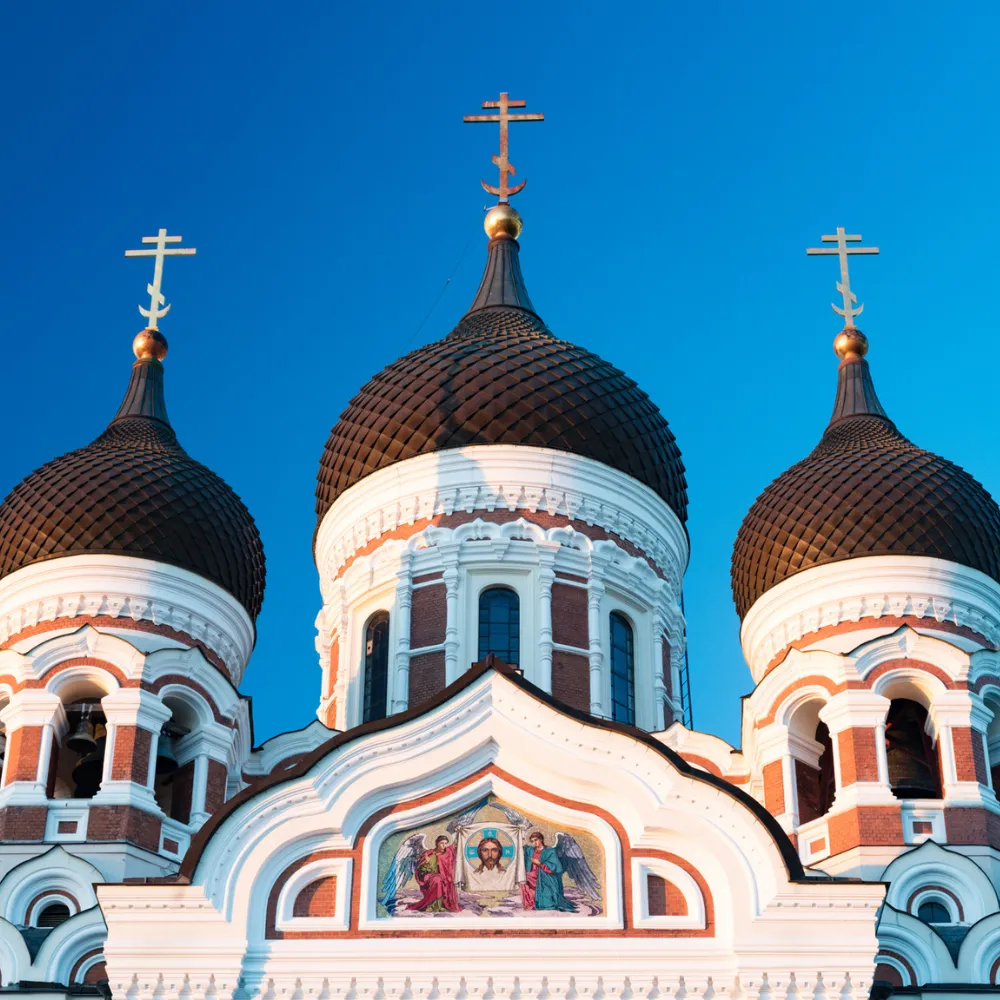
To get to the top of Toompea hill you can take a bus or a taxi, but why would you? It’s an easy 15-minute climb. Once you’re there, you can check out Toompea Castle , which is where the Estonian Parliament meets. More interesting, for me, are the 13th-century St. Mary’s Cathedral (great views from the top of its tower) and the stunningly over-the-top Russian-style Alexander Nevsky Cathedral .

Alexander Nevsky Cathedral is a prominent landmark in Tallinn, known for its striking Russian Revival architecture and ornate onion domes, located on Toompea Hill © Getty Images
Kadriorg Park and its Baroque palace were constructed more than three centuries ago on the orders of Peter the Great. The gardens are gorgeous, especially the Japanese Garden. And the Kadriorg Palace contains the Estonian Art Museum’s collection of foreign art.
There are other museums on the grounds, such as the Estonian Art Museum’s main building, called the Kumu, the Miiamilla Children’s Museum and the house museum of Peter the Great , to name just a few.
If you happen to be at Kalamaja Park, you may as well check out the nearby Proto Invention Factory (PROTO avastustehas), a kind of virtual reality museum where you can explore a time machine, test inventions and other neat stuff using virtual reality. It’s also a very cool – and reasonably priced – place for lunch.
You’ll find another modern take of the city and the country’s culture at the Telliskivi Creative City , a former factory which now contains design shops, restaurants and cultural institutions such as Fotografiska Tallinn , a center for contemporary photographic art that is associated with the internationally known Fotografiska Museum Stockholm.
This site also offers some of the finest street art in the city, which is known for the quantity and quality of its outdoor creativity. So . . .
Tallinn’s Street Art
As already suggested, Tallinn is a great place for street art, which can be found throughout the city. For example, supposedly the largest street artwork in the Baltics can be found on the façade of Ülemiste City, located at Suur-Sõjamäe 12a and home to numerous startups and IT companies. It is called “Ülemiste Girl” and the rain falling on her red umbrella actually consists of a binary code.
On a wall of Telliskivi 60a, there is a remarkable depiction of the Estonian writer Friedrich Reinhold Kreutzwald , based on an oil painting. It is called “F.R. Kreutzwald” and is remarkable because it was created by two robots(!!).
A small, unremarkable building near the headquarters of the Estonian telecommunications giant Telia Eesti is covered with several fascinating murals, the best of which is probably the one called “Dusk and Dawn,” which shows a wolf’s head with two different-colored eyes on a background of patterned circles. It’s based on a legend about two lovers who meet every Midsummer Night, which is the Summer Solstice.
These are just a few of the dozens of terrific works of art that decorate this interesting city.
What to Eat
I’ve already mentioned the verivorst with mulgikapsad, or blood sausage with sauerkraut. But of course Estonians eat other dishes as well, such as smoked sprats.
Sprats are similar to sardines, but smaller and longer, and they are much loved by Estonians. They are smoked, pickled or fried and eaten on an open sandwich, called a kiluvõileib, made of black rye bread, green onions and often a boiled egg.

Kiluvõileib is Estonia’s answer to fast food — if your idea of fast food includes smoked fish, black rye, and a boiled egg with attitude© Getty Images
Homemade bread with dark rye flour is another essential element of traditional Estonian cuisine. Try it with the semi-hard Estonian cheese called Eesti Juust, which has a mild, slightly sour flavor.
Another staple of the local cuisine is pork, which is often roasted (Seapraad) and served with sauerkraut and potatoes. Pork can also be prepared as sült (jellied pork).
Try these dishes with Estonian beer, which is actually pretty good, especially the porter. And why shouldn’t it be? The Estonians are hardly beginners in brewing. The first written reference to brewing beer comes from the year 1284, with physical evidence of beer production going back to 1000 BCE! Terviseks! (Cheers!)
For dessert, you might try Mannavaht, a traditional Estonian dessert made from semolina, milk and sugar and often topped with berries.

Mannavaht is what happens when semolina gets dreamy — a sweet, fluffy cloud of dessert often crowned with berries just to show off a little © Getty Images
A great place to try some of these dishes is the Balti Jaam Market, which is near Old Town and houses some 300 retailers and smaller producers in and around it. If you’re accommodation offers cooking facilities, you’ll find plenty of fresh local and imported produce here. If not, there’s a large street food section and several eateries, with lots of vendors to choose from. And definitely try the nearby Tšungel restaurant and terrace for a unique dining experience (NB: have a beer and NOT a mixed cocktail).
There are also shops offering antiques, clothing and handicrafts as well as a brewery, supermarket, and fitness club. In any case, there are lots of restaurants in Tallinn serving both local and international dishes at affordable prices.
If you’re at or near the Telliskivi Creative City and hungry for a quick bite, look for the Bueno Gourmet Telliskivi food truck, which offers excellent burgers, empanadas, burritos and other international street food at mouth-wateringly low prices.
Psst, Steam Heat
If you’re into saunas, you’re going to like Tallinn because the city has a great sauna culture, with some places offering an experience that includes a bar, restaurant and even dancing. In any case, it really behooves you (I’ve always wanted to use that verb in a written sentence) to try a sauna in Estonia, because the sauna is an essential part of who they are.
There are over 100,000 saunas in the country, which comes down to about one sauna for every 13 Estonians. More than a quarter of all private houses and even about one of ten apartments have saunas. Not to mention the many public saunas at sport clubs and swimming pools.
There is actually a kind of protocol to follow in a sauna, if you’ve never been. It’s not complicated and any Estonian will be more than happy to explain sauna basics to you.
The Tallinn Sauna (aka the Tartu Road Sauna) is located opposite the Central Bus and is a good place to think about if you suddenly get the urge for a sauna but don’t have a sauna bag with you. (I have to confess that I have never had my sauna bag with me.) You can buy birch sauna whisks, flip-flops and drinks there and rent a towel. It opened in 1882 and is the oldest sauna in the city, and you can see its origins in the beautiful chandeliers and brick ceiling vaults.
If you’re in a group and want to get together in a sauna, you might like the black-wood Igloo Saunas at Iglupark. The saunas themselves are modular, as real igloos are, and can fit up to 10 people. They are located on the Baltic Sea in the upscale Noblessner district, so you can jump in the water after your sauna, no matter what the temperature or season.
The sauna at the Põhjala Tap Room comes with good food and beer and can be rented during the restaurant’s opening hours. After your sauna (but never before!) you can have a good meal, drink some of their self-brewed beer and have a tour of the brewery. The sauna and food are a little pricy, but if your budget allows for the expense, it is a cool experience. If you’re in a group of up to eight people, it’ll be cheaper, of course.
The Kalma Sauna in Kalamaja dates from 1928 and is housed in a beautiful building of the period. Men’s and women’s saunas are open every day and everybody can jump in the pool afterwards. Soft drinks are on sale and the essential sauna accessories are available.
Final Words
Tallinn is a surprisingly interesting and fun place to visit for a long weekend – or, if you want to have a look at some of the rest of the country, a week. It’s cosmopolitan and modern without having lost any of its traditions and identity. And the Estonians are warm, progressive and, despite (or perhaps because of) the country’s long and largely unfortunate relationship with neighboring Russia, fiercely European.
It’s one of those places that you visit for a few days, return home with a smile and then regret that you didn’t spend a little more time looking around and meeting the locals. You can meet them in saunas or, better, at one of the late- night (open until at least 2 a.m.) places situated around the triangle of streets between Suur-Karja and Sauna streets. I forgot to say that Tallinn is also known as a decent party town.