





“So, why Portland?” That might as well be the slogan of the local tourist board, so many times was I asked it. I’d only been there a few days, but I quite enjoyed being met with what can only be described as happy bafflement whenever people realized I wasn’t a local. It’s a fair question, but one that I could only answer with “well, why not?” I was visiting my friend Maddy, we had a plan, and I also had a day in Seattle seeing another friend and going underground . So, why not indeed?
How (not) to deal with jetlag
The first challenge, as always with trips like these, was the jetlag . But aha! I had a plan for that too. The journey would be long — with waking up early to get to Prague Airport and a layover in London , it totaled 22 hours. So, upon arriving around 6.30 pm local time to be collected by Maddy at the airport — hello! — we dropped my stuff off at my Airbnb and set out. The idea was that if I could stay awake ‘til say, 10 pm, I could sleep for 12 hours and then be fresh as a daisy the next morning. In reality, what happened was that we bumbled into a local bar that was about half an hour into their weekly quiz night. A couple of beers and what was now around 24 hours without sleep meant that I was quietly, slightly hysterically mumbling answers to myself (“Fiji”, “the Battle of the Bulge”, “Damon Hill”, “1986”), while Maddy slowly ate a sandwich with the look of someone who’s just realized they’ve made a terrible mistake.
Portland
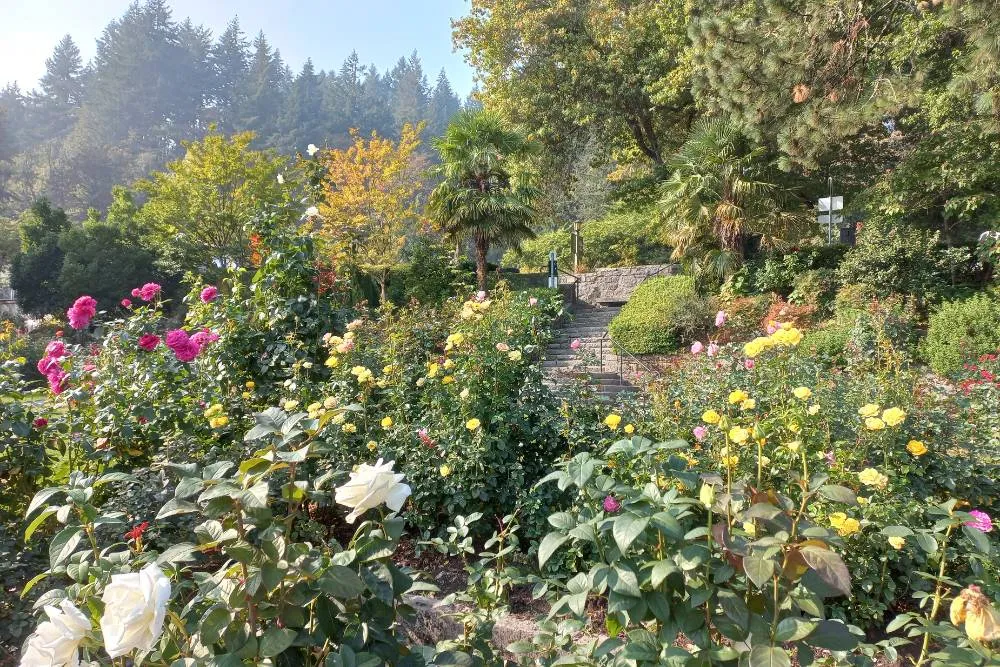 Portland is nicknamed Rose City — David Szmidt
The theory, however, was sound, and I did manage to wake up — if not daisy-fresh, then certainly in a doing-things mood. Maddy, as is her way, had come up with a list of local things to do, so we set off for the Rose Garden. A gentle stroll around a perfectly pruned park was the perfect way to blow the cobwebs away, and it reminded me that, for good reason, Portland’s nickname is Rose City. 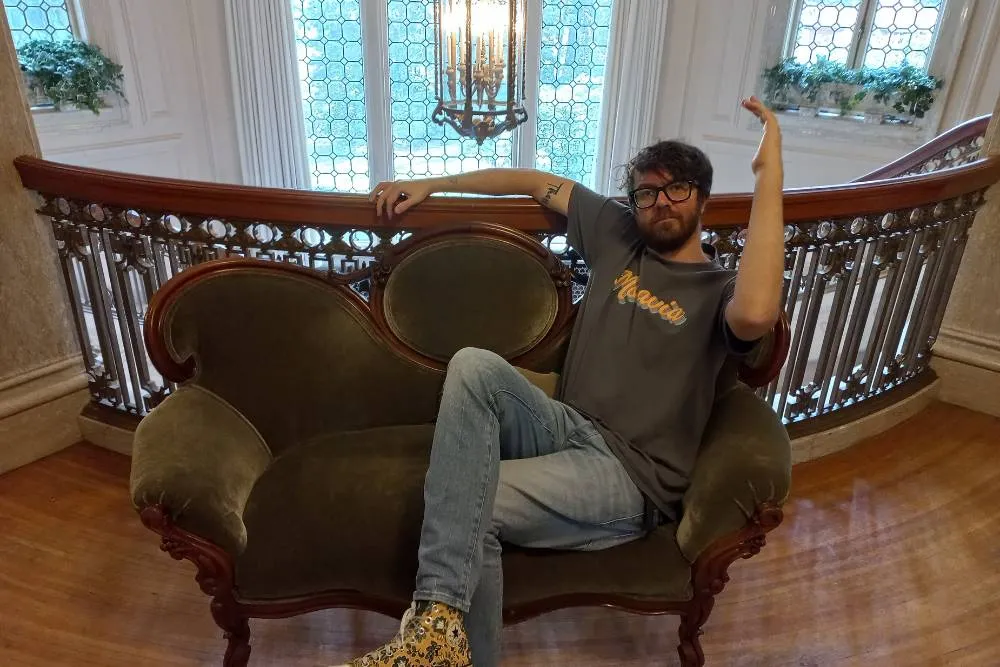 David settling in at Pittock Mansion — David Szmidt From there, we headed up to the Pittock Mansion. I’d (obviously) never heard of the place, and it didn’t look massively promising from the outside, just a large early-20th-century house. Well, it was admirable. Built by publisher Henry Pittock, the house not only tells the story of the family, but of Portland itself; the Pittocks and their influence, philanthropy, and all-round good-egg-ery are entwined with the years that Portland grew from riverside backwater to Oregon’s largest city. Each room is thoughtfully decorated, and has just enough well-chosen text on the walls to be satisfyingly informative without producing caption-reading burnout — something that this sentence is singularly failing to achieve. It’s genuinely excellent. Well done to everyone involved.
 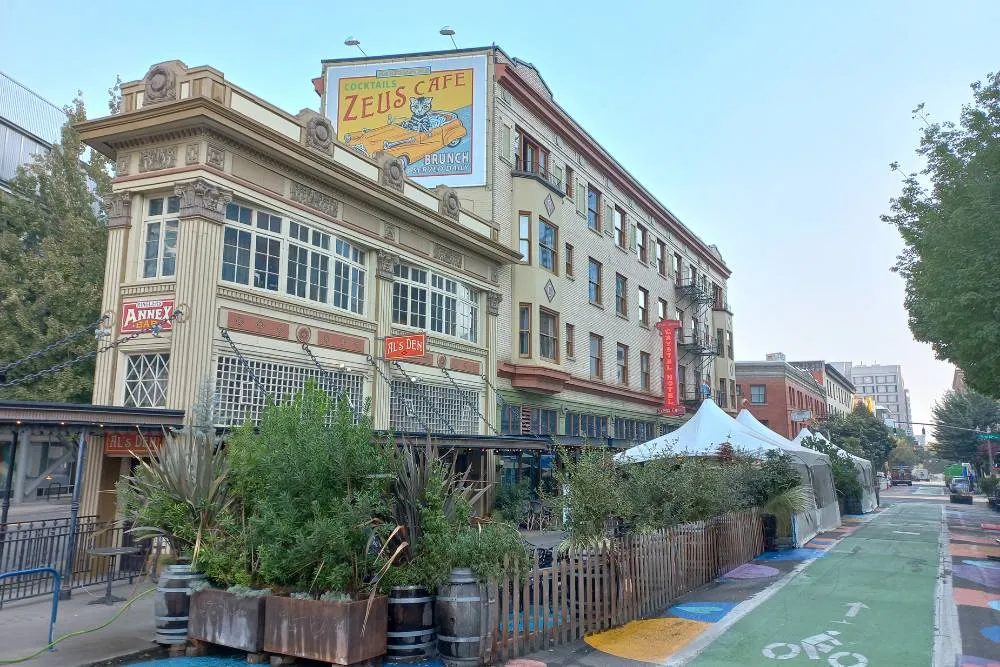 McMenamins might be a restaurant chain, but each of their places has its own character — David Szmidt
 Budget Guides
Going underground: the mysteries of subterranean Seattle
Our lead writer descends below the busy streets for an underground tour of Seattle and finds out about the city's best secrets
Read the guide
Budget Guides
Going underground: the mysteries of subterranean Seattle
Our lead writer descends below the busy streets for an underground tour of Seattle and finds out about the city's best secrets
Read the guideWe headed Downtown and went for lunch at McMenamins. Actually, I should clarify: one of the many McMenamins, as they’re sort of an institution up in the Pacific Northwest. A brewery since 1983, their habit is that of buying struggling pubs, hotels, restaurants, music venues, etc. and rebranding them under the McMenamins umbrella. Each is decorated with a sense of the history of the place, the beer is great, and everything’s reasonably priced. (For reference, lunch that particular day was at Zeus Cafe at the Crystal Hotel
, while near where I was staying, I would have the occasional beer or three in the Barley Mill Pub
.) Full of our choice of lunch options and having discovered my egg preference is over-medium — didn’t even know I had an egg preference! — we walked downhill to Powell’s City of Books
, and gosh! What a city it is. Books, both new and secondhand, spread across three floors of virtually an entire block, leading to us wandering rather aimlessly around, not knowing where to begin. Eventually, the choice became too wide and I settled on a Powell’s T-shirt featuring what can only be described as a superior fox standing on a pile of books
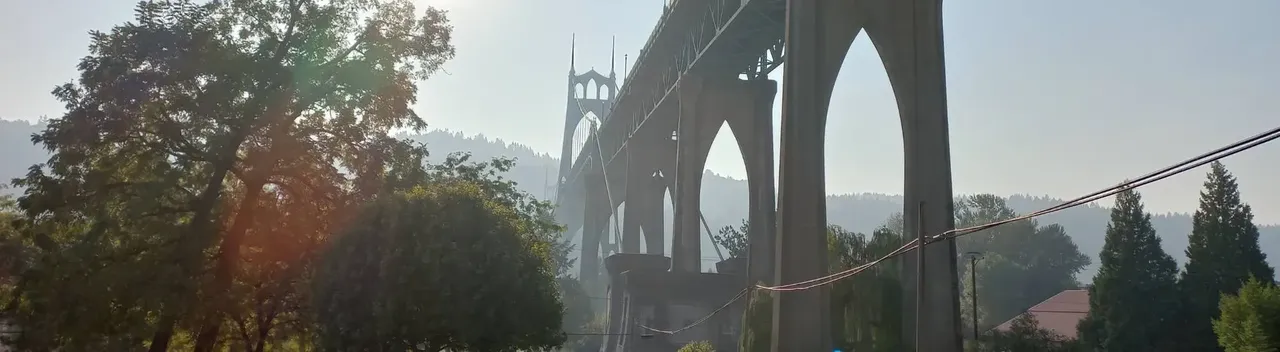
. I was very happy. 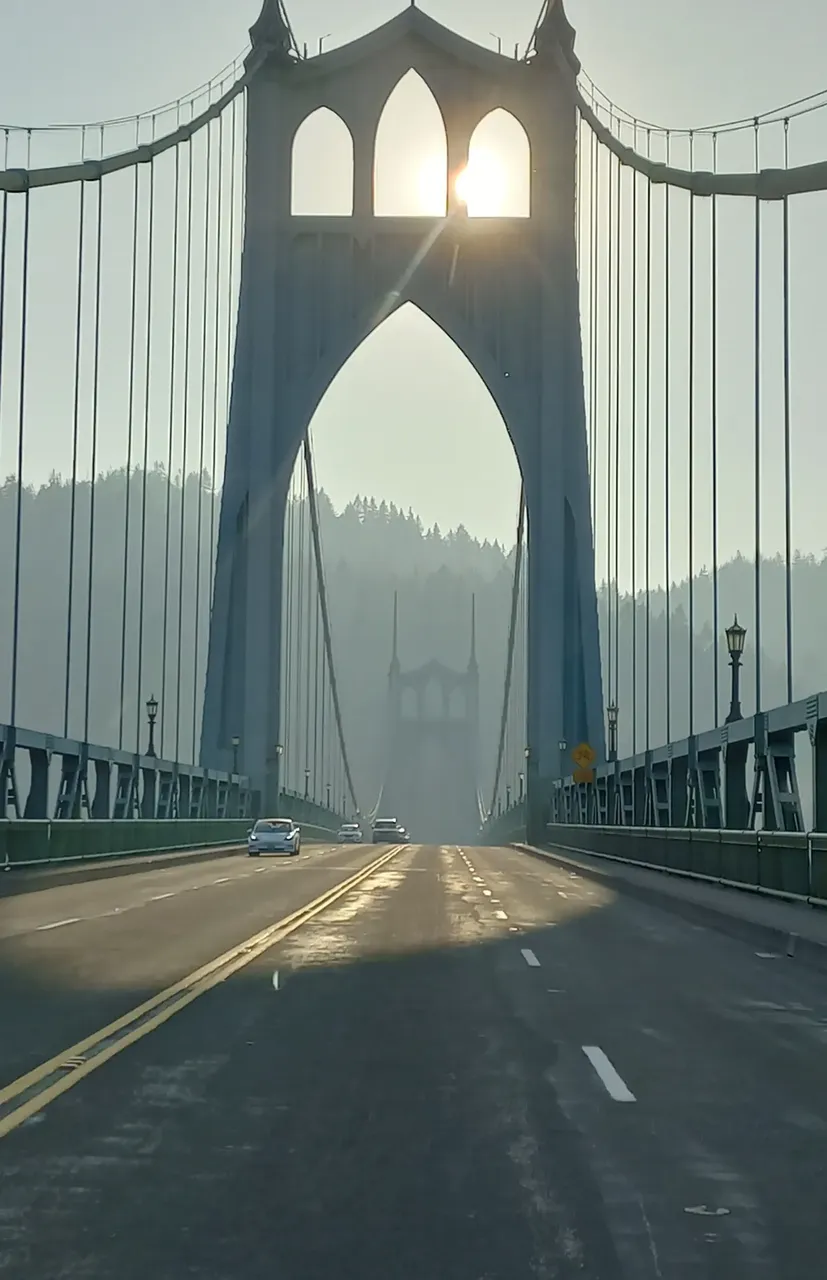 Crossing St. John’s Bridge — David Szmidt We headed back via a detour to the splendor of St. John’s Bridge, which we crossed, then hopped out to take photos from Cathedral Park. After making a lot of what-a-fine-bridge noises, we called it a day in preparation for an early start tomorrow.
The Columbia River Gorge
Today, the idea was to do a bit of driving
, stopping at various places for views, food, general local interest, and to be educated about fish. 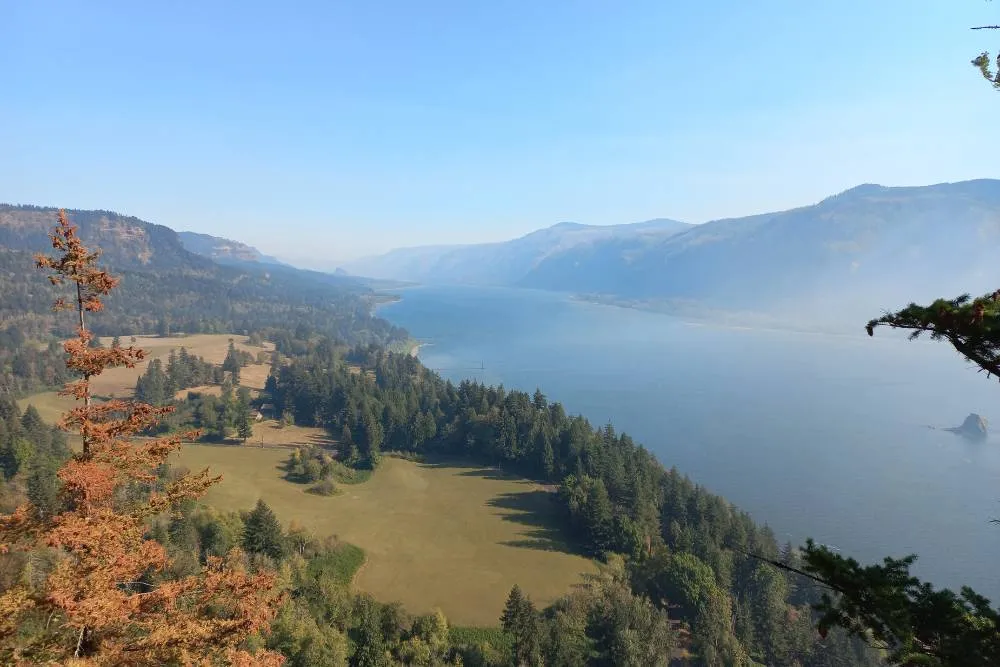 The spectacular view from Cape Horn — David Szmidt
We drove out of the city in glorious sunshine, the smoke from the unseasonal fires high in the hills clearing to reveal blue skies. (The fires, I learned, had been a major topic of conversation and justified worry among the locals. Normally there’d have been rain to put them out by now, but this was yet another disturbing example of climate change being… not normalized, but occurring with a feeling of powerlessness among those affected.) Trying to put that dispiriting thought to one side, we drove northeast, entering Washington
(tick!), and to Cape Horn Lookout. As the highway turned left, the view opened up beneath us, and we stopped by the roadside for a glorious panorama of the mighty river below. It was all I could do to not throw my head back and belt some John Denver into the open air, but mindful of the fact there were other people there and it was a dreadfully long way down, I decided against it. Further on, we stopped for lunch in the wonderfully-named county of Skamania (“brass sections and bouncy guitars for all the family!”), and the sleepy riverside town of Stevenson. Clark and Lewie’s
is a waterfront restaurant with a wooden patio and a selection of local ales, and seems pretty well-known throughout the local area. 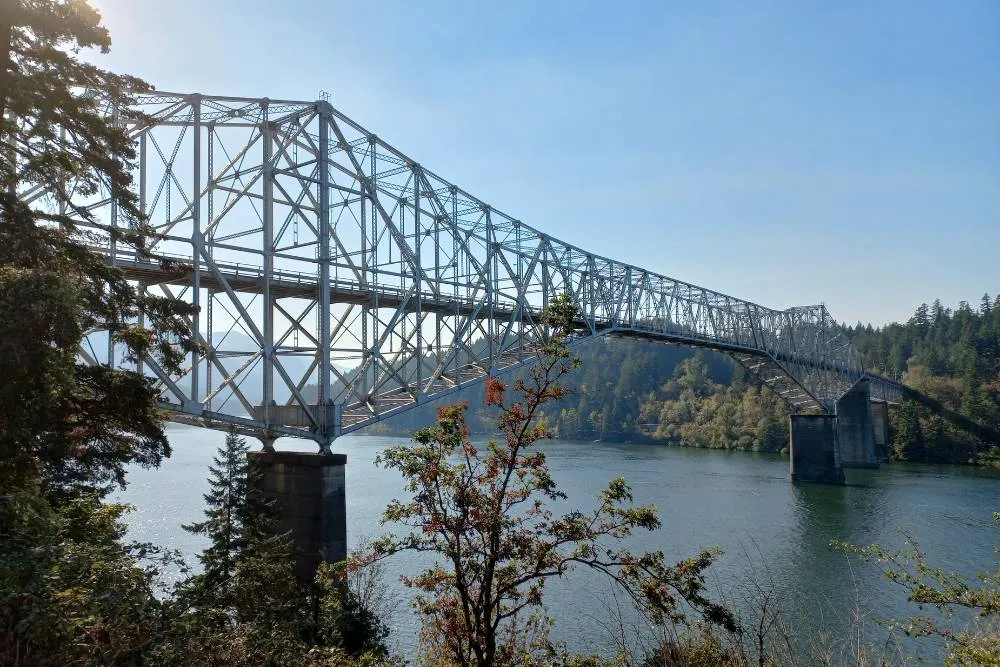 Bridge of the Gods — David Szmidt Satisfied, we pressed on, aiming to cross the river using the Bridge of the Gods. A dramatic name it was, and a dramatic structure it is, a spindly spider web of steel dating back to 1926. Impressed, we turned and headed back west along the Oregon side of the river and in a few miles, found ourselves at Bonneville Fish Hatchery. This I wasn’t necessarily expecting, but it turned out to be incredibly wholesome, the sort of place that attracts families with kids called Bobby and Ed Jr. who get their hair ruffled and called “sport” a lot. It just had a very 1950s vibe to it, with its whitewashed clapboard buildings, green lawns and gently-worded signs not instructing you not to do things, but simply implying it might be rather bad form. I found it quite charming, and we learned a lot about sturgeon, so that was a bonus.
 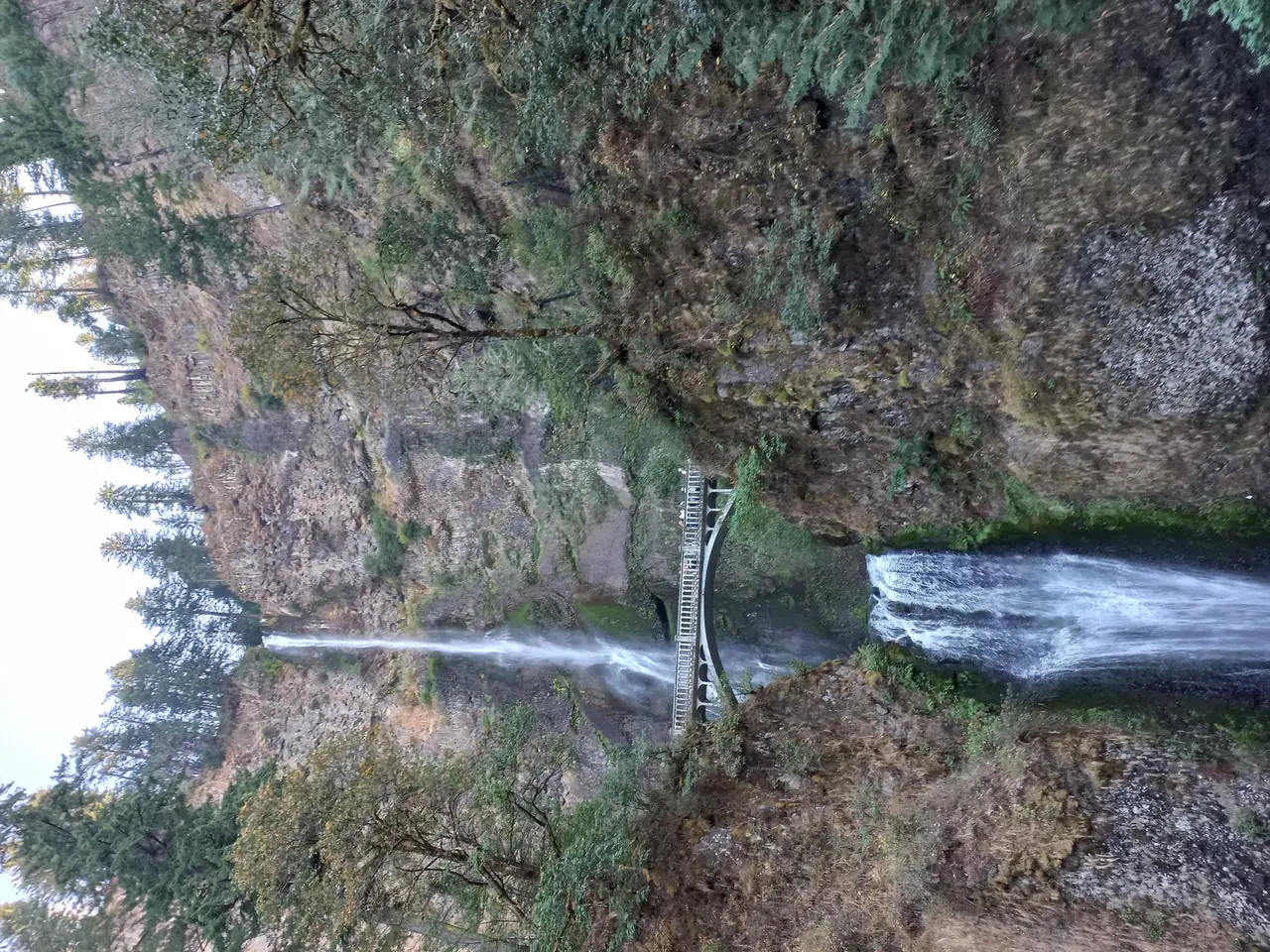 Multnomah Falls is the most popular natural attraction in this region of the US — David Szmidt Back on the highway for another 15 minutes and we arrived at the pit-stop parking lot in the middle of the road opposite Multnomah Falls, 189 meters in height and the most-visited natural attraction
in the Pacific Northwest. Thankfully this wasn’t apparent on this October afternoon, and we had space to wander about, take photos and make appropriately impressed comments about what is essentially just water dropping. In fairness, as a tourist site, it’s well done, with the natural frame of the falls enhanced by the necessary but tasteful addition of a stone bridge. Again, signage was brief but informative, and a steep and winding trail meant you could head all the way to the clifftop if you so wished. We did not so wish, but gamely wheezed to a couple of lower viewpoints before heading back down to the car. My first two full days in Portland had been wonderful. There was more to come, I was promised. I couldn’t wait. Click here
for Part Two of David’s Oregon Trail adventure!…
Multnomah Falls is the most popular natural attraction in this region of the US — David Szmidt Back on the highway for another 15 minutes and we arrived at the pit-stop parking lot in the middle of the road opposite Multnomah Falls, 189 meters in height and the most-visited natural attraction
in the Pacific Northwest. Thankfully this wasn’t apparent on this October afternoon, and we had space to wander about, take photos and make appropriately impressed comments about what is essentially just water dropping. In fairness, as a tourist site, it’s well done, with the natural frame of the falls enhanced by the necessary but tasteful addition of a stone bridge. Again, signage was brief but informative, and a steep and winding trail meant you could head all the way to the clifftop if you so wished. We did not so wish, but gamely wheezed to a couple of lower viewpoints before heading back down to the car. My first two full days in Portland had been wonderful. There was more to come, I was promised. I couldn’t wait. Click here
for Part Two of David’s Oregon Trail adventure!…