



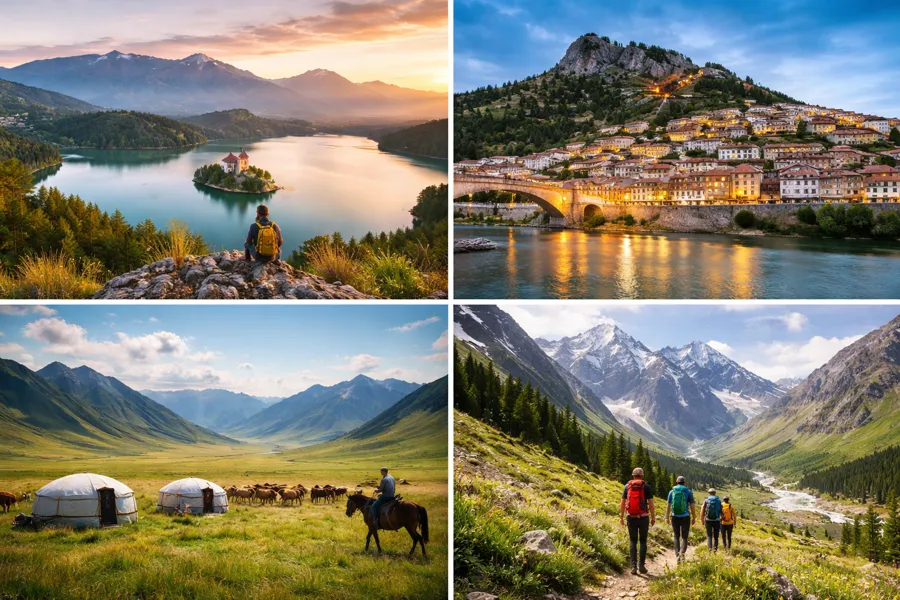
The five countries discussed below are all “undiscovered pearls” experiencing a boom that will eventually transform them into major tourist destinations. Uzbekistan , for example, welcomed a record 11.7 million foreign visitors in 2025, and the government has officially set a long-term target of reaching 20 million by 2030. The country has an aggressive incentive program for travelers that includes reimbursements for 15% of their flight, train, or bus tickets. Be sure to acquaint yourself with how to benefit from the incentives where available.
Albania
Often cited as a budget-friendly alternative to the Amalfi Coast, Albania’s Ionian Sea beaches and mountain villages offer untouched beauty and warm hospitality. The country is on the verge of becoming a major tourist destination.
Rapidly Increasing Arrivals
There were 12.47 million foreign visitors in 2025, a 6.6% growth over the 2024 figures, confirming Albania as an increasingly popular travel destination.
Infrastructure & Accessibility
Major Roadworks
The opening of the Llogora Tunnel in July 2024 reduced travel time to the Albanian Riviera from 30 minutes to just 7.
New Transport Hubs
Significant government investment is being funneled into expanding the Tirana -Durrës highway and constructing the new Port of Porto Romano
Aviation Expansion
Increased direct flight connections and the planned construction of a new airport in the south are making the country more accessible to international markets.
Global Recognition
- Top Rankings: Albania was ranked as the top travel destination for 2025 by The Independent and was among the top three emerging destinations worldwide according to Travel Radar.
- Eco-Tourism Buzz: The Vjosa Wild River National Park was featured in The New York Times’ 52 Places to Go in 2023, highlighting its unspoiled nature.
Significant Private Investment
International Hotel Chains
Brands like Marriott, Melia, Radisson, Hilton, and Hyatt have established a presence, reflecting high investor confidence.
Luxury Developments
High-profile projects include a proposed $1.4 billion luxury hotel on Sazan Island by Jared Kushner. "
Highlights That Make Albania a Future Tourism Giant
Extreme Affordability
Albania remains one of the most budget-friendly Mediterranean options, with average daily tourist spending around €427, significantly lower than in neighboring Greece or Italy.
Seasonality Shift
Data from late 2025 shows a 7% increase in arrivals during traditionally “off-season” months like December, indicating that Albania is successfully rebranding as a year-round destination.
The Albanian Riviera
Crystal-clear waters, dramatic cliffs, and beaches like Ksamil, Dhermi, and Jale lend Albania a similar “vibe” to the Greek islands but without the crowds or prices.
The Accursed Mountains
They are one of Europe’s most spectacular hiking regions, with the Theth–Valbona trail becoming a bucket-list trek.
UNESCO Cities: Berat & Gjirokastër
- Ottoman architecture, stone houses, and fortress views.
- Perfect for slow travel and culture lovers.
Food & Wine Scene
Mediterranean meets Balkan: fresh seafood, farm-to-table produce, and excellent local wines.
Mongolia
Mongolia offers a unique mix of nomadic culture and vast, pristine steppes and is rapidly emerging as a global travel destination due to a “perfect storm” of government policy, improved accessibility, and major international endorsements. In 2024, the country welcomed a record 808,956 tourists, and by late 2025, arrivals had already surged by an additional 16%.
The “Years to Visit Mongolia” Initiative (2023–2028)
Originally a three-year plan, the Mongolian government has extended this national campaign through 2028. The goal is to reach 2 million annual tourists by 2030.
Visa-Free Expansion
Mongolia has exempted citizens from 34 countries (including most of the EU, UK, and Australia) from visa requirements for stays of up to 30 days. This policy has been extended through January 1, 2027.
E-Visa System
Citizens from 99 countries can now apply for 30-day tourist e-visas online via the Official E-Visa Portal.
Major Infrastructure & Aviation Upgrades
New International Hub
The Chinggis Khaan International Airport (UBN) , which opened in 2021, is already targeting a throughput of 2.4 million passengers by the end of 2025, exceeding its initial design capacity.
Regional Airport Growth
The government is launching Public-Private Partnership (PPP) projects to upgrade regional airports in Khovd, Khuvsgul, Dornod, and Umnugobi.
New Flight Routes
United Airlines launched its first-ever direct flight to Mongolia in May 2025, a major milestone for Western accessibility.
International Recognition
Top Rankings
Lonely Planet named Mongolia its “#1 country to visit for 2024,” citing its wide-open spaces and unique nomadic culture.
Wellness & Adventure
National Geographic highlighted the Gobi Desert as a top wellness escape for its combination of Buddhist teachings, yoga, and nomadic stays.
Economic Growth and Regional Cooperation
The “Tea Road” Project
In November 2025, Mongolia, China , and Russia signed a joint plan to develop cross-border self-driving routes and tourism stops along the historic “Great Tea Road,” which runs north from China’s heartland through Mongolia and across Siberia.
Revenue Surge
Tourism revenue hit an all-time high of $1.6 billion in 2024, leading to increased private investment in ger camps, luxury lodges, and local hospitality. (A ger is a portable, felt-covered nomadic tent.)
Selected Tourist Highlights
National Parks & Natural Wonders
- Gobi Desert: A vast region featuring the Khongoryn Els (Singing Sands), which reach up to 300 meters in height, and Bayanzag (Flaming Cliffs), famous for the discovery of the first dinosaur eggs.
- Gorkhi Terelj National Park: One of the most accessible parks from Ulaanbaatar, known for its alpine scenery, Turtle Rock, and the Aryabal Meditation Temple.
- Khuvsgul Lake: Known as the “Blue Pearl,” this is one of the deepest freshwater lakes in Central Asia. It is known for summer boating and the winter Ice Festival.
Cultural & Historical Landmarks
- Chinggis Khaan Statue Complex: Located about 54km from Ulaanbaatar, this 40-meter-tall equestrian statue is the tallest in the world. Visitors can take an elevator to the horse’s neck for panoramic views or explore the onsite museum.
- Erdene Zuu Monastery: Built in 1586, it is the oldest surviving Buddhist monastery in Mongolia.
Slovenia
Frequently described as a “hidden gem” that is rapidly gaining global recognition, Slovenia features “fairytale” spots like Lake Bled and the Julian Alps, yet remains far less crowded than its neighbors. However, its transformation to a tourist hot spot is imminent due to a record-breaking expansion of flight connectivity, prestigious cultural designations, and international recognition as a global leader in sustainable “green” travel.
Record-High Connectivity
New Routes
Key additions for the 2026 season include direct flights to Edinburgh (easyJet), with expanded services from KLM (to 14 flights weekly to Amsterdam) and Iberia **(**extending its Madrid service from June through September).
Carrier Expansion
The airport now hosts a record number of scheduled airlines, including major hubs like Lufthansa (Frankfurt/Munich), Turkish Airlines (Istanbul), and British Airways (London Heathrow).
Major Cultural Milestones
Europe’s Best Cultural Heritage Town
Ptuj, Slovenia’s oldest town, has been named the “Best Cultural Heritage Town in Europe” for 2026 by European Best Destinations.
Škofja Loka Passion Play
This massive open-air Baroque performance involving over 1,000 volunteers takes place only once every six years. The 2026 staging (March 21–April 19) is the first since its inscription on the UNESCO Intangible Cultural Heritage list.
New Museums
The Muzej Lah in Bled is scheduled to open in summer 2026, adding a major contemporary art destination to the iconic lake region.
Global “Green” Endorsements
The country is highly regarded for its commitment to sustainability, being the first in the world to be declared a “Green Destination of the World” in its entirety.
National Geographic “Must-Visit”
It was selected as a top travel destination for 2026 by National Geographic, specifically for its immersive outdoor adventures like Alpine hiking and river paddling.
Sustainable Awards
At the Green Destinations Story Awards 2026, three Slovenian destinations (Bela Krajina, Bohinj and Bled) received top honors for sustainable practices.
Cycling and the “Tadej Pogačar Effect”
Tadej Pogačar is universally regarded as the best cyclist in the world and one of the greatest of all time. He has significantly transformed the country into a global cycling powerhouse and a top-tier destination for active holidays.
Infrastructure and Tourism Development
The surge in interest has led to a more robust and specialized infrastructure catering to cyclists.
- Specialized Accommodations: There has been a rise in “cycling-friendly” hotels and providers offering specialized services for bike travelers.
- Expanded Route Networks: Slovenia now boasts an extensive network of diverse trails, from professional-grade Alpine climbs in the Julian Alps to scenic coastal routes.
- The “Pogačar Effect”: Fans now travel specifically to ride the same roads Pogačar used for training, such as the climbs in the Soča Valley and around his hometown of Komenda.
Kyrgyzstan
Kyrgyzstan is no longer just a “hidden gem” but is actively trending toward becoming a mainstream destination for adventure and sustainable travel. The recently expanded Kyrgyz Nomad Trail is positioning it as the next big thing for trekking. Several key indicators suggest the country is at a tipping point.
High-Profile Media Endorsement
Kyrgyzstan has earned significant international recognition in 2026, most notably being featured in The New York Times list of the world’s best tourist destinations for 2026. The publication specifically highlighted the Tian Shan mountain ranges as a must-visit for global travelers.
Massive Surge in Inbound Traffic
Official statistics from early 2026 show a “sharp increase” in visitors. In 2025, nearly 21 million foreign citizens entered the country, an 18.6% increase from the previous year. While many are from neighboring Central Asian countries, there is rapidly growing interest from Europe and wider Asia, specifically Germany, China and India.
Aggressive Infrastructure Expansion
The Kyrgyz government and international funds are making large-scale investments to move beyond “accidental” tourism:
Tourist Bases
The government identified 156 potential sites for new tourist bases, with 40 launched in 2025 across every region, including Issyk-Kul, Naryn, and Osh.
Ski Clusters
Significant funding is driving the development of the “Karkyra” all-season complex, aimed at creating a major ski cluster in the Issyk-Kul region.
Digital Nomad Growth
A rise in digital nomadism is leading to longer-term stays and better connectivity in urban hubs like Bishkek.
Cross-Border “Single Tourist Space”
In early 2026, Kyrgyzstan and Kazakhstan began forming a joint economic and tourist corridor between Bishkek and Almaty. This initiative aims to reduce travel time between these hubs and market the two countries as a single, seamless destination for international Silk Road itineraries.
Shift to Organized Tourism
Kyrgyzstan is transitioning from a “backpacker-only” destination to an organized tourism market. Expert tour operators in 2026 note that while demand is stable, travelers are increasingly seeking high-end boutique experiences and “insider access” to local experts.
Selected Tourist Highlights
Kyrgyzstan’s tourism highlights revolve around its mountainous terrain (which covers about 95% of the country) and its rich nomadic culture.
Iconic Alpine Lakes
- Issyk Kul: The world’s second-largest alpine lake, known as the “Pearl of Central Asia.” Its southern shore is popular for its “raw” beauty and unique red-rock canyons, while the north is more developed for beach resorts.
- Song-Kul: A high-altitude lake where travelers can experience the authentic nomadic lifestyle by staying in yurts and going on multi-day horse treks.
Natural Wonders & Adventure
Ala-Archa National Park: The most accessible natural attraction, located just 40km from Bishkek. It offers alpine meadows, glaciers, and a variety of hiking trails.
Jeti-Oguz (Seven Bulls): A famous gorge near Karakol featuring dramatic red sandstone rock formations.
Cultural & Historical Landmarks
Burana Tower: A 25-meter-high minaret that is one of the few remaining relics of the ancient Silk Road city of Balasagun. The site includes a museum and a field of balbals (ancient stone grave markers).
Sulaiman-Too (Osh): A sacred mountain and UNESCO World Heritage site in the city of Osh, featuring ancient caves, mosques, and a historical museum.
Osh Bazaar (Bishkek): One of the most vibrant and atmospheric markets in Central Asia for experiencing local food and daily life.
Uzbekistan
Uzbekistan is transitioning from a “niche Silk Road destination” to a major global player. The legendary Silk Road cities (Samarkand, Bukhara, Khiva) are becoming much easier to visit thanks to new high-speed rail connections and improved visa policies.
Record-Breaking Growth
In 2025, the country welcomed a record 11.7 million foreign visitors, a nearly 47% increase from 2024. The government has officially set a target of reaching 20 million by 2030.
Major Policy & Visa Liberalization
U.S. Visa-Free Entry
Starting January 1, 2026, all U.S. citizens can enter Uzbekistan visa-free for up to 30 days, removing a significant logistical barrier for North American travelers.
Digitalization Drive
A presidential decree has mandated the implementation of modern digital navigation, mobile applications, and interactive systems to make the country more “tourist-friendly”.
Aggressive Incentives
Uzbekistan has one of the most aggressive incentive programs in Central Asia.
Direct Cashback
Domestic and international travelers can receive reimbursements for 15% of their flight, train, or bus tickets, 15–20% of accommodation costs, and 50% of tickets to cultural sites.
VAT Refunds (Tax Free)
Starting April 1, 2026, a new system allows foreign tourists to reclaim 85% of the VAT on purchases over 300,000 UZS (~$24.50) at all international airports.
Tour Operator Subsidies
The government pays tour operators $20 to $100 per foreign tourist brought from countries with low visitor flow, with higher amounts for winter travel.
Rapid Infrastructure & Connectivity Expansion
Accommodation Boom
By early 2026, the number of tourism service providers surpassed 3,100, including 1,023 new boutique hotels and family guesthouses opened for the 2026 season.
Transport Upgrades
- Air Access: Samarkand’s major new airport terminal (opened in 2022) has significantly increased capacity for international routes.
- Highway Modernization: A five-year program is underway to upgrade 4,000km of highways to international “autobahn” standards, linking major hubs like Tashkent, Samarkand, and Khiva.
Investment
Over $6.5 billion has been funneled into the tourism sector over the last eight years, adding more than 130,000 hotel rooms.
Diversification Beyond “The Big Three”
While Samarkand, Bukhara, and Khiva remain anchors, 2026 is seeing a shift toward:
Business & MICE Tourism
Business travelers nearly tripled by late 2025, driven by a surge in international exhibitions and forums.
Alternative Regions
New projects are being launched in the Fergana Valley, Karakalpakstan, and the mountains of Kashkadarya.
Selected Tourist Highlights
Uzbekistan is the architectural heart of the Silk Road and is famed for its blue-tiled domes, towering minarets, and ancient mud-walled cities. The “Big Three” cities are absolute must-sees.
Samarkand: The “Crossroad of Cultures”
- Registan Square: Arguably the most iconic sight in Central Asia. It’s a massive square framed by three ornate madrasahs (Islamic schools) covered in intricate blue mosaics.
- Shah-i-Zinda: A stunning necropolis with a “street” of blue-tiled mausoleums. The colors are so vivid they almost look photoshopped.
- Gur-e-Amir: The gold-heavy mausoleum of the conqueror Tamerlane.
Bukhara: The Living Museum
Unlike Samarkand, which is a modern city with ancient pockets, Bukhara’s Old City is a walkable maze of history.
- Po-i-Kalyan Complex: Features the massive Kalyan Minaret, which was so impressive that, according to legend, Genghis Khan spared it from destruction.
- The Ark of Bukhara: A massive 5th-century fortress that served as the residence of the Emirs.
- Chor Minor: A charming, photogenic little mosque with four distinct blue towers.
Khiva: The “Open-Air Museum”
- Itchan Kala: The inner walled city is a UNESCO site. It feels like stepping back 500 years in time.
- Kalta Minor Minaret: An unfinished, turquoise-tiled minaret that is incredibly wide and distinctive.
- Islam Khoja Minaret: The tallest minaret in the city; you can climb to the top for a view of the entire desert oasis.
FAQs
When is the best time to visit these under-the-radar destinations?
For the best experience, visit them as soon as possible before they become as crowded and expensive as their mainstream rivals. Of the five destinations described above, Albania and Slovenia are the closest to “blowing up,” while Mongolia will probably be the last to become a mass tourist destination.
How good is digital connectivity in these countries?
Connectivity is of Western European standard in Slovenia, while in Albania it is spotty in the mountains and trekking areas. In the other three countries, it is best in the major cities and is constantly being upgraded. Kyrgyzstan, for example, has a well-developed mobile network, though coverage varies significantly between urban centers and remote mountain regions. Before you travel, consult the official coverage maps of the major providers in Kyrgyzstan, Uzbekistan, and Mongolia. Because signal drops out completely in many trekking areas, download offline maps while you can.
What about the ATM situation in some of these countries?
In Uzbekistan, Kyrgyzstan, and Mongolia, ATMs are reliable in cities but become unreliable, scarce, or nonexistent once you head into the steppe, mountains, or desert. Cash is still king for local markets, guesthouses, and remote transport. Be sure to always carry 20% more cash than you think you’ll need. These countries are often flagged for suspicious activity, so send a travel notice to your bank to avoid your card being swallowed or blocked. And always carry $200 to $300 in pristine, uncreased US Dollar bills. In Albania, always carry a backup of Euros because many guesthouses and tour operators prefer being paid in that currency.
Popular routes on Kiwi.com
- Cheap flights from London to Turkey
- Cheap flights from London to Barcelona
- Cheap flights from London to Japan
- Cheap flights from London to New York
- Cheap flights from New York to Paris
- Cheap flights to Spain
- Cheap flights to Italy
- Cheap flights to the United States
- Cheap flights to the United Kingdom
- Last minute flights
People Also Read

How to Travel Patagonia: A First-Timer's Guide to Chile & Argentina's Wild South
Where to stay in Palma de Mallorca: best areas for beaches, culture and nightlife