


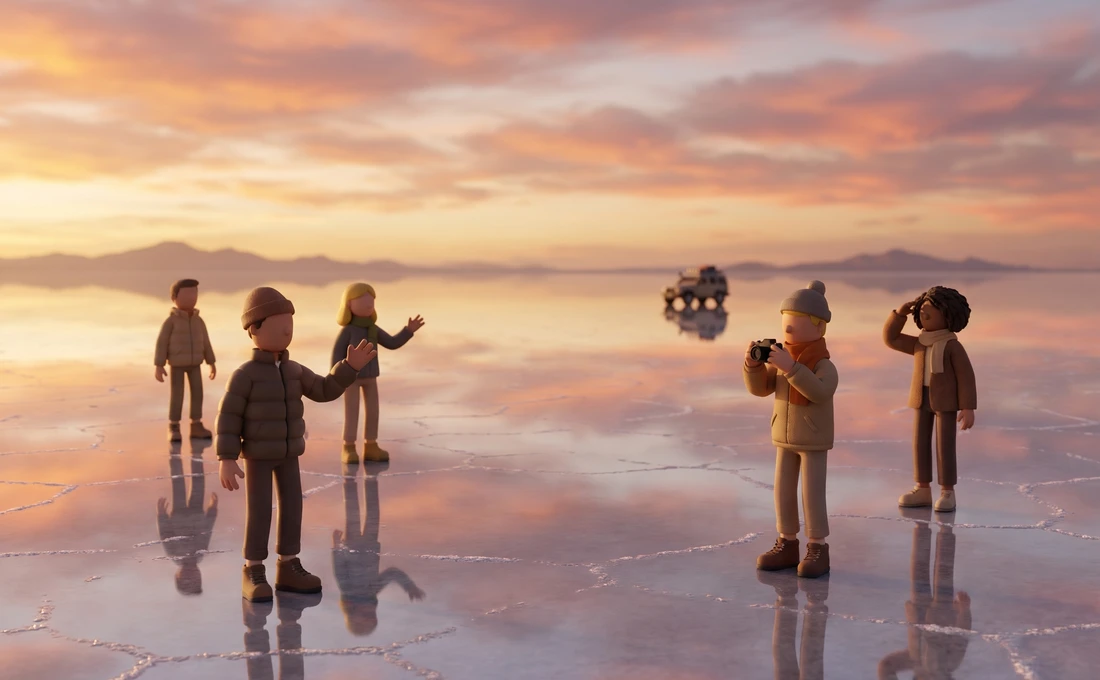
Picture a white horizon with no edges. After rain, the Salar de Uyuni becomes a giant mirror, and the sky ends up under your feet. It is one of the most photographed places in South America. And you can see it without spending a fortune.
In this article
The flat has two looks. In the wet season, a thin layer of water turns it into a mirror that reflects the sky. In the dry season, the salt crust dries into white hexagon patterns that stretch to the horizon.
This guide covers how to get there, when to go, what tours include and what it all costs in bolivianos (BOB) and euros. It also covers how to cope at about 3,650 metres.
Key takeaways
Best time: January to March for the mirror, May to October for the salt hexagons.
Getting there: fly into La Paz (LPB). Then take a short flight or an overnight bus to Uyuni (UYU). From Chile, 3-day tours start in San Pedro de Atacama.
Altitude: Uyuni sits at about 3,650 metres. Spend a few nights at altitude first.
Tours: shared 1-day tours start at around €45. Shared 3-day tours start at around €135.
Pack: warm layers, sun protection and cash in BOB. There are no ATMs on the tour route.
Check first: Bolivia is under a state of emergency. Read your government's latest travel advice and allow extra time.
How to Get to Uyuni
Bolivia is currently under a state of emergency, and road blockades can disrupt overland travel at short notice. Check your government’s latest travel advice before you go, and allow extra time between connections.
Most visitors fly into La Paz (LPB) . From there, you have two ways to reach Uyuni:
- Fly. The flight to Uyuni (UYU) takes about an hour. It costs several times more than the bus. Flights are cancelled more often in the rainy season, so don’t book a tight connection home.
- Take the overnight bus. Buses leave in the evening and arrive early in the morning. The journey usually takes 9 to 12 hours. Wear warm clothes, because the buses get cold.
- From Chile. Many 3-day tours start in San Pedro de Atacama. You cross the border at Hito Cajón, at about 4,500 metres, and finish in Uyuni. That saves you the trip back. But San Pedro sits at only 2,400 metres, and the tour climbs above 4,000 metres on the first day. You have little time to adapt, so take it slowly, drink water and tell your guide if you feel unwell. Also make sure you get your Bolivian entry stamp. If you have not sorted your flights to Chile yet, it is worth comparing where in Chile you arrive.
Find flights for this trip
Altitude: Acclimatise First
Uyuni is at about 3,650 metres, and La Paz is at about 3,640. The lagoon route goes higher still. The Eduardo Avaroa reserve lies between 4,200 and 5,400 metres.
Altitude illness can affect anyone above 2,500 metres, so give your body time. Many visitors pair Uyuni with Peru and Machu Picchu without a tour package , so plan the high-altitude stops in the same trip and acclimatise before either one.
- Spend your first two or three nights in La Paz or Uyuni. They sit at about the same height as the start of your tour, and the route then climbs higher.
- Drink plenty of water and skip alcohol for the first days.
- Walk slowly and rest if you get a headache.
- If symptoms get worse, go down to a lower altitude and see a doctor.
Mirror or Hexagons: When to Go
The mirror needs a thin layer of rainwater on the salt. That means the rainy season, roughly January to March. The water is deepest in January and February.
In the dry season, from May to October, the salt hardens into white hexagon patterns. Vehicles can cross most of the flat. April and November sit in between, so you may see a bit of both. The mirror is never guaranteed, because the rains can start or end weeks early or late.
| Mirror season | Hexagon season | |
|---|---|---|
| Months | January to March | May to October |
| What you see | The sky reflected in shallow water | White salt hexagons and clear skies |
| Getting around | Parts of the flat may flood and routes change. Incahuasi is often closed to tours | Most of the flat is open |
| Temperatures | Mild days, nights near freezing | Nights as low as -20°C in June to August |
| Crowds | Carnival in February fills hotels | July and August are busiest |
| The catch | More flight and road delays | Very cold nights |
1-Day vs. 3-Day Tours
Almost everyone sees the flat on a shared 4x4 tour with a driver-guide. Compare what is included before you pay.
| 1-day tour | 3-day tour | |
|---|---|---|
| Time | 8 to 10 hours | 3 days, 2 nights |
| Covers | Train cemetery, salt flat, lunch on the flat, Incahuasi in the dry season | Salt flat, lagoons, flamingos, geysers, hot springs |
| Usually included | Transport, guide, lunch | Transport, simple lodging, meals, guide |
| Often extra | Island entry fee, tips | Reserve entry fee, hot springs, sleeping bag, showers, tips |
| Rough price | 590 to 1,180 BOB (€45 to €90) | 1,770 to 2,950 BOB (€135 to €225) |
Pick an established operator rather than the cheapest offer. Ask whether the guide speaks English. Ask whether a sleeping bag is included. And never drive on the flat yourself. It is easy to get lost or stuck, especially in the rainy season. Some operators add 5 to 10% when you pay by card.
 Budget Guides
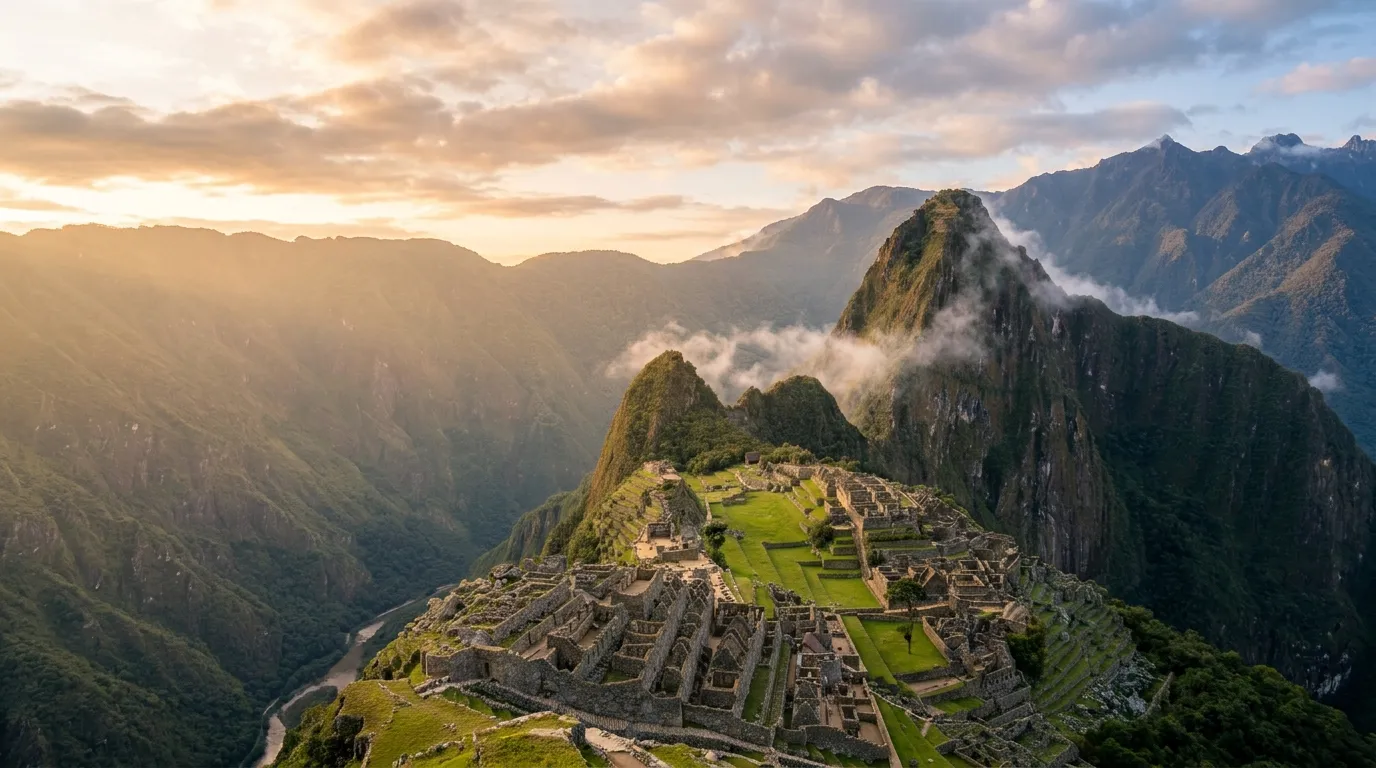
Machu Picchu Without the Tour Package: How to See Peru's Icon on Your Own (and for Less)
Plan Machu Picchu on your own: how tickets work, the cheapest ways to get there, what it costs in PEN and EUR, and the mistakes that ruin trips.
Read the guide
What You’ll See
Incahuasi Island
A rocky island in the middle of the salt flat, covered in giant cacti. Walk up to the viewpoint for a view across the white plain. In the mirror season, tours often skip it.
The train cemetery
Rusting locomotives stand in the desert near Uyuni. It is usually the first stop on a 1-day tour. It also makes a good photo.
The salt hotels
A few hotels on and near the flat are built from blocks of salt. The walls and even the furniture are made of it. A night in one costs far more than a hostel, so most budget travellers just visit. Ask whether your tour includes a stop at one.
Coloured lagoons and flamingos
The 3-day route crosses the Eduardo Avaroa reserve. Laguna Colorada, at 4,278 metres, has red-tinged water. Andean, James’s and Chilean flamingos feed there. You also pass geysers, hot springs and the Stone Tree, a rock shaped by the wind.
Perspective Photo Tips
- Go far out. The flat has no reference points, which makes tricks with distance work.
- Use a small prop. Put a toy near the camera and stand further back. Use a timer or ask your guide to help.
- Get low. Hold your phone near the ground and keep everything in focus.
- Wear bright colours. They stand out against the white.
- In the mirror season, shoot at sunrise or sunset. Hold your phone just above the water.
- Protect your gear. Wipe salt off your phone or camera.
What to Pack
- Warm layers. Nights can fall to about -20°C from June to August. In the rainy season they are near freezing. Bring thermals, a fleece, a windproof jacket, a hat and gloves.
- A sleeping bag. It is essential in winter. Some operators include one, so ask.
- Sun protection. The sun is strong at altitude, and the salt reflects it. Bring high-factor sunscreen, UV sunglasses and lip balm.
- Waterproof boots. Closed shoes are best in any season. Avoid long trousers that drag in salty water.
- Cash in BOB. There are no ATMs on the tour route, and the ones in Uyuni can run empty. Withdraw cash in La Paz and carry small notes.
Visa and Entry for EU Travellers
EU citizens can generally visit Bolivia as tourists for up to 90 days without a visa. Your passport should be valid for at least six months when you arrive. Border officers may ask for proof of onward travel and of where you are staying. Keep both handy.
Make sure you get an entry stamp, especially if you enter by land. You can be fined without one when you leave. A yellow fever certificate is only needed if you arrive from a country with yellow fever risk. Rules can differ by nationality, so check your own government’s official travel advice and Bolivia’s official migration rules .
What It Actually Costs
Prices checked on 11 November 2026 and subject to change. At the time of writing, €1 ≈ 13.16 BOB (Central Bank of Bolivia, 8 November 2026). Euro amounts are approximate, and the rate you get may differ, because it has been moving. Bolivia no longer has a fixed exchange rate, so check the current rate before you travel.
| Item | BOB | EUR |
|---|---|---|
| Shared 1-day tour | 590 to 1,180 | €45 to €90 |
| Shared 3-day tour, 2 nights, meals | 1,770 to 2,950 | €135 to €225 |
| Reserve entry fee (3-day route, often extra) | 150 | €11 |
| Tips for driver-guide and cook, per person | 80 to 150 | €6 to €11 |
| Overnight bus, La Paz to Uyuni | 180 to 530 | €14 to €40 |
| Budget room or hostel in Uyuni, per night | 120 to 300 | €9 to €23 |
| Set lunch or street food in Uyuni | 60 to 95 | €4.50 to €7 |
| Bottled water, 1 litre | 6 to 12 | €0.50 to €0.90 |
Here is a rough budget trip. It has one bus ride, a shared 3-day tour, the reserve fee, tips, one night in Uyuni and a few meals. It comes to about €190 to €340, not counting your flight to Bolivia.
Find flights for this trip
Ready to See It?
The Salar de Uyuni rewards a little planning. Acclimatise, pick your season and keep some flexibility in your dates. Ready to go? Search flights to Bolivia on Kiwi.com .