






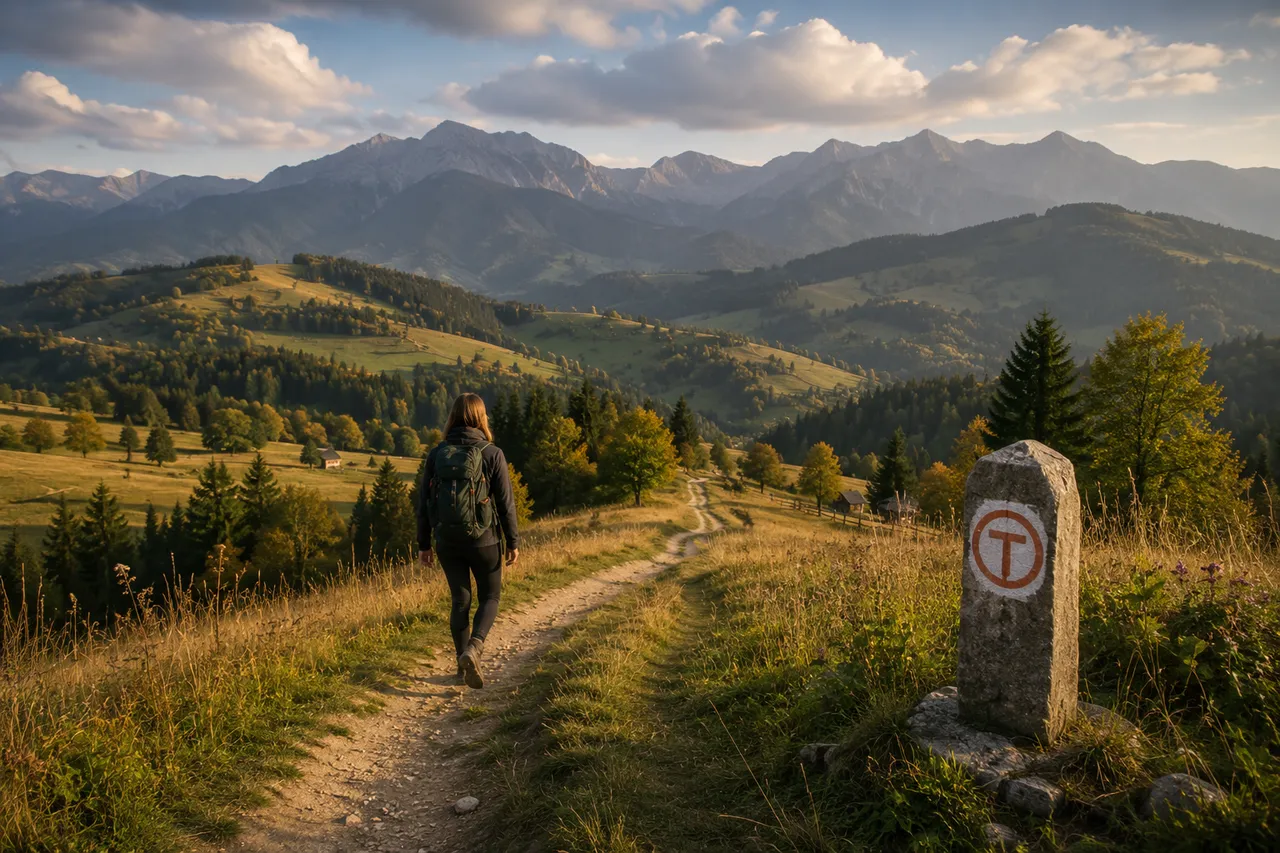
You can hike short sections for 3 to 7 days, covering 60 to 150 kilometers) and choosing your preferred type of terrain; or you can hike the entire trail in one go, devoting 60 to 70 days to the trip. This calls for adaptable planning and gear for changing weather. It is also very demanding physically, requiring cardiovascular fitness, joint durability, and mental resilience. Romania has lots of brown bears, so carry bear spray and stay informed via the app.
The 7 Cultural-Historical Regions
The trail passes through 10 distinct counties and is divided into 7 distinct cultural-historical lands:
Bucovina
Famous for lush rolling hills and stunning UNESCO-listed painted monasteries.
Ținutul de Sus (The Highlands)
A landscape of wild, alpine scenery bordering the rugged Rodnei Mountains.
Terra Siculorum (Székely Land)
Home to rich Hungarian-Romanian cultural traditions and mineral springs.
Terra Saxonum (Saxon Land)
Characterized by rolling pastures, ancient fortified churches, and colorful medieval towns like Sighișoara .
Terra Dacica
Steeped in ancient history, passing close to the ruins of the Dacian and Roman empires.
Terra Banatica
A rugged landscape featuring deep limestone gorges and unique multicultural villages.
Terra Romana
The dramatic final stretch descending toward the banks of the Danube River.
What Makes It Unique
The World’s Longest Art Gallery
Every single kilometer of the trail is marked by a unique, individually hand-carved andesite milestone, making this trail one of the longest outdoor sculpture exhibitions in the world.
Key Facts About the Milestones
Weight & Material
Each milestone is carved from exceptionally durable, natural volcanic andesite and weighs approximately 260 kg (570 lbs).
The Artists
The stones are sculpted by hundreds of individual Romanian and international artists, often working out of the Tășuleasa Social NGO campus. Famous creators, such as painter Ștefan Câlția and sculptor Virgil Scripcariu, have contributed custom works.
Local Symbolism
The engravings on each stone are unique and frequently inspired by the historical, cultural, or agricultural landscape of the specific village or community where they are placed.
Special Markers
While most serve as kilometer counters, specific symbolic milestones are erected to mark expansion regions, cultural bridges, or endpoints—such as the unique milestone placed on Simian Island near Trajan’s Bridge to honor local heritage.
Navigation & Function
Along with orange and white painted trail blazes on trees, these robust stones act as the primary visual anchors keeping hikers from getting lost. If you see a carved stone face with an intricate animal, geometric shape, or plant emblem, you know you are on track.
Deep Cultural Immersion
The path winds through more than 400 rural communities. Instead of tourist crowds, hikers share paths with horse-drawn carts, shepherds, and local farmers.
Eight UNESCO Sites
The route directly links eight UNESCO World Heritage sites, offering unmitigated access to centuries of European history. They are:
- Sucevița Monastery: One of the Painted Churches of the historical region of Northern Moldavia.
- Moldovița Monastery: Another of the Painted Churches of the historical region of Northern Moldavia.
- Putna Monastery: Starting point of the trail; part of the broader Bucovina monastic heritage (not individually listed but included in UNESCO cluster references).
- Ulpia Traiana Sarmizegetusa: Roman capital of Dacia; UNESCO-listed as part of the Dacian Fortresses of the Orăștie Mountains.
- Sarmizegetusa Regia: The main Dacian fortress in the UNESCO group (the trail passes near the Dacian sites cluster).
- Viscri: Saxon village with a UNESCO-listed fortified church; the trail crosses Terra Saxonum.
- Prejmer Fortified Church: Part of the UNESCO Fortified Churches of Transylvania.
- Biertan Fortified Church: Another major UNESCO fortified church along the Terra Saxonum segment.
A Sustainable Economic Lifeline
The project serves as an eco-tourism lifeline for aging, depopulated mountain villages. Money spent by hikers on homestays, farmstead dinners, and local guides directly funds these rural communities.
Practical Information for Hikers
The Pace
The total route features roughly 67 to 70 daily stages, with each stage averaging a manageable 20 to 25 kilometers.
The Terrain
It can be navigated on foot, by mountain bike, or even on horseback. The trails are mostly well-marked dirt tracks, forest paths, and country roads, though some mountain passes present steep climbs.
Accommodation
Unlike wilder thru-hikes, you don’t need to carry heavy camping gear if you don’t want to. Family-run guesthouses, local parishes, and farmstays offer warm beds and home-cooked Romanian meals at the end of nearly every stage.
The Passport
Hikers can purchase a traveler’s passport to collect stamps from villages and historic checkpoints along the way, reminiscent of traditional European pilgrimages.
Safety Note
Romania is home to Europe’s largest population of brown bears. Hikers should make noise on remote trails, carry bear spray, and stay updated via the official Via Transilvanica mobile app, which offers live alerts and downloadable GPX.
Short Sections Versus Full-Thru Hikes
Choosing between a short section and a full thru-hike depends entirely on your available time, fitness level, and what you want to get out of the trail.
Via Transilvanica: Short Sections (3 to 7 Days)
Short section hikes are ideal for vacationers, families, or those wanting a taste of the trail without intense physical or mental burnout.
Characteristics
- Time Commitment: 3 to 7 days.
- Distance covered: 60 to 150 kilometers (37 to 93 miles).
- Logistics: Highly manageable. Easy to book all guesthouses in advance and arrange local taxis or trains for transport to and from trailheads.
- Physical Demand: Moderate. You can select regions with flatter terrain that require lighter backpacks.
Best 3-to-7 Day Sections to Choose
For Fairytale Landscapes & Culture: Terra Saxonum (Saxon Land)
- Highlights: Rolling green hills, medieval fortified churches, and the UNESCO citadel of Sighișoara.
- Vibe: Very gentle hiking, excellent traditional Saxon farmhouses, and great local food.
For Spiritual Serenity: Bucovina
- Highlights: Starting at Putna Monastery, this section winds through pristine forests and traditional Bucovina villages famed for painted monasteries.
- Vibe: Rolling ridges, peaceful paths, and deep cultural immersion.
For Mountain Drama: Ținutul de Sus (The Highlands)
- Highlights: Traversing the volcanic Călimani mountains and alpine meadows.
- Vibe: More physically demanding, panoramic ridge views, and wilder scenery.
Via Transilvanica: The Full Thru-Hike
A thru-hike means tackling the entire 1,400-kilometer (870-mile) trail from Putna to Drobeta-Turnu Severin in one continuous journey. It is a life-altering pilgrimage through the heart of Romania.
Characteristics
- Time Commitment: 2 to 2.5 months (typically 60 to 70 days of walking).
- Distance Covered: 1,400 kilometers (870 miles).
- Logistics: Complex. Requires adaptable planning, using the official app for day-to-day choices, and managing gear for shifting weather.
- Physical Demand: Extremely high. Demands excellent cardiovascular fitness, joint durability, and mental resilience to handle consecutive days of 20+ kilometer walks.
The Thru-Hike Experience
The Grand Transition
You watch the landscape, architecture, accents, and local cuisine gradually change every week as you transition from Slavic-influenced Bucovina, through Hungarian and Saxon enclaves, into ancient Dacian lands, and finally down to the Mediterranean-influenced Danube valley.
The Community
Thru-hikers become minor celebrities in the smaller villages. Local communities eagerly check passports and welcome long-haul walkers with incredible hospitality.
The Mental Journey
Like the Camino de Santiago, a thru-hike is a psychological marathon. It offers vast stretches of solitude, deep reflection, and a profound sense of accomplishment upon reaching the final milestone at the Danube.
Where to Stay Overnight
Camping: The Wild & Independent Option
Camping on the Via Transilvanica offers ultimate freedom. Romania allows for wild camping in most areas, provided you follow “Leave No Trace” principles and respect private property.
Pros
- Complete Freedom: You do not have to stick to a rigid schedule. You can stop and pitch your tent whenever you are tired.
- Budget-Friendly: It dramatically cuts down the cost of a long-distance hike.
- Nature Connection: You get to sleep under pristine starlight in some of Europe’s wildest landscapes.
Cons
- Much Heavier Pack: You must carry a tent, sleeping pad, sleeping bag, stove, fuel, and extra food, which adds significant physical strain.
- The Bear Factor: Romania has a massive population of brown bears. Camping requires strict food storage safety (using bear canisters or hanging food high in trees far from your tent).
- Weather Issues: Heavy summer thunderstorms can turn a campout into a cold, muddy ordeal with no easy way to dry your gear.
Village Homestays: The Cultural & Comfortable Option
Staying in family-run guesthouses (pensiuni), local parishes, or rural family homes is a cornerstone of the Via Transilvanica experience.
Pros
- Lightweight Backpack: You only need to carry your clothing, water, and basic safety gear. Your pack will weigh half as much as a camper’s pack.
- Unmatched Hospitality: You are welcomed into local homes, often treated to massive, multi-course dinners cooked with fresh ingredients straight from the family garden.
- Comfort & Recovery: A warm shower, a real bed, and electricity to charge your phone or GPS device ensure your body recovers quickly for the next day.
- Supporting the Community: Your money goes directly into the pockets of rural families, helping preserve these historic, depopulated villages.
Cons
- Higher Cost: While rural Romanian homestays are generally very affordable by Western standards, paying for a room and two meals every day adds up over a multi-week hike.
- Availability Issues: In tiny villages, lodging options are limited. During peak summer months, rooms can fill up quickly, requiring booking weeks in advance.
The Best of Both Worlds: The Hybrid Strategy
Many thru-hikers choose a hybrid approach. They carry lightweight camping gear for the wilder, mountainous sections (like Ținutul de Sus or Terra Banatica), where villages are far apart, but stay in comfortable homestays when passing through the cultural valleys of Terra Saxonum and Bucovina to enjoy the local food and hospitality.
When to Hike the Via Transilvanica
The absolute best time to hike the Via Transilvanica is from May to October, when the weather is mildest and the trails are fully accessible. Because Romania has a distinct continental climate, your ideal window depends entirely on whether you are doing a short section or a full 60-to-70-day thru-hike.
Autumn (September – October): The Golden Window
Why It’s the Best
This is widely considered the peak time for the trail. The weather becomes highly stable, the sweltering summer heat breaks, and the foliage turns brilliant shades of red and gold.
The Vibe
Tourist crowds thin out. Villages are in the middle of harvest season, meaning guesthouses are full of fresh produce, wine, and traditional homemade plum brandy (țuică).
Watch Out For
Nights become very chilly, dropping near or below freezing, especially in October. If you are thru-hiking, it is highly recommended to hike from North to South during this time to outrun the early winter snow in the northern mountains.
Spring (May–June): The Lush & Vibrant Window
Why It’s Great
The landscapes are incredibly green, wildflowers blanket the meadows, and water sources are running full. Temperatures are comfortably cool for long days of walking.
The Vibe
You will catch traditional spring and Easter celebrations in the villages, featuring Romania’s famous painted eggs.
Watch Out For
Late-season snow can still block the high mountain passes in May (like the Călimani or Rodnei ranges). Spring is also the rainiest season, meaning that trails can get very muddy and logging roads heavily rutted.
Summer (July–August): The Long-Days Window
Why It’s Great
You get maximum daylight hours, ensuring you never have to hike in the dark. High alpine sections (above 1,000 meters) offer a beautifully pleasant, cool escape from the heat.
The Vibe
The trail is at its most social, and all seasonal guesthouses are open.
Watch Out For
Lower altitude sections (like Terra Saxonum or Terra Romana) can face punishing heat exceeding 35°C (95°F). Severe afternoon thunderstorms are very common in the Carpathian Mountains, requiring you to start hiking at dawn to be off the ridges by noon.
Summary: Best Strategy for a Thru-Hike
If you are planning to tackle the entire 1,400-kilometer trail in one go, you have two perfect timing windows to ensure you avoid both freezing mountain snow and extreme valley heat:
- The Spring-to-Summer Start: Start in mid-May at Putna (North) and finish in mid-July at the Danube (South).
- The Summer-to-Autumn Start: Start in mid-August at Putna (North) and finish in mid-October at the Danube (South).
Booking an Overnight
Download the Official Guidebook
Your first step should always be downloading the official Via Transilvanica Hiker’s Guide from the organization’s website. It provides geographic stages including up-to-date phone numbers and names of local hosts, parish houses, and guesthouses for each specific village. Use the listed numbers to call or message the hosts directly.
Message or Call via WhatsApp
Direct communication is the norm for rural Romanian hospitality.
Most village hosts prefer a text on WhatsApp. You can easily use Google Translate to text them in Romanian if they do not speak English. If you do not get a rapid text response, a direct phone call is highly recommended.
What to Ask
Always confirm if they provide half-board (dinner and breakfast**)**. In tiny hamlets, these home-cooked meals are often your only food option.
Use Niche Regional Booking Platforms
For the stages where you prefer securing a spot online via a card payment, skip global platforms in favor of curated Romanian platforms:
Travlocals : This platform specializes in authentic, eco-friendly boutique stays, traditional Saxon homes, and high-quality pensiuni right along the trail.
Romanian Friend : Excellent for booking multi-day segments or finding advice on certified heritage accommodations along the route.
Leverage the Trail Community
Facebook Groups: The active Via Transilvanica Facebook Group is an invaluable asset. Hikers constantly share real-time updates on new stays, hospitable locals opening their homes, or closures.
Important Booking Tips
Timeline
If you are hiking during the peak summer months (July–August), book your rooms 2 to 3 months in advance for popular regions like Bucovina or Terra Saxonum. For off-peak times, booking 1 to 2 days ahead while on the trail is usually sufficient. In remote sections (Suceava, Bistrița-Năsăud, Harghita), sometimes same-day is fine.
Carry Cash (Romanian Leu)
Many rural hosts cannot accept credit cards. Always carry physical cash to pay for your lodging, drinks, and meals.
Planning a Via Transilvanica Hike? Read These Essential FAQs Before You Go
What and where is the Via Transilvanica?
The Via Transilvanica is Romania’s long-distance hiking trail, stretching approximately 1,400 kilometers (870 miles) from Putna in northeastern Romania to the Serbian border in the southwest. The route crosses seven culturally distinct regions, including Bucovina, Terra Saxonum, Terra Banatica, and other historic landscapes, offering hikers an unforgettable journey through mountains, forests, villages, and centuries of Romanian heritage.
What makes the Via Transilvanica trail so unique?
Every kilometer of the trail features a hand-carved stone milestone created by different artists, making it one of the world’s longest outdoor sculpture exhibitions. The route passes through more than 400 rural communities where hikers experience authentic Romanian village life, and it connects eight UNESCO World Heritage Sites, including the famous Saxon village of Viscri and the painted monasteries of Bucovina.
Where can I stay overnight on the Via Transilvanica?
Accommodation options include camping with your own tent, family-run guesthouses (pensiuni), local parish accommodations, and rural homestays. Many hikers combine camping in remote mountain sections with guesthouses in villages, allowing them to enjoy comfortable beds, hot showers, homemade meals, and opportunities to recharge electronic devices while keeping overall costs reasonable.
How do I book accommodation along the trail?
Use the official Via Transilvanica accommodation guide to find guesthouses and contact information. Most rural hosts prefer WhatsApp messages or phone calls, and using simple Romanian or a translation app can improve communication. During July and August, reserve accommodations 2–3 months in advance for popular regions like Bucovina and Terra Saxonum. Outside peak season, booking one or two days ahead is generally sufficient. Carry cash in Romanian Leu, as many rural accommodations do not accept card payments.
When is the best time to hike the Via Transilvanica?
The best hiking season is September through October, when temperatures are comfortable, rainfall is generally lower, and autumn colors transform the landscape. Overall, the trail is most accessible from May through October. For a complete north-to-south thru-hike, the ideal windows are mid-May to mid-July or mid-August to mid-October.
Popular routes on Kiwi.com
- Cheap flights from London to Turkey
- Cheap flights from London to Barcelona
- Cheap flights from London to Japan
- Cheap flights from London to New York
- Cheap flights from New York to Paris
- Cheap flights to Spain
- Cheap flights to Italy
- Cheap flights to the United States
- Cheap flights to the United Kingdom
- Last minute flights
People Also Read


How to Travel Patagonia: A First-Timer's Guide to Chile & Argentina's Wild South

Where to stay in Palma de Mallorca: best areas for beaches, culture and nightlife