





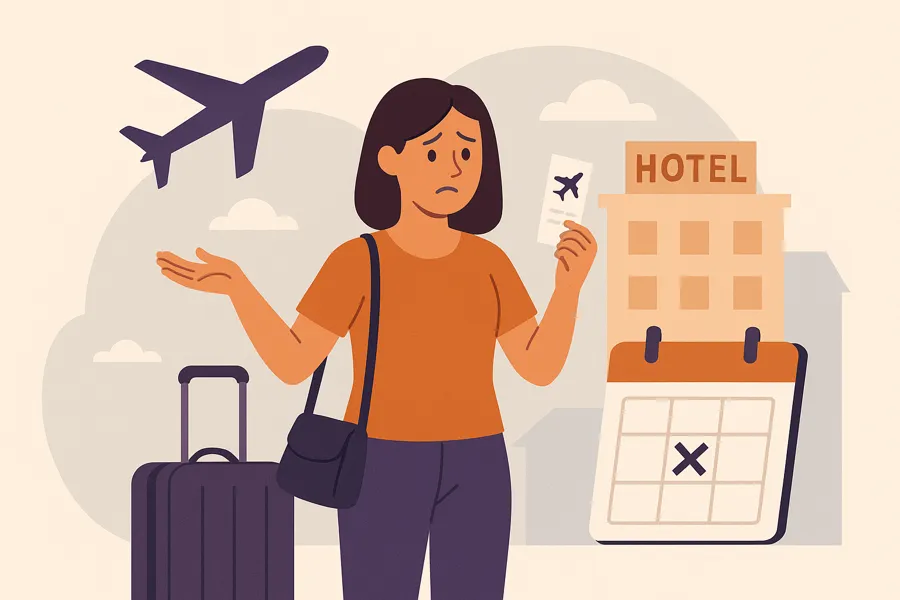
Airlines are usually responsible for rebooking flights or arranging hotel stays when the disruption is caused by the airline itself, such as issues with aircraft, crew, or other operational problems. However, the rules vary by region. In the EU, passengers are strongly protected. Regulations require airlines to reroute travelers or provide overnight hotel accommodation if flights are canceled within certain timeframes, and these rules apply to all airlines. In contrast, in the US, there are no legal requirements for airlines to rebook passengers, although most, including Spirit Airlines , voluntarily offer rebooking. If they don’t, passengers are entitled to a full refund instead. Knowing your rights in situations where your flight must be rebooked, or you’re placed in a hotel, is essential to ensure you receive the compensation and support you’re entitled to.
Why Airlines Rebook Passengers or Provide Overnight Accommodation
The Flight Is Overbooked
Every now and then, airlines sell more tickets than there are seats available. This practice is known as flight overbooking. For example, if an airline like Transavia sells 120 tickets for a plane with only 115 seats, that’s considered overbooking.
Flight Cancellation
Airlines really don’t like canceling flights, but when they have no other option, they will, and it can happen for a variety of reasons. Some airlines are more prone to cancellations than others. For instance, in Europe, between January and May 2025, KLM recorded the highest number of cancellations on the continent, with 2,760 flights canceled.
Lack of Crew Members to Operate
Without a crew, no flight can take off. Airlines work tirelessly to ensure they have enough staff, both cabin crew and pilots, to operate their schedules, but things don’t always go as planned. Unexpected schedule changes, staff sickness, and even airport strikes can cause major disruptions. One such example is the strike scheduled for November 28th in Italy, expected to affect staff at KPMG and Air France , which may lead to additional flight rebookings.
Aircraft Issues
Planes, like any other vehicle, sometimes experience mechanical or technical problems that temporarily take them out of service. Since passenger safety is a core priority for airlines, they can’t take risks with aircraft. As a result, flights may need to be canceled if the aircraft is facing issues.
Severe Weather
There’s no denying that aircraft have evolved to handle a wide range of weather conditions, but severe weather presents a different challenge. Heavy thunderstorms, strong winds, dense fog, and snow are all causes for concern. While light forms of these conditions are generally manageable, when things get more extreme, airlines may have no choice but to cancel flights.
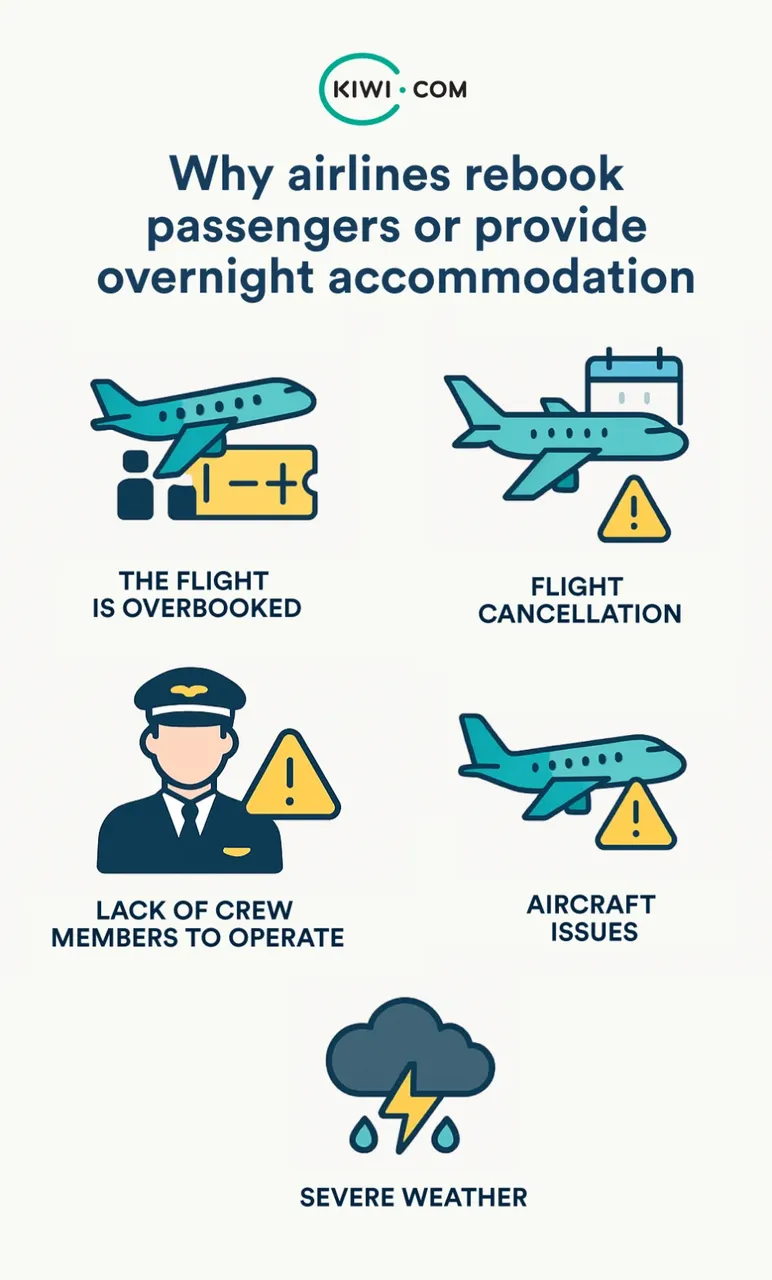
Why airlines sometimes need to rebook travelers or provide overnight stays, shown through five key causes like overbooking, cancellations, crew shortages, aircraft problems, and severe weather © Kiwi.com
So, Who Really Covers the Rebooking or Hotel Costs?
When flights need to be rebooked or passengers have to stay overnight in a hotel, there are generally two parties involved: the company, meaning the airline, and the traveler.
It’s important to distinguish between the two because when the change is made by the traveler, they’re usually responsible for taking care of the fees. However, if the airline initiates the change, they’re typically responsible for covering the expenses, though there are certain conditions and exceptions.
Where you’re located can have a significant impact on how the situation is handled, because each country has its own rules that airlines must follow. Usually, the regulations of the departure country are the ones the airline must adhere to at that time. For example, if you’re taking off from Athens International Airport and flying to King Khalid International Airport in Riyadh, EU rules apply because your journey began in the EU. However, there are some nuances with EU passenger rights. Even if your flight originates outside the EU, if it lands in the EU and is operated by an EU-based airline, the airline is still obliged to follow the EU rules. We’ll discuss this more in the next section.
When plans fall apart, knowing who has your back matters. To see how this works in real-life scenarios, these Kiwi.com reviews from our flight crew members give an inside view of how disruptions are handled when travel doesn’t go smoothly.
Country- Or Region-Specific Passenger Rights
European Union
When flying in the European Union, passengers have the following rights as long as they fall into one of these categories:
- They fly with an EU-based airline to the bloc from a country that’s not part of it.
- They use any airline, either EU-based or not, within the EU.
- They take a flight departing from the EU to a country outside the EU, on airlines both based and not based in the EU.
EU Rebooking Rules
Passengers can pick between rerouting, receiving compensation, or rescheduling to a later date if their flight has been cancelled.
EU Accommodation Rules
If a passenger has to stay overnight, the airline has to cover the cost of the hotel and transport between the airport and the hotel, and provide meals.
United States of America
Unlike the European Union, the US has a different policy around who pays for what. Airlines in the US aren’t bound by law to rebook or provide hotels, but they’re legally required to provide a refund if they cancel a flight. Here’s how it works.
US Rebooking Rules
There are no laws requiring airlines to rebook passengers, but if they choose not to rebook you onto another flight, they must give you a refund. However, airlines such as American Airlines, Delta Air Lines, and Spirit all state that they rebook passengers on their own airline at no additional cost if there’s a cancellation.
US Accommodation Rules
Since there are no laws requiring airlines to provide hotels, some airlines choose not to, like Frontier. However, others, like Alaska Airlines and Hawaiian Airlines, do offer hotels in certain situations.
Canada
Canada is another country that strictly enforces rules on passenger rights, but it depends on whether it’s within the airline’s control.
Canada Rebooking Rules
Airlines must rebook passengers when there’s a delay of more than 3 hours or when the flight is canceled. Under no circumstances should an airline leave a passenger behind or fail to complete their itinerary, as they’re required to ensure passengers reach their final destination.
Canada Accommodation Rules
When there’s a delay or cancellation, airlines have to provide what’s known as ‘assistance.’ Accommodation, along with food and drinks, falls under this category. This applies when the delay or cancellation was due to something related to the airline or safety.
Australia
Australia has what are called ‘consumer guarantees,’ which are a set of rights that passengers have when doing the following:
- Using travel services in Australia.
- Using travel services that depart from Australia.
- Using travel services that arrive in Australia when booked through the Australian version of the company’s website.
Australia Rebooking Rules
The rules state that if a service isn’t performed within a reasonable time, the service being a flight, the airline must provide either a replacement service (which would be rebooking) or a refund.
Australia Accommodation Rules
There are no laws requiring airlines to provide accommodation to passengers flying in Australia . This is up to the airline, so they may choose to offer it if they wish, but they don’t have to.
Urgent and Practical Travel Rebooking FAQs
If I change my travel plans, will the airline still rebook me free of charge?
No. If you decide to change your travel plans, the airline is not obligated to rebook you onto another flight for free because the change was initiated by you and not caused by the airline. Some airlines, like JetBlue, may allow certain ticket types to be changed without a fee, but you may still need to pay any difference in fare.
What should I do if the airline refuses to rebook or provide a hotel for the night?
If this happens, start by filing a formal complaint with the airline directly. If they refuse to resolve the issue, you can escalate the matter to a regulatory body such as the US Department of Transportation or the relevant authority in your region. Keep copies of all documentation, including booking confirmations and boarding passes, to support your claim.
Do budget airlines have to follow the same rules as full-service airlines?
Yes. If laws exist in the departure country, all airlines, including budget carriers, must follow the same rules as full-service airlines. However, in regions like the US, where regulations are less strict, budget airlines such as Frontier offer fewer services during delays or cancellations. Always review their policies before booking.
What happens with rebookings and hotel stays if I booked through a travel agent?
Your travel agent should assist you, but the airline ultimately decides what you’re entitled to regarding rebooking or hotel stays. Since the agency booked your flights, they can help manage the situation, though they may be difficult to reach quickly. For faster resolution, it’s best to work directly with the airline.
Popular routes on Kiwi.com
- Cheap flights from London to Barcelona
- Cheap flights from London to New York
- Cheap flights from London to Asturias
- Cheap flights from London to Pattaya
- Cheap flights from London
- Cheap flights to Spain
- Cheap flights to Italy
- Cheap flights to Thailand
- Cheap flights to the United States
- Cheap flights to the United Kingdom
- Cheap flights from London Luton Airport
- Last minute flights
People Also Read

How to Travel Patagonia: A First-Timer's Guide to Chile & Argentina's Wild South