






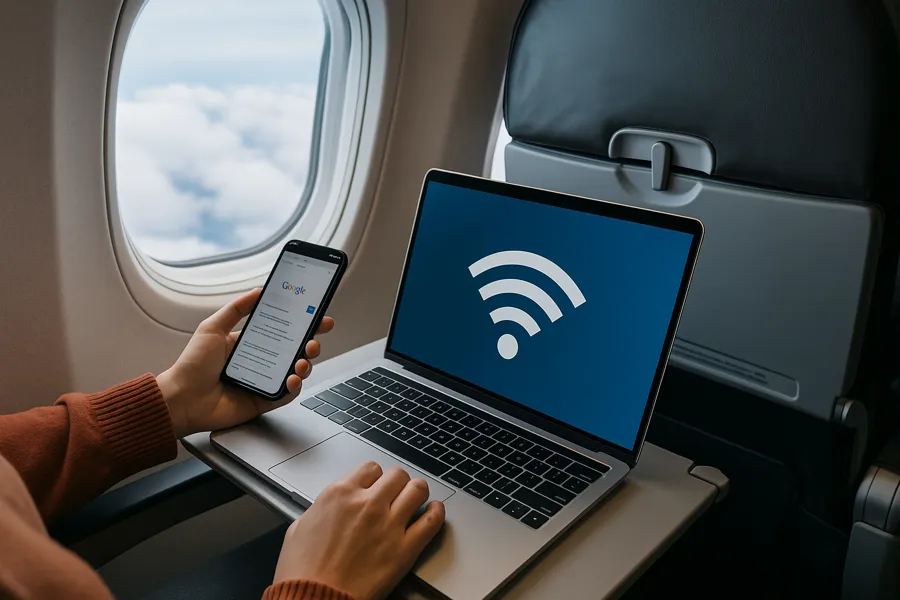
Many airlines, including Air France , Delta , and Qatar Airways , have Wi-Fi on their aircraft, but coverage and quality vary widely. Some carriers sell Wi-Fi packages, such as Cathay Pacific , which charges from $12.95 (€11.16) for unlimited access on flights under six hours, and $19.95 (€17.19) to $24.95 (€21.50) on longer routes. Others, like Qatar Airways, provide free Wi-Fi on select aircraft equipped with Starlink. If Wi-Fi is essential to your trip, check each airline’s plans and pricing to make an informed choice.
Availability by Region and Carrier
Europe
Air France
- Passengers can buy “Free Message” passes on aircraft with Wi-Fi.
- Internet access for work or streaming is available with paid Wi-Fi passes.
Air France is also introducing free, unlimited high-speed Wi-Fi on all flights, but it will be available only to Flying Blue members.
British Airways
- Messaging packages that cover the main chat apps and email, though attachments aren’t supported.
- Streaming packages for watching movies and using social media platforms.
British Airways recently signed a deal with Starlink, which they hope to integrate into their flights in 2026.
KLM
- Option to purchase Wi-Fi passes on flights that have connectivity.
- Flying Blue members can use messaging passes free of charge. When members fly in Europe, they can also receive one of KLM’s ‘Wifi Passes.’
North America
Delta
- Most domestic and international flights operated by Delta have complimentary Wi-Fi, though it can only be used by those with a SkyMiles Membership.
American Airlines
- Wi-Fi packages can be purchased on most domestic and international flights operated by American Airlines.
Air Canada
- Aeroplan members can enjoy free Wi-Fi access when flying within North America or to a ‘Sun destination.’ Air Canada also offers free messaging on selected platforms to membership holders who include their phone number when checking in for their flights.
Middle East
Emirates
- Wi-Fi packages, including unlimited messaging, general internet access, and short-term access (e.g, 30 minutes), are available to buy onboard with Emirates.
- Emirates Skywards members can avail of complimentary Wi-Fi when flying in business or first class, with additional offerings based on their seat selection.
Emirates plans to roll out Starlink on all flights for every passenger in the future.
Qatar Airways
- Complimentary access to Starlink on select aircraft for everyone on several routes.
- For planes that aren’t yet compatible with Starlink, you can still purchase Wi-Fi packages for an additional fee.
Turkish Airlines
- People flying in business class and Miles&Smiles members get certain Wi-Fi access depending on their status.
- All passengers can buy Wi-Fi packages on board Turkish Airlines Flights, including unlimited data or messaging, as well as MB allowances.
East Asia
Japan Airlines
- Unlimited 1-hour free Wi-Fi on international flights for all passengers. Once it’s used, you can purchase additional hours at an extra fee.
Singapor e Airlines
- Wi-Fi is available for free to select passengers, including those flying in Suites, first and business class, as well as supplementary card owners and PPS Club members. If you’re flying in premium economy or standard economy, you can also use Wi-Fi on board, once you’re part of the KrisFlyer program.
- All other passengers can buy Wi-Fi packages after take-off.
Korean Air
- Internet and messaging packages are available to buy on international and domestic routes on select aircraft.
South America
LATAM Airlines
- Selected LATAM pass holders, including Black, Gold, Platinum, Gold Plus, and Black Signature, get free Wi-Fi access, including messaging and browsing, when flying in South America. However, this only applies to aircraft with single aisles. All LATAM pass members can use messaging services on the same types of flights.
- All passengers can buy in-flight Wi-Fi passes for an additional fee.
Oceania
Qantas
- Free Wi-Fi is available for everyone on selected aircraft.
Air New Zealand
- As long as the aircraft you’re flying on has Wi-Fi, it’s free for all passenger classes.
Africa
Ethiopian Airlines
- Business class ticket holders receive free Wi-Fi for the duration of their flight.
- Members of ShebaMiles can enjoy one hour of free Wi-Fi.
- All other passengers can buy Wi-Fi packages onboard.
EgyptAir
- Wi-Fi can be purchased onboard selected aircraft.
Messaging-Only vs Full Browsing Packages
The two main packages that airlines often include in their offerings are Messaging-Only and Full Browsing. Here’s what you get with them.
Messaging-Only
The name gives it away, but messaging-only literally means you can only send messages. You’ll be able to use all the typical messaging platforms like WhatsApp and WeChat. However, some airlines, including Thai Airways, will also let you use messaging services on social media platforms like Facebook’s Messenger app.
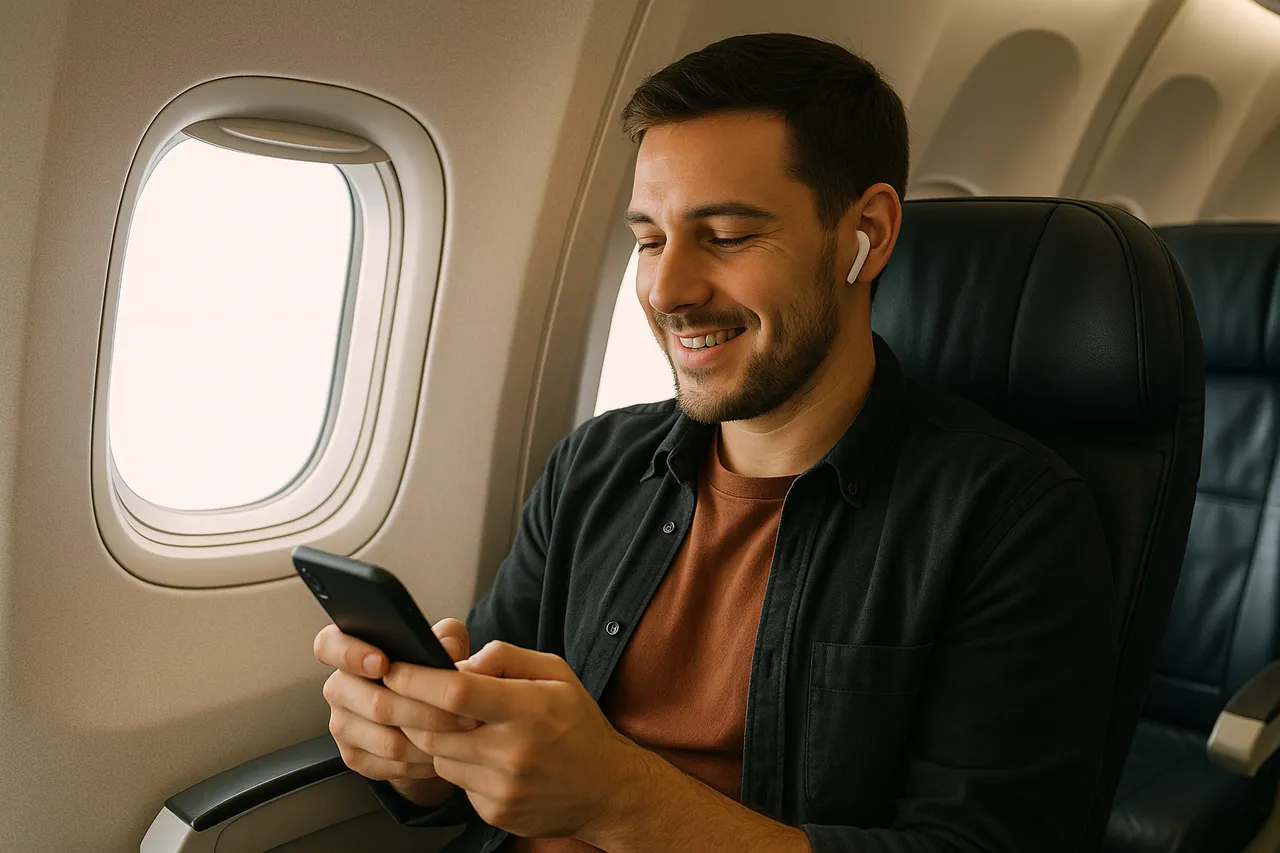
Messaging in the sky feels effortless for this passenger enjoying in flight connectivity © Kiwi.com
Full-Browsing Packages
Full browsing packages are a step up from messaging-only plans, as you’re able to scroll on Instagram, watch Netflix, or work in Google Docs. Most airlines that offer in-flight Wi-Fi provide complete browsing packages, though access may vary. For example, Singapore Airlines doesn’t allow streaming services like YouTube.
Streaming, VPNs, and Limits on Use
Streaming
Who doesn’t love the idea of catching up on their favorite shows instead of subjecting themselves to Avatar for the third time in a row? Depending on who you’re flying with, you may or may not be allowed to stream. Since streaming services use a lot of data, some airlines, like Southwest, block them, but here are some that don’t.
- Qatar Airways’ Starlink connection allows passengers to stream for free.
- United Airlines’ standard Wi-Fi connection permits passengers to stream videos on certain flights.
- When flying on AirBaltic’s Airbus A220-300 aircraft, Starlink is available for streaming.
VPNs
All types of public Wi-Fi networks pose risks when used, and in-flight Wi-Fi is no different. Unfortunately, like streaming services, VPNs consume a considerable amount of bandwidth, so many airlines, such as EVA Air with its ‘Unlimited Web Browsing’ package, have banned them.
Some carriers encourage the use of VPNs, though, such as Lufthansa , which states in its advertisements for the FlyNet Premium package that workers can connect to their workplaces’ VPNs without complication.
Limits on Use
Many carriers will have limits on the amount of Wi-Fi you can use, or charge a premium for an unlimited-use package.
- Philippine Airlines offers 10MB and 100MB packages, as well as unlimited-use options.
- Turkish Airlines provides certain ticket holders with complimentary Wi-Fi, including 1GB, 250MB, or 400MB, but they must purchase additional usage to continue using it after it runs out.
- Scoot has limits on all its Wi-Fi plans, with 20MB, 80MB, 200MB, and 1GB packages ready to purchase.
Cost and Payment Methods on Board
The price you’ll pay for in-flight Wi-Fi depends on several factors, such as the airline, distance, and the reason you’re using it.
Low-Cost Packages
As the saying goes, you get what you pay for. Often, when buying a low-cost package, you’ll either get limited access or a very slow version of Wi-Fi. Considering that low-cost is under €10, here’s what it can get you:
- Emirates: Between $2.99 (€2.57) and $5.99 (€5.15) for messaging or $9.99 (€8.60) for unlimited access on certain flights.
- Finnair: An hour of browsing for €7.95 or an hour of streaming for €6.95.
Premium Packages
If you want to stay connected throughout your flight, you’ll prefer a premium package. The most expensive plans tend to include unlimited Wi-Fi access, letting you do whatever you want online for the duration of your flight:
- Cathay Pacific: Unlimited Wi-Fi on flights less than six hours for $12.95 (€11.16), or on flights more than six hours, prices range from $19.95 (€17.19) to $24.95 (€21.50).
- Aer Lingus : Full-access prices for an entire flight start from €20.49.
Payment Methods
Most carriers will let you pay for a Wi-Fi package with your debit or credit card. You’ll usually connect to the Wi-Fi and then be prompted to pay before you can get any access. Frequent fliers who regularly fly with airlines like United can also sign up for one of their subscriptions. This gives them unlimited Wi-Fi for an entire month of flying with them for $49 (€42.16), but fees for these services vary by airline.
Airlines with Free Wi-Fi
Is free Wi-Fi a deal breaker for you? Consider booking flights with these airlines that offer it.
| Airline | Availability |
|---|---|
| Qatar Airways | On select aircraft with Starlink |
| Qantas | On select aircraft |
| Air New Zealand | On select aircraft |
| AirBaltic | On select aircraft |
| All Nippon Airways | On select aircraft for international flights |
| Japan Airlines | On select aircraft for domestic flights |
| JetBlue | On all flights, regardless of the destination |
| Malaysia Airlines | On select aircraft |
| Hawaiian Airlines | On select aircraft |
Using eSIMs or In-Flight SMS for Connectivity
Airlines require passengers to switch their devices to airplane mode during flight, which shuts off both physical SIMs and eSIMs. That means you can’t use mobile data or traditional SMS texting while in the air.
The only way to send or receive messages onboard is through internet-based messaging apps, which can be used only if the airline has a Wi-fi package or a messaging plan, as KLM and several others do. These apps don’t depend on cellular service. As long as you have an in-flight internet connection, you can use them to send basic texts.
Key FAQs About Using Wi Fi During Your Flight
Why is Wi Fi on a plane sometimes slow?
Wi Fi can feel slow in the air because many passengers are sharing limited bandwidth. Newer systems such as Starlink, now used by airlines like Qatar Airways, offer noticeably faster speeds. If performance matters, the highest tier Wi Fi package often delivers the best results.
How will I know if my flight will have Wi Fi?
You can check your airline’s website for aircraft equipped with Wi Fi, then compare that list with the aircraft type shown on your ticket. Some airlines like Delta make this very clear. When in doubt, reach out to the airline for confirmation.
Can I make a video call with Wi Fi on a plane?
Policies vary by airline. Some airlines restrict video calls to avoid interference or noise issues, while others such as JetBlue allow FaceTime and similar apps. Ask a crew member or review the airline’s Wi Fi rules before purchasing a package if video calling is important.
Which airline has the fastest Wi Fi?
Hawaiian Airlines is known for strong speeds, with reports around 161 Mbps thanks to Starlink on its Airbus aircraft. Qatar Airways also performs well, with Starlink gradually rolling out across parts of its fleet.
Popular routes on Kiwi.com
- Cheap flights from London to Barcelona
- Cheap flights from London to New York
- Cheap flights from London to Asturias
- Cheap flights from London to Pattaya
- Cheap flights from London
- Cheap flights to Spain
- Cheap flights to Italy
- Cheap flights to Thailand
- Cheap flights to the United States
- Cheap flights to the United Kingdom
- Cheap flights from London Luton Airport
- Last minute flights
People Also Read



How to Travel Patagonia: A First-Timer's Guide to Chile & Argentina's Wild South