



Armenia’s capital has been continuously inhabited for nearly 2,800 years. It has passed through Persian rule, Ottoman rule, and Russian rule. It spent 70 years as a Soviet republic. Now it’s three and a half decades into being an independent country, still figuring out its own skyline and style.
In this article
You’d never guess the age from a walk around the city centre. Yerevan looks less like an ancient city and more like someone handed a Parisian boulevard planner a stack of pink volcanic stone and told them to go wild. That pink stone is exactly why locals call it the “Pink City”.
Yerevan offers a laid-back lifestyle with a buzzing café scene, vibrant street life, and budget-friendly food. It’s affordable, extremely safe, walkable, and rich in culture and history.
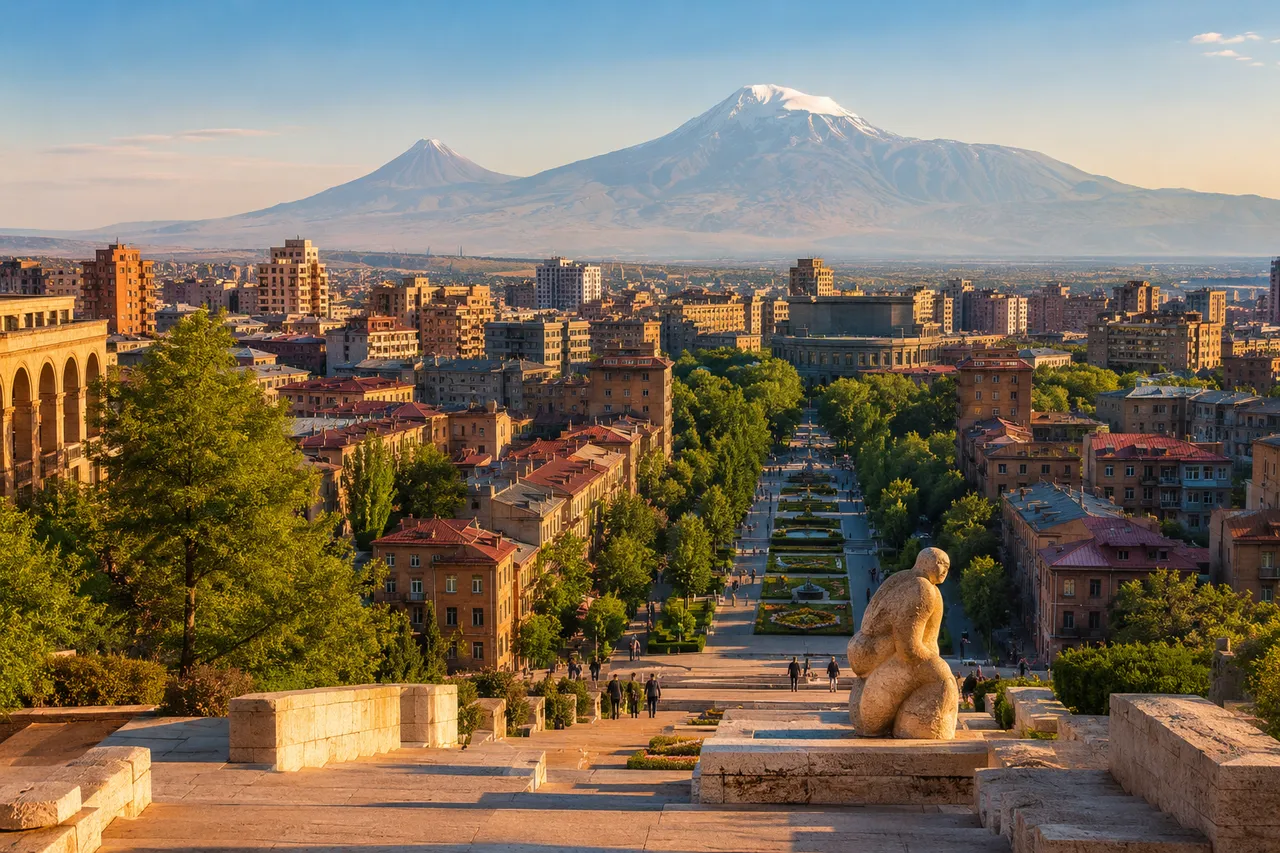
On a clear day, Mount Ararat sits on the horizon like it’s part of the skyline, even though technically it belongs to Turkey.
Find flights for this trip

None of this costs very much to see. That’s really the whole pitch.
From The Airport Into The City On Any Budget
Zvartnots International Airport (EVN) sits about 12km west of the centre. Getting into town from there is refreshingly easy.
The cheapest option is Bus 201, sometimes signed as the Airport Express, which runs to Republic Square for 300 AMD. It’s a fine choice in daylight hours with light luggage. It only runs every 20 to 30 minutes and doesn’t operate late at night, so it’s not the move for a red-eye landing.
For almost everyone else, the better answer is a ride-hailing app. Download GG Taxi or Yandex Go before you land. Both are widely used across Armenia, both show the fare upfront, and both are dramatically cheaper than the drivers waiting just outside arrivals. Expect to pay 2,500 to 4,000 AMD for the 20 to 30 minute ride into the centre. If you’d rather negotiate with a driver at the taxi rank in person, aim for 4,000 to 5,000 AMD. Treat anything north of 6,000 as a tourist markup, and politely decline it.
A pre-booked private transfer runs $15 to 30 if you want someone holding a sign with your name on it. Nice for a first night in an unfamiliar city. Unnecessary for every trip after that.
Whichever way you go, you’ll likely clear the airport faster than you’d expect, immigration included. Armenia currently offers visa-free or visa-on-arrival entry to a long list of nationalities, and the full requirements are laid out on the Armenian Ministry of Foreign Affairs website . Worth checking before you fly, since the list changes.
Moving Around Once You’re In
Central Yerevan is made for wandering. Republic Square, the Cascade, Vernissage, and most of the restaurant scene along Saryan Street and Northern Avenue all sit within a twenty-minute radius of each other.
When your feet need a break, the metro is a good call. It’s almost comically cheap: a flat 100 AMD per ride on a single north-south line. It won’t cover everywhere you want to go, but it does connect the railway station area to the Cascade district in a few stops. For everything else, use GG Taxi or Yandex Go. A cross-city ride rarely climbs past 1,000 to 1,500 AMD, and both apps show the price before you commit.
If you’re tempted by a day trip, and Armenia genuinely rewards one, marshrutka minibuses connect Yerevan to just about everywhere. Garni Temple and Geghard Monastery are both reachable in a half-day round trip for a few thousand AMD each way. Lake Sevan isn’t much further.
Five Landmarks That Explain The City
Republic Square
Everything in Yerevan seems to eventually lead back here. It’s a great hub for people-watching and gathering. Head here in the evening to watch the free singing and dancing fountain light show.
The square is framed by majestic pink tuff neoclassical buildings and anchored by a 122-metre clock tower. Look down at the ground while you’re there. A mosaic map of ancient Armenia, ringed by hand-cut coloured stones, is set directly into the square’s floor.
The Cascade
A 572-step limestone staircase connecting central Yerevan with the upper neighbourhood might not sound like a headline attraction. It earns its reputation anyway.
Climb it, or take the escalators inside, past fountain terraces and modern sculpture gardens, and you’re rewarded with panoramic views of the city skyline, Mount Ararat included on a clear day. It’s a popular, completely free spot to hang out at sunset with local youth and fellow travellers.
Stop at the Cafesjian Center for the Arts , tucked into the structure itself. There’s a small entry fee for its contemporary art galleries. Worth it if modern art is your thing. Entirely skippable if you’d rather just enjoy the view and the sculptures outside for nothing.
Keep climbing past the top of the Cascade and you’ll reach Victory Park, where the light on Ararat turns genuinely golden in late afternoon.
 Budget Guides
Toast to Tbilisi: How to Eat, Wander, and Wonder Without Going Broke
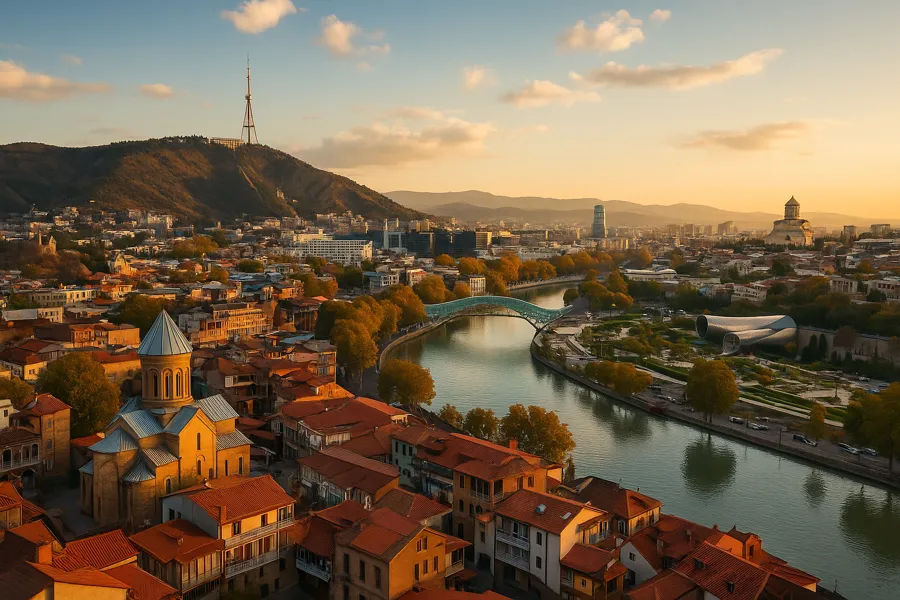
Arrive in Tbilisi and it hits you instantly: warm bread smell in the streets, balconies hanging like lace, grand old mansions collapsing beautifully, and locals debating life, philosophy, and football over glasses of wine that taste better than anything costing twenty times more in London. It’s a city that welcomes you in like a long-lost cousin, and if you know where to look, it can be incredibly kind to your wallet.
Read the guide
Budget Guides
Toast to Tbilisi: How to Eat, Wander, and Wonder Without Going Broke
Arrive in Tbilisi and it hits you instantly: warm bread smell in the streets, balconies hanging like lace, grand old mansions collapsing beautifully, and locals debating life, philosophy, and football over glasses of wine that taste better than anything costing twenty times more in London. It’s a city that welcomes you in like a long-lost cousin, and if you know where to look, it can be incredibly kind to your wallet.
Read the guideVernissage & GUM Markets
Weekends belong to Vernissage, an open-air flea market near Republic Square selling handmade jewellery, carpets, woodwork, and vintage Soviet memorabilia. Browsing is free, haggling is expected, and Sunday mornings bring out the best selection.
A short walk away, the GUM Market is where Yerevan actually shops. Dried fruit piled into pyramids, spices, cheese, and enough free samples pressed into your hands that you could plausibly call it lunch.
Tsitsernakaberd Armenian Genocide Memorial Complex
A hilltop monument and museum honouring the victims of the 1915 Armenian Genocide, and essential context for understanding modern Armenia. Entrance to the complex and museum is free, though donations are welcome, and the surrounding park offers quiet views over the city.
It is, without question, the heaviest thing on this list. It’s also hard to miss. The eternal flame memorial and the peace and quiet around it will get under your skin.
Give yourself proper time here. This isn’t a fifteen-minute stop, and it isn’t meant to be.
Matenadaran
If Yerevan has a single sacred object, it’s an alphabet. In the 5th century, a monk named Mesrop Mashtots invented a script from scratch specifically so Armenian could survive as a written language under empires that wanted it gone. The Matenadaran is where that obsession with the written word turned into one of the world’s great manuscript collections.
Over 17,000 volumes, some nearly 1,600 years old, sit behind glass up a grand staircase lined with statues of the scholars who copied, translated, and smuggled them through centuries of war. It’s less a museum than a monument to stubbornness. Adult admission is 2,000 AMD. The plaza and statues outside cost nothing at all.
Eating And Drinking Your Way Through Yerevan
Five Things To Try First
Armenian food doesn’t get talked about outside the Caucasus nearly as much as it should. It’s typically heavy on grilled meat, fresh herbs, and bread that’s practically a national symbol. It’s also cheap enough that trying everything below in one day won’t ruin your budget.
- Khorovats is Armenia’s answer to barbecue: pork, lamb, or chicken marinated and grilled over coals, wrapped in lavash with grilled vegetables on the side. The national dish, and rightly so.
- Lavash is a thin flatbread baked in a clay oven, UNESCO-listed as intangible cultural heritage. It’s served with everything, or eaten on its own with cheese and herbs for a meal that costs next to nothing.
- Dolma (Tolma) is grape leaves stuffed with minced meat, rice, and herbs. Armenians take genuine pride of ownership over this one.
- Manti are small, light baked dumplings served with garlic yoghurt. Best at a proper lunch spot like Poloz Mukuch, below.
- Gata is a sweet, flaky pastry filled with butter and sugar, ideal alongside an Armenian coffee to close out a meal.
- Speaking of coffee: Armenian coffee (surch) is thick and unfiltered, served in a small cup, grounds and all. It’s an entirely different drink from the espresso-style coffee you’ll find at most cafés.
- Armenian brandy, often just called “cognac” locally, is the big one. Ararat Brandy is reportedly what Winston Churchill drank.
Where To Eat
Poloz Mukuch
Recently reopened in a larger space on Abovyan Street, is the place locals point you toward for proper Armenian lunch food. Order the manti, or the harissa if you’re there on a Sunday, when this slow-cooked wheat-and-meat porridge traditionally shows up. A full lunch runs 2,500 to 5,000 AMD, resolutely local pricing for food that punches well above it.
Tavern Yerevan (Yerevan Pandok)
It is a reliable, atmospheric chain serving the Armenian classics: khorovats, dolma, kebab, all in a folk-tavern setting. A meal averages around 4,000 AMD. Order the pork if you’re not sure where to start.
Lumen Coffee 1936
A coffee spot inside a converted 1930s bookstore, tucked near the Matenadaran, with its original interior still intact. It’s the kind of café where you order an Armenian coffee, get a glass of water and a small sweet alongside it without asking, and end up staying twice as long as planned. A coffee here costs 1,000 to 1,500 AMD.
Best Time To Visit
- Late spring (May–June) hits the sweet spot: warm, green, and exactly when the Republic Square fountain shows kick into gear for the season.
- Summer (Jul–Aug) turns properly hot in the city centre. Yerevan sits in a valley and holds the heat. It’s also peak season for the fountains and outdoor café culture.
- Early autumn (Sep–Oct) rivals late spring for the best weather, with the added bonus of grape harvest season if you’re planning a detour out to wine country.
- Winter (Dec–Feb) turns cold, sometimes snowy, and the fountains shut down. Hotel prices drop accordingly, and Ararat looks spectacular capped in white against a clear winter sky.
How Expensive Is Yerevan?
Approximate prices, in Armenian drums and euros (at roughly 1 EUR ≈ 422 AMD).
{{/* Content rules (MARFE-143): every label and price verbatim from the list above, same order.
Bars: per-item rows share one scale (upper bound / 8,000); per-night and daily-total
rows are different units, so no bar. */}} Copy the code to embed this table on your site.Item Price Coffee (Armenian coffee or cappuccino, café) 1,000–1,500 AMD (€2.35–3.55) Beer (local, at a bar) 800–1,200 AMD (€1.90–2.85) Casual lunch (business lunch menu, bistro, market food court) 2,000–3,500 AMD (€4.75–8.30) Sit-down dinner 4,000–8,000 AMD (€9.50–19) Hostel dorm bed 5,000–7,000 AMD/night (€12–16.60) Budget hotel/private room 12,000–17,000 AMD/night (€28.50–40) Daily budget total, spent reasonably 10,000–15,000 AMD, roughly €24–35
Free, or close to it: the Republic Square fountains, the walk up the Cascade, Tsitsernakaberd’s memorial and museum, Vernissage on a Sunday morning, and the view of Ararat from more or less anywhere with a rooftop.
A Capital Older Than The Word “Capital”
Yerevan doesn’t get talked about the way Tbilisi or Baku do. That has less to do with what’s actually here and more to do with how few people have bothered to update their mental map of the Caucasus.
What’s actually here is a capital founded before most of the nations that outshine it on a map today even existed. It’s wrapped in pink stone that glows at sunset, and priced like it hasn’t noticed. And on a clear day, Mount Ararat sits on the horizon.
Cities this old rarely feel this alive. Fewer still are this cheap to fall in love with. Yerevan somehow pulls off both, and it’s still waiting for the rest of the world to catch on.
Ready to see it for yourself? Search flights to Yerevan on Kiwi.com and get there before everyone else finally does too.